

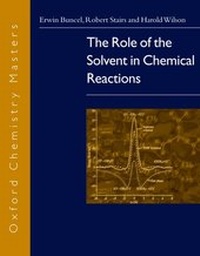
The Role of the Solvent in Chemical Reactions
Published on 28. August 2003
Book
Paperback/Softback
170 pages
978-0-19-851100-7 (ISBN)
Description
The Oxford Chemistry Masters series is designed to provide clear and concise accounts of important topics - both established and emergent - that may be encountered by chemistry students as they progress from the senior undergraduate stage through postgraduate study to leadership in research. These Masters assume little prior knowledge, other than the foundations provided by an undergraduate degree in chemistry, and lead the reader through to an appreciation of the
state of the art in the topic whilst providing an entree to the original literature in the field.
The role of the solvent in chemical reactions is one of immediate and daily concern to the practising chemist. Whether in the laboratory, or in industry, most reactions are carried out in the liquid phase. In the majority of these, one or two reacting components, or reagents, are dissolved in a suitable medium and the reaction is allowed to take place. Given the importance of solvent, the need for an in-depth understanding of this topic is obvious. However, many inorganic and organic chemistry
texts only make passing references to solvents, or worse still, fail to mention that a given reaction takes place in a particular solvent at all. This book successfully addresses the gap in our understanding of solvent chemistry, and brings the role of the solvent rightly to the fore.
The book begins with a summary of essential thermodynamic and kinetic facts, emphasizing aspects of these fields, where relevant, to reactions in solution. Chapter 2 introduces the reader to the role of the solvent purely as a medium, touching on early theories based on electrostatic considerations (Born and Kirkwood-Onsager) and the solubility parameter (Hildebrand). Chapter 3 discusses the role of solvent as an active participant, chiefly through hydrogen bonding, Bronsted-Lowry and
Lewis acid-base interactions, including hard and soft acids and bases. The ability of solvents to serve as media for oxidation and reduction is also touched upon. There then follows a chapter on chemometrics; the application of statistical methods to chemical phenomena and spectra, chiefly linear free
energy correlations and principal component analysis. A novel method for the presentation of data is also described. In chapter 5, methods of theoretical calculation are discussed. These include quantum-mechanical ab-initio and semiempirical methods, integral-equation theories, and methods based on statistical mechanics (Monte Carlo and molecular dynamics). Examples to illustrate these methods are detailed in the chapter. Chapters 6 and 7 look at a selection of particular classes of solvents
including aprotic-dipolar, acidic, basic, room-temperature ionic, and chiral. The suitability of examples from each class of solvent for particular purposes is also discussed. The final chapter presents some concluding observations.
Throughout the book, the authors use a semiquantitative and thermodynamically based approach, deliberately avoiding unnecessary detail or rigour, so that the discussions are accessible to both senior undergraduates and postgraduates. The text is also interspersed with helpful examples taken from both inorganic and organic chemistry.
state of the art in the topic whilst providing an entree to the original literature in the field.
The role of the solvent in chemical reactions is one of immediate and daily concern to the practising chemist. Whether in the laboratory, or in industry, most reactions are carried out in the liquid phase. In the majority of these, one or two reacting components, or reagents, are dissolved in a suitable medium and the reaction is allowed to take place. Given the importance of solvent, the need for an in-depth understanding of this topic is obvious. However, many inorganic and organic chemistry
texts only make passing references to solvents, or worse still, fail to mention that a given reaction takes place in a particular solvent at all. This book successfully addresses the gap in our understanding of solvent chemistry, and brings the role of the solvent rightly to the fore.
The book begins with a summary of essential thermodynamic and kinetic facts, emphasizing aspects of these fields, where relevant, to reactions in solution. Chapter 2 introduces the reader to the role of the solvent purely as a medium, touching on early theories based on electrostatic considerations (Born and Kirkwood-Onsager) and the solubility parameter (Hildebrand). Chapter 3 discusses the role of solvent as an active participant, chiefly through hydrogen bonding, Bronsted-Lowry and
Lewis acid-base interactions, including hard and soft acids and bases. The ability of solvents to serve as media for oxidation and reduction is also touched upon. There then follows a chapter on chemometrics; the application of statistical methods to chemical phenomena and spectra, chiefly linear free
energy correlations and principal component analysis. A novel method for the presentation of data is also described. In chapter 5, methods of theoretical calculation are discussed. These include quantum-mechanical ab-initio and semiempirical methods, integral-equation theories, and methods based on statistical mechanics (Monte Carlo and molecular dynamics). Examples to illustrate these methods are detailed in the chapter. Chapters 6 and 7 look at a selection of particular classes of solvents
including aprotic-dipolar, acidic, basic, room-temperature ionic, and chiral. The suitability of examples from each class of solvent for particular purposes is also discussed. The final chapter presents some concluding observations.
Throughout the book, the authors use a semiquantitative and thermodynamically based approach, deliberately avoiding unnecessary detail or rigour, so that the discussions are accessible to both senior undergraduates and postgraduates. The text is also interspersed with helpful examples taken from both inorganic and organic chemistry.
Reviews / Votes
... a useful introduction to solvent effects on chemical reactions. * Angewandte Chemie *More details
Series
Language
English
Place of publication
Oxford
United Kingdom
Target group
Professional and scholarly
Illustrations
numerous line drawings and tables
Dimensions
Height: 245 mm
Width: 188 mm
Thickness: 10 mm
Weight
407 gr
ISBN-13
978-0-19-851100-7 (9780198511007)
Copyright in bibliographic data and cover images is held by Nielsen Book Services Limited or by the publishers or by their respective licensors: all rights reserved.
Schweitzer Classification
Other editions
Additional editions
Erwin Buncel | Robert A. Stairs | Harold Wilson
The Role of the Solvent in Chemical Reactions
Book
08/2003
Oxford University Press
€216.65
Article exhausted; check different version
Persons
Professor E. Buncel: Ph.D., D.Sc. (London); FCIC (Fellow of the Chemical Institute of Canada); F.W.I.F. (Fellow of World Innovation Foundation; Syntex Award in Physical Organic Chemistry; R. U. Lemieux Award in Organic Chemistry (Canadian Society of Chemistry)
Professor R. A. Stairs: Ph.D. (Cornell); FCIC; C.Chem. (Association of the Chemical Profession of Ontario)
Dr H. Wilson: Ph.D. (Rice); Polysar Award for College Teaching; ACCC Teaching
Professor R. A. Stairs: Ph.D. (Cornell); FCIC; C.Chem. (Association of the Chemical Profession of Ontario)
Dr H. Wilson: Ph.D. (Rice); Polysar Award for College Teaching; ACCC Teaching
Content
1. Introduction ; 2. The Solvent as a Medium ; 3. The Solvent as Participant ; 4. Chemometrics: Emperical correlations of solvent effects ; 5. Theoretical calculations ; 6. Some Specific Examples (1): Dipolar-Aprotic Solvents ; 7. Some Specific Examples (2): acidic, basic, chiral, ionic solvents ; 8. Concluding observations ; Appendix -Solvent properties ; References