

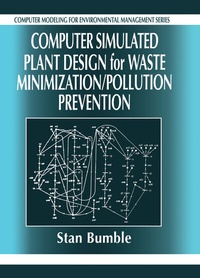
Computer Simulated Plant Design for Waste Minimization /Pollution Prevention
1st Edition
Published on 15. March 2000
Book
Hardback
385 pages
978-1-56670-352-9 (ISBN)
Description
Environmental science combined with computer technology. One click on a mouse and information flows into your PC from up to 10,000 miles away. When you receive this information you can ferret through the data and use it in any number of computer programs. The result: solutions to plant design problems that affect the health and well being of people around the globe. What does that mean to you, the environmental professional, scientist, or engineer?
Computer Simulated Plant Design for Waste Minimization/Pollution Prevention builds on the concepts introduced in Stan Bumble's Computer Generated Physical Properties, the first volume of the Computer Modeling for Environmental Management series. Bumble discusses using computer simulation programs to solve problems in plant design before they occur. He covers design issues for stationary and non-stationary sources of pollution, global warming, troposcopic ozone, and stratospheric ozone.
With Computer Simulated Plant Design for Waste Minimization/Pollution Prevention you will understand how to use computer technology to design plants that generate little or no pollution. Even better, you can use the information generated by computer simulation for technical data in proposals, presentations and as the basis for making policy decisions.
Computer Simulated Plant Design for Waste Minimization/Pollution Prevention builds on the concepts introduced in Stan Bumble's Computer Generated Physical Properties, the first volume of the Computer Modeling for Environmental Management series. Bumble discusses using computer simulation programs to solve problems in plant design before they occur. He covers design issues for stationary and non-stationary sources of pollution, global warming, troposcopic ozone, and stratospheric ozone.
With Computer Simulated Plant Design for Waste Minimization/Pollution Prevention you will understand how to use computer technology to design plants that generate little or no pollution. Even better, you can use the information generated by computer simulation for technical data in proposals, presentations and as the basis for making policy decisions.
More details
Language
English
Place of publication
Bosa Roca
United States
Publishing group
Taylor & Francis Inc
Target group
College/higher education
Professional and scholarly
Professional
Illustrations
1 s/w Tabelle
1 Tables, black and white
Dimensions
Height: 280 mm
Width: 210 mm
Weight
735 gr
ISBN-13
978-1-56670-352-9 (9781566703529)
Schweitzer Classification
Other editions
Additional editions
E-Book
02/2020
1st Edition
CRC Press
€73.99
Available for download
E-Book
02/2020
1st Edition
CRC Press
€73.99
Available for download
Person
Stan Bumble, Ph.D., has guided research, development, and engineering at DuPont and Dow Corning with computer programs that optimized the best products and properties. He has used computer programs for assisting the U.S. government with the development of their missile program and with the recovery of disaster victims. He has helped (with the assistance of computers) the U.S. Department of Justice and the Environmental Protection Agency at many hazardous sites such as Love Canal.
Content
Pollution Prevention and Waste Minimization. Mathematical Methods. Computer Programs for Pollution Prevention and/or Waste Minimization. Computer Programs for the Best Raw Materials and Products of Clean Processes. Pathways to Prevention. Conclusions.