

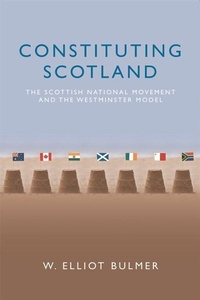
Constituting Scotland
The Scottish National Movement and the Westminster Model
Published on 18. July 2016
Book
Hardback
280 pages
978-0-7486-9759-5 (ISBN)
Description
Long description from APFThis book contributes to the (currently sparse) literature on constitutional design in Scotland. The rise of the Scottish national movement has been accompanied by the emergence of a distinct constitutional ideas, claims and arguments. Drawing on the fields of constitutional theory, comparative constitutional law, and Scottish studies, this book examines the historical trajectory of the constitutional question in Scotland and analyses the influences and constraints on the constitutional imagination of the Scottish national movement, in terms of both the national and international contexts. It identifies an emerging Scottish nationalist constitutional tradition that is distinct from British constitutional orthodoxies but nevertheless corresponds to broad global trends in constitutional thought and design. Much of the book is devoted to the detailed exposition and comparative analysis of the draft constitution for an independent Scotland published by the SNP in 2002. The 2014 draft interim Constitution presented by the Scottish Government is also examined, and the two texts are contrasted to show the changing nature of the SNP's constitutional policy: from liberal-procedural constitutionalism in pursuit of a more inclusive polity, to a more populist and majoritarian constitutionalism.
Short description (too long for box) from APF
Before the independence referendum in 2014, the First Minister of Scotland Alex Salmond promised a written constitution for Scotland in the event of a 'Yes' vote. In most other democratic countries, this would have been unremarkable. But the UK is almost unique in having never adopted a written constitution or other fundamental law. Why did this commitment arise in Scotland? What in Scotland's constitutional history and recent political trajectory brought this to the fore? What form did the SNP's proposals take, why, and what did they mean? This book addresses these questions, which remain relevant to scholars of constitutional theory, comparative constitutional law, and Scottish politics.
Short description (too long for box) from APF
Before the independence referendum in 2014, the First Minister of Scotland Alex Salmond promised a written constitution for Scotland in the event of a 'Yes' vote. In most other democratic countries, this would have been unremarkable. But the UK is almost unique in having never adopted a written constitution or other fundamental law. Why did this commitment arise in Scotland? What in Scotland's constitutional history and recent political trajectory brought this to the fore? What form did the SNP's proposals take, why, and what did they mean? This book addresses these questions, which remain relevant to scholars of constitutional theory, comparative constitutional law, and Scottish politics.
More details
Language
English
Place of publication
Edinburgh
United Kingdom
Target group
College/higher education
Product notice
sewn/stitched
Cloth over boards
Dimensions
Height: 239 mm
Width: 163 mm
Thickness: 25 mm
Weight
635 gr
ISBN-13
978-0-7486-9759-5 (9780748697595)
Copyright in bibliographic data and cover images is held by Nielsen Book Services Limited or by the publishers or by their respective licensors: all rights reserved.
Schweitzer Classification
Other editions
Additional editions
E-Book
07/2016
1st Edition
Edinburgh University Press
€0.00
Available for download
Person
W. Elliot Bulmer holds a PhD in Politics from the University of Glasgow. Previously the Research Director of the Constitutional Commission in Scotland (2009-2013), he is now part of the Constitution Building Processes team for the International Institute for Democracy and Electoral Assistance in The Hague, Netherlands. His previous works include A Model Constitution for Scotland (Edinburgh: Luath Press, 2011) and A Constitution for the Common Good (Edinburgh: Luath Press, 2014).
Content
Acknowledgements; 1, Introduction; 2, The Global Development Of The Westminster Model; 3, The Scottish Context; 4, The Westminster Model In A Dreich Climate: The Emergent Scottish Constitutional Tradition; 5, 2002 Draft I: Parliament And The Legislative Power; 6, 2002 Draft II: Head Of State And The Executive Branch; 7, 2002 Draft III: Judiciary, Rights And Substantive Provisions; 8, The SNP's Constitutional Policy 2002-2014: From Liberal Procedural Constitutionalism To Democratic Populism?; Bibliography .