

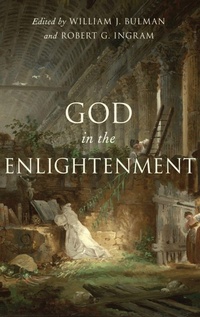
God in the Enlightenment
Published on 12. May 2016
Book
Hardback
336 pages
978-0-19-026707-0 (ISBN)
Description
We have long been taught that the Enlightenment was an attempt to free the world from the clutches of Christian civilization and make it safe for philosophy. The lesson has been well learned---in today's culture wars, both liberals and their conservative enemies, inside and outside the academy, rest their claims about the present on the notion that the Enlightenment was a secularist movement of philosophically-driven emancipation. Historians have had doubts about the accuracy of this portrait for some time, but they have never managed to furnish a viable alternative to it---for themselves, for scholars interested in matters of church and state, or for the public at large. In this book, William J. Bulman and Robert Ingram bring together recent scholarship from distinguished experts in history, theology, and literature to make clear that God not only survived the Enlightenment, but thrived within it as well.
The Enlightenment was not a radical break from the past in which Europeans jettisoned their intellectual and institutional inheritance. It was, to be sure, a moment of great change, but one in which the characteristic convictions and traditions of the Renaissance and Reformation were perpetuated to the point of transformation, in the wake of the Wars of Religion and during the early phases of globalization. Its primary imperatives were not freedom and irreligion but peace and prosperity. As a result, it could be Christian, communitarian, or authoritarian as easily as it could be atheist, individualist, or libertarian. Honing in on the intellectual crisis of late seventeenth and early eighteenth centuries while moving everywhere from Spinoza to Kant and from India to Peru, God in the Enlightenment offers a spectral view of the age of lights.
The Enlightenment was not a radical break from the past in which Europeans jettisoned their intellectual and institutional inheritance. It was, to be sure, a moment of great change, but one in which the characteristic convictions and traditions of the Renaissance and Reformation were perpetuated to the point of transformation, in the wake of the Wars of Religion and during the early phases of globalization. Its primary imperatives were not freedom and irreligion but peace and prosperity. As a result, it could be Christian, communitarian, or authoritarian as easily as it could be atheist, individualist, or libertarian. Honing in on the intellectual crisis of late seventeenth and early eighteenth centuries while moving everywhere from Spinoza to Kant and from India to Peru, God in the Enlightenment offers a spectral view of the age of lights.
Reviews / Votes
very much because of the volume's successes and the stylistic and interpretive issues it raises, each contribution to God in the Enlightenment advances our understanding of the period by sparking further debate about, and investigation into, what in France was known to contemporaries as the siecle de lumieres (century of lights). This important edited volume depicts the Enlightenment as a diverse constellation of reform programs that had, among their origins, theological controversies of the sixteenth to eighteenth centuries, and as their consequences, seismic shifts in how Modern Europeans (and the societies shaped or disrupted by them) would eventually talk about God, faith, and religious expression. * Jeffrey D. Burson, Journal of Jesuit Studies * No reader of this valuable collection will be left in any doubt that the traditional view of the period as a radical break with the past is not merely misleading but fundamentally erroneous. In a kaleidoscopic array of essays ranging in topic from Hobbes and Spinoza to Leibniz and Kant and from Hinduism to pre-Hispanic Andean religions, the resilience of the Renaissance and the Reformation is everywhere in evidence. God not only survived but seemed to thrive in an environment that we have grown accustomed to conceiving as characteristically individualistic and libertarian but which was just as often, and just as vigorously, communitarian and authoritarian. * Fernando Cervantes, Left History * God in the Enlightenment incorporates many insightful discussions on a diverse range of topics, and embodies the ethos of recent trends in Enlightenment studies... It will be of a great interest to those who wish to explore the origins of contemporary discussions on the role and place of religion in liberal democracies. * Simon Lewis (University College, Oxford), Wesley and Methodist Studies * By any standard, this is a fine collection of essays, anchored in the second half of the seventeenth century and also reflecting the global turn in Enlightenment studies. * Nigel Aston, Renaissance Quarterly * This work shines with essays from an intellectual diversity of important scholars and often strikingly original perspectives. It not only addresses the increasingly problematic interaction of religion and the eighteenth-century Enlightenment in provocative and significant ways, it goes to the underlying issue of the place of God in Enlightenment debate, dilemmas, continuities, and reevaluations. This is a genuinely important collection. * Alan Charles Kors, Henry Charles Lea Professor History, University of Pennsylvania *More details
Other editions
Additional editions
William J. Bulman | Robert G. Ingram
God in the Enlightenment
Book
06/2016
Oxford University Press Inc
€52.50
Shipment within 15-20 days
William J. Bulman | Robert G. Ingram
God in the Enlightenment
E-Book
04/2016
1st Edition
OUP eBook
€19.99
Available for download
William J. Bulman | Robert G. Ingram
God in the Enlightenment
E-Book
04/2016
1st Edition
OUP eBook
€18.99
Available for download
Persons
William J. Bulman is Assistant Professor of History at Lehigh University. Robert G. Ingram is Associate Professor of History and Director of the George Washington Forum on American Ideas, Politics, and Institutions at Ohio University.
Editor
Assistant Professor of HistoryAssistant Professor of History, Lehigh University
Associate Professor of History and Director of the George Washington Forum on American Ideas, Politics, and InstitutionsAssociate Professor of History and Director of the George Washington Forum on American Ideas, Politics, and Institutions, Ohio University
Content
Acknowledgements
Abbreviations
Editors and Contributors
Introduction: Enlightenment for the Culture Wars
William J. Bulman
1: Godless Politics: Hobbes and Public Religion
Justin Champion
2: Reason and Utility in French Religious Apologetics
Anton Matytsin
3: Bernabe Cobo's Re-creation of an Authentic America in Colonial Peru
Claudia Brosseder
4: From Christian Apologetics to Deism: Libertine Readings of Hinduism, 1600-1730
Joan-Pau Rubies
5: The Platonic Captivity of Primitive Christianity and the Enlightening of Augustine
Paul C.H. Lim
6: God's Word in the Dutch Republic
Jetze Touber
7: Suffering Job: Christianity Beyond Metaphysics
Jonathan Sheehan
8: The Reformation Origins of the Enlightenment's God
Brad S. Gregory
9: 'God' and 'the Enlightenment': The Divine Attributes and the Question of Categories in British Discourse
J. C. D. Clark
10: Medicine, Theology, and the Problem of Germany's Pietist Ecstatics
H. C. Erik Midelfort
11: Richard Bentley's Paradise Lost and the Ghost of Spinoza
Sarah Ellenzweig
Conclusion: The Varieties of Enlightened Experience
Dale K. Van Kley
Abbreviations
Editors and Contributors
Introduction: Enlightenment for the Culture Wars
William J. Bulman
1: Godless Politics: Hobbes and Public Religion
Justin Champion
2: Reason and Utility in French Religious Apologetics
Anton Matytsin
3: Bernabe Cobo's Re-creation of an Authentic America in Colonial Peru
Claudia Brosseder
4: From Christian Apologetics to Deism: Libertine Readings of Hinduism, 1600-1730
Joan-Pau Rubies
5: The Platonic Captivity of Primitive Christianity and the Enlightening of Augustine
Paul C.H. Lim
6: God's Word in the Dutch Republic
Jetze Touber
7: Suffering Job: Christianity Beyond Metaphysics
Jonathan Sheehan
8: The Reformation Origins of the Enlightenment's God
Brad S. Gregory
9: 'God' and 'the Enlightenment': The Divine Attributes and the Question of Categories in British Discourse
J. C. D. Clark
10: Medicine, Theology, and the Problem of Germany's Pietist Ecstatics
H. C. Erik Midelfort
11: Richard Bentley's Paradise Lost and the Ghost of Spinoza
Sarah Ellenzweig
Conclusion: The Varieties of Enlightened Experience
Dale K. Van Kley