

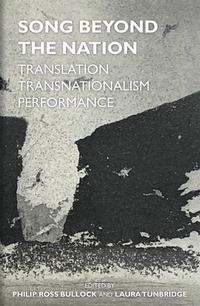
Song Beyond the Nation
Translation, Transnationalism, Performance
Published on 20. May 2021
Book
Hardback
352 pages
978-0-19-726719-6 (ISBN)
Description
Within classical music, much writing on the Western song tradition since 1800 has assumed a direct link between musical cultures and national literatures, and song has typically been interpreted as one of the means by which constructions of nationalism and nationhood have been pursued in the cultural sphere. Yet song can also be a mobile and cosmopolitan genre and form of cultural practice, able - through performance, publication, and translation - to cross boundaries between cultures and languages.
This volume brings together musicologists, literary scholars, linguists, and cultural historians to examine the ways in which song creation, practice, and interpretation has been defined by, and in turn defines, conceptions of nationalism and the transnational. It focuses on four key poets - the Persian Hafiz, German Heine, American Whitman, and French Verlaine - and examines how their poems have been 'translated' into song, and how music can challenge the seemingly organic relationship between language and nation.
This volume brings together musicologists, literary scholars, linguists, and cultural historians to examine the ways in which song creation, practice, and interpretation has been defined by, and in turn defines, conceptions of nationalism and the transnational. It focuses on four key poets - the Persian Hafiz, German Heine, American Whitman, and French Verlaine - and examines how their poems have been 'translated' into song, and how music can challenge the seemingly organic relationship between language and nation.
More details
Series
Language
English
Place of publication
Oxford
United Kingdom
Target group
Professional and scholarly
Illustrations
51 music examples, 5 figures, 7 tables
Dimensions
Height: 240 mm
Width: 160 mm
Thickness: 22 mm
Weight
640 gr
ISBN-13
978-0-19-726719-6 (9780197267196)
Copyright in bibliographic data and cover images is held by Nielsen Book Services Limited or by the publishers or by their respective licensors: all rights reserved.
Schweitzer Classification
Persons
Philip Ross Bullock is Professor of Russian Literature and Music at the University of Oxford, and Fellow and Tutor in Russian at Wadham College. As well as teaching at the University of Wales, Bangor, and University College, London, he has held visiting fellowships at the Institute for Advanced Study at Princeton and the Paris Institute for Advanced Study.
Laura Tunbridge is Professor of Music at the University of Oxford, and Henfrey Fellow and Tutor in Music at St Catherine's College. She taught at the Universities of Reading and of Manchester. She has been a visiting scholar at the Max Planck Institute, Berlin, and Columbia University, New York, and currently holds a Major Research Fellowship from the Leverhulme Trust.
Laura Tunbridge is Professor of Music at the University of Oxford, and Henfrey Fellow and Tutor in Music at St Catherine's College. She taught at the Universities of Reading and of Manchester. She has been a visiting scholar at the Max Planck Institute, Berlin, and Columbia University, New York, and currently holds a Major Research Fellowship from the Leverhulme Trust.
Content
INTRODUCTION
'L'invitation au voyage'
HAFIZ
1: Natasha Loges: Hafiz between Nations: Song Settings by Daumer/Brahms and Peacock/Beamish
2: Stephen Downes: Szymanowski, a Hafiz 'Grablied', and the 'translation' of Nietzsche
3: Philip Ross Bullock: The German Roots of Russian Orientalism: Hafiz's Poetry in Early Twentieth-Century Russian Song
HEINE
4: Suzannah Clark: Traces of Tourism and Transnationalism in Liszt's Heine Settings
5: Benjamin Binder: Performance Matters in Heine: The Case of Pauline Viardot's 'Das ist ein schlechtes Wetter'
6: Laura Tunbridge: 'Once again...speaking of' Heine, in Song
VERLAINE
7: Peter Dayan: Why song in Verlaine's Verse is Always Already Beyond the Nation
8: David Evans: French Impressions: The Transnational Afterlives of Verlaine's 'La Lune blanche' in Song
9: Carlo Caballero: Paul Verlaine in Parallel: Loeffler, Faure, Debussy
10: Helen Abbott: Song Just Beyond the Nation, or Debussy via Verlaine
WHITMAN
11: Jennifer Ronyak: Johanna Mueller-Hermann's Lied der Erinnerung: Austria, America, and Beyond
12: Lawrence Kramer: The Emigre Walt Whitman: Songs of Mourning, 1943-48
13: Elizabeth Helsinger: A Song, the Sea, and a Listening Boy: Whitman - Swinburne - Delius
14: Emma Sutton: Whitman and Stevenson: Singing the Nation from Scotland to Samoa via Ohio and Hawai'i
Afterword
'L'invitation au voyage'
HAFIZ
1: Natasha Loges: Hafiz between Nations: Song Settings by Daumer/Brahms and Peacock/Beamish
2: Stephen Downes: Szymanowski, a Hafiz 'Grablied', and the 'translation' of Nietzsche
3: Philip Ross Bullock: The German Roots of Russian Orientalism: Hafiz's Poetry in Early Twentieth-Century Russian Song
HEINE
4: Suzannah Clark: Traces of Tourism and Transnationalism in Liszt's Heine Settings
5: Benjamin Binder: Performance Matters in Heine: The Case of Pauline Viardot's 'Das ist ein schlechtes Wetter'
6: Laura Tunbridge: 'Once again...speaking of' Heine, in Song
VERLAINE
7: Peter Dayan: Why song in Verlaine's Verse is Always Already Beyond the Nation
8: David Evans: French Impressions: The Transnational Afterlives of Verlaine's 'La Lune blanche' in Song
9: Carlo Caballero: Paul Verlaine in Parallel: Loeffler, Faure, Debussy
10: Helen Abbott: Song Just Beyond the Nation, or Debussy via Verlaine
WHITMAN
11: Jennifer Ronyak: Johanna Mueller-Hermann's Lied der Erinnerung: Austria, America, and Beyond
12: Lawrence Kramer: The Emigre Walt Whitman: Songs of Mourning, 1943-48
13: Elizabeth Helsinger: A Song, the Sea, and a Listening Boy: Whitman - Swinburne - Delius
14: Emma Sutton: Whitman and Stevenson: Singing the Nation from Scotland to Samoa via Ohio and Hawai'i
Afterword