

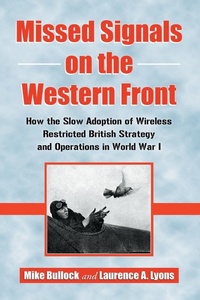
Missed Signals on the Western Front
How the Slow Adoption of Wireless Restricted British Strategy and Operations in World War I
Published on 31. August 2010
Book
Paperback/Softback
236 pages
978-0-7864-4937-8 (ISBN)
Description
Though wireless communication was in early development during World War I, the technology could have made a profound impact on tactical operations and on the entire strategic conduct of the war. Providing details on how and why the technology did not fulfill its promise as a great military tool until years later, the book points primarily to the British army's institutional bias against wireless communication as the technology's downfall, reinforced by the crude, unreliable wireless sets with which the army began the war. It also demonstrates how improved wireless communications between infantry, command, artillery and air observation could have improved the flexibility, accuracy and effectiveness of the British military strategy in the German Spring Offensive, the Hundred Days Counteroffensive and the battles of the Somme, Passchendaele, and Cambrai.
Reviews / Votes
"An essential read"-The NYMAS Review.More details
Language
English
Place of publication
Jefferson, NC
United States
Target group
Professional and scholarly
Interest Age: From 18 years
Product notice
Paperback (trade)
Illustrations
13 photos, appendices, notes, bibliography, index
Dimensions
Height: 229 mm
Width: 152 mm
Thickness: 14 mm
Weight
393 gr
ISBN-13
978-0-7864-4937-8 (9780786449378)
Copyright in bibliographic data and cover images is held by Nielsen Book Services Limited or by the publishers or by their respective licensors: all rights reserved.
Schweitzer Classification
Persons
The late Mike Bullock was a retired bank director. He lived in Warwickshire, England. Laurence A. Lyons, an adjunct professor of electrical engineering at the University of West Florida and the University of South Alabama, lives in Foley, Alabama.
Content
Table of Contents
Acknowledgments
Preface
Introduction
1. Military Wireless Before the War
2. Operational Signals-Pre-war and Early Mobile Warfare
3. Operational Signals-Static Warfare in 1915
4. 1915-The RFC Invents Wireless Telephony
5. Operational Signals on the Somme
6. A Counterfactual-The Somme with Wireless Telephony
7. Operational Signals in 1917
8. A Counterfactual-Passchendaele and Cambrai with Wireless Telephony
9. Operational Signals in 1918
10. A Counterfactual-The German Spring Offensive and Hundred Days with Wireless Telephony
11. Command, Control and Communications
12. Intercept, Encryption and Jamming
13. An Assessment of Wireless as It Was Actually Employed
Conclusion
Appendix A: Wireless Technology
Appendix B: Signal Service Units, 1914
Appendix C: Signals Service Units Later in the War
Chapter Notes
Bibliography
Index
Acknowledgments
Preface
Introduction
1. Military Wireless Before the War
2. Operational Signals-Pre-war and Early Mobile Warfare
3. Operational Signals-Static Warfare in 1915
4. 1915-The RFC Invents Wireless Telephony
5. Operational Signals on the Somme
6. A Counterfactual-The Somme with Wireless Telephony
7. Operational Signals in 1917
8. A Counterfactual-Passchendaele and Cambrai with Wireless Telephony
9. Operational Signals in 1918
10. A Counterfactual-The German Spring Offensive and Hundred Days with Wireless Telephony
11. Command, Control and Communications
12. Intercept, Encryption and Jamming
13. An Assessment of Wireless as It Was Actually Employed
Conclusion
Appendix A: Wireless Technology
Appendix B: Signal Service Units, 1914
Appendix C: Signals Service Units Later in the War
Chapter Notes
Bibliography
Index