

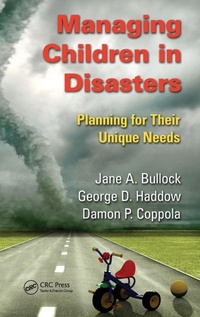
Managing Children in Disasters
Planning for Their Unique Needs
1st Edition
Published on 3. December 2010
Book
Hardback
394 pages
978-1-4398-3766-5 (ISBN)
Description
Each year, disasters such as house fires, car accidents, tsunamis, earthquakes, and hurricanes impact hundreds of thousands of children. Child victims can suffer disproportionately and the physical and psychological damage sustained can far outweigh the same effects in adults, often requiring years of therapy. Sadly, emergency planners to date have largely failed to adequately recognize and accommodate the particular requirements of children in times of disaster.
Identify Needs
Highlighting the infrastructure that supports children in a safe and secure community, Managing Children in Disasters begins by identifying the special needs of children, including physical security, emotional stability, family unity, and ongoing education. It looks at how hazard mitigation actions can reduce the long- term impact of a disaster on this infrastructure, and outlines the many steps that can be taken by parents, emergency managers, school officials, and child care providers to prepare for a future incident.
Target Resources
The book reviews what agencies and organizations can do to ensure that children are protected and families remain intact. It examines evacuation plans and processes, emergency shelters, and the recovery and rebuilding process. The final chapter provides a list of resources in emergency planning, psychosocial recovery, training and education courses, technical assistance, and other organizations. It includes examples of existing programs, reports, sample plans, and guides written for children.
Offering guidance for the family and community, this book discusses the types of efforts that can be undertaken in all phases of emergency management including preparation, immediate response, and recovery.
Identify Needs
Highlighting the infrastructure that supports children in a safe and secure community, Managing Children in Disasters begins by identifying the special needs of children, including physical security, emotional stability, family unity, and ongoing education. It looks at how hazard mitigation actions can reduce the long- term impact of a disaster on this infrastructure, and outlines the many steps that can be taken by parents, emergency managers, school officials, and child care providers to prepare for a future incident.
Target Resources
The book reviews what agencies and organizations can do to ensure that children are protected and families remain intact. It examines evacuation plans and processes, emergency shelters, and the recovery and rebuilding process. The final chapter provides a list of resources in emergency planning, psychosocial recovery, training and education courses, technical assistance, and other organizations. It includes examples of existing programs, reports, sample plans, and guides written for children.
Offering guidance for the family and community, this book discusses the types of efforts that can be undertaken in all phases of emergency management including preparation, immediate response, and recovery.
Reviews / Votes
Managing Children in Disasters is a welcome addition to the growing body of literature in an area that has sorely needed it. The authors cite the latest studies and best practices on the subject, referencing the current list of resources available from leading children advocacy organizations. The result offers an invaluable resource on the challenges of providing for the needs of children during crises and natural hazard events.- Mark K. Shriver, Chairman of the National Commission on Children in Disasters and Senior Vice President of Save the Children's U.S. Programs Managing Children in Disasters is a welcome addition to the growing body of literature in an area that has sorely needed it. The authors cite the latest studies and best practices on the subject, referencing the current list of resources available from leading children advocacy organizations. The result offers an invaluable resource on the challenges of providing for the needs of children during crises and natural hazard events.
- Mark K. Shriver, Chairman of the National Commission on Children in Disasters and Senior Vice President of Save the Children's U.S. Programs
More details
Language
English
Place of publication
Bosa Roca
United States
Publishing group
Taylor & Francis Inc
Target group
Professional and scholarly
Academic and Professional Practice & Development
Illustrations
46 s/w Abbildungen
46 Illustrations, black and white
Dimensions
Height: 240 mm
Width: 161 mm
Thickness: 26 mm
Weight
757 gr
ISBN-13
978-1-4398-3766-5 (9781439837665)
Copyright in bibliographic data and cover images is held by Nielsen Book Services Limited or by the publishers or by their respective licensors: all rights reserved.
Schweitzer Classification
Other editions
Additional editions
Jane A. Bullock | George Haddow | Damon P. Coppola
Managing Children in Disasters
Planning for Their Unique Needs
E-Book
12/2010
1st Edition
CRC Press
€205.99
Available for download
Jane A. Bullock | George Haddow | Damon P. Coppola
Managing Children in Disasters
Planning for Their Unique Needs
E-Book
12/2010
1st Edition
CRC Press
€205.99
Available for download
Persons
Jane Bullock is a Research Scientist and Adjunct Professor at the Institute for Crisis, Disaster, and Risk Management at the George Washington University in Washington, DC. She is also Principal in Bullock and Haddow LLC, a homeland security and disaster management consulting firm.
George D. Haddow holds is a Research Scientist and Adjunct Professor at the Institute for Crisis, Disaster, and Risk Management at the George Washington University in Washington, DC. He is the second Principal at Bullock and Haddow LLC.
George D. Haddow holds is a Research Scientist and Adjunct Professor at the Institute for Crisis, Disaster, and Risk Management at the George Washington University in Washington, DC. He is the second Principal at Bullock and Haddow LLC.
Content
Unique Needs of Children in Disasters. Child Infrastructure. Mitigation. Preparedness. Response. Recovery. Resources.