

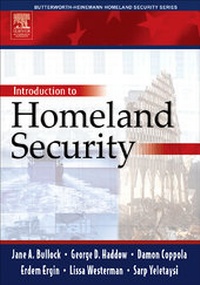
Introduction to Homeland Security
Published on 28. September 2004
Book
Hardback
552 pages
978-0-7506-7787-5 (ISBN)
Description
"Introduction to Homeland Security" provides educators, students, and practitioners with a comprehensive account of past and current homeland security reorganization and practices, policies and programs in relation to the government restructure.The structure of each chapter is designed to accommodate useful pedagogical elements such as learning objectives for each chapter; definitions of the terms used in homeland security, a comprehensive contact list of Federal and State government homeland security offices and officials; case studies of past terrorism events; and an Instructor Guide complete with chapter summaries, exam questions and discussion topics. In addition the book provides an historic context for current homeland security activities. It recounts US government and private sector actions taken in the aftermath of 9/11 in the areas of legislation, government organization, communications, technology, and emergency management practices. Case studies and best practices will be included as well as a comprehensive glossary of homeland security terms and acronyms.
Reviews / Votes
Six authors, headed by Jane A. Bullock, have produced a worthy tome. Written particularly with a text book audience in mind, the book also could benefit managers wanting a solid overview to the topic. Particularly strong are chapters on hazards in which concise information on different types of biological and chemical attacks is presented. The organization and brief history of DHS is neatly covered. - Security LetterIntroduction to Homeland Security by George Haddow and Jane Bullock, offers a comprehensive account of past and current homeland security reorganization and practices, policies and programs in relation to the government restructure. The structure of each chapter is consistent throughout this text, from Butterworth-Heinemann, and designed to accommodate useful pedagogical elements such as learning objective for each chapter, definitions of the terms used in homeland security, a comprehensive contact list of federal and state government homeland security offices and officials, and more. -Law Enforcement Technology The authors are knowledgeable in their fields, and they explore topics from an independent point of view. The public debate on the Patriot Act and civil liberties properly covers the various views. - Security Management Introduction to Homeland Security has case histories of domestic terrorism events and the government's post-event actions. The book provides educators, students, and practitioners with an account of homeland-security practices, policies, and programs. - Evidence Technology The newest release from Elsevier publishers, Introduction to Homeland Security by Bullock and Haddow, in the Butterworth-Heinemann series on homeland security is a welcome addition to many bookshelves.The book accomplishes, in a reasonably complete way, a documentation of the structure and relationship of the various agencies and programs that are considered part of the Department of Homeland Security (DHS). The descriptive narrative of statutory authority, related legislation, and executive orders and of the role of various agencies and organizations is the book's strength.The authors have included a series of appendices (eleven) that zinclude items such as a list of acronyms (Appendix 1), a copy of the Homeland Security Act of 2002 (Appendix 3), a contact list for state emergency management offices (Appendix 4), a compilation of web sites for additional information (Appendix 8), and similar information that is valuable to have compiled in one location.The book would also be of interest to anyone who wishes to gain a better understanding of the way in which DHS has taken shape. The book has a valuable role to play in courses that address the topic of homeland security as it does offer a compilation of information that is scattered in reports, legislation, and websites. It is an excellent overview and introduction that would be valued at the practitioner and undergraduate level.This book is something most academics and practitioners would find useful. The descriptive nature of the text will serve as historical documentation of the initial framework of homeland security as it began to evolve following 9/11, and for that reason, if for no other, I find the book a good reference source. - David M. Simpson, Ph.D., AICP, Director, Center for Hazards Research and Policy Development, University of Louisville in the Journal of Homeland Security and Emergency ManagementThe appendices alone constitute a vast store of really useful information. The book is absolutely littered with reference sections, notations directing the reader to relevant publications and websites and contributions from media reports or experts... The discussion of the terrorist attacks and honest commentary upon the Federal government preparedness is impressive for both its objectivity and the breadth of information it provides...Of particular note is the chapter on hazards. The notes regarding preventative actions are also of real interest... Again the chapter on communications was found to be a real goldmine of information and the case study on the impact of the media of the Washington sniper makes superb reading. The descriptions of the impact of fear on the communities affected by the sniper is worthy of real consideration by any security manager who may face having to respond to press enquiries during an incident. For any security manager wishing to know more about critical incidents and who has a need for a single source to start their learning then I cannot recommend this book more highly. An absolute gem of a book. Professional Security, UK , March 2005More details
Language
English
Place of publication
Oxford
United Kingdom
Publishing group
Elsevier Science & Technology
Target group
College/higher education
Dimensions
Height: 246 mm
Width: 187 mm
Weight
1380 gr
ISBN-13
978-0-7506-7787-5 (9780750677875)
Copyright in bibliographic data and cover images is held by Nielsen Book Services Limited or by the publishers or by their respective licensors: all rights reserved.
Schweitzer Classification
Other editions
New editions
Jane Bullock | George Haddow
Introduction to Homeland Security
Principles of All-Hazards Risk Management
Book
03/2006
2nd Edition
Butterworth-Heinemann
€58.17
Article exhausted; check for reprint
Persons
Jane A. Bullock served more than 20 years in support of Federal emergency management efforts, culminating as the Chief of Staff at the Federal Emergency Management Agency (FEMA) for Director James Lee Witt. In this position Ms. Bullock served as principal advisor to the Director on all Agency programmatic and administrative activities, provided advice and recommendations to the Director on policies required to carry out the mission of the agency; managed the day-to-day operations of the Agency; directed, monitored, and evaluated Agency strategic and communication processes; and oversaw administration of the Agency's resources, including the disaster relief fund. In 2001, Ms. Bullock co-founded the disaster management consulting firm Bullock & Haddow, LLC. She currently serves on the governing boards of the National Earthquake Hazards Program, the Earthquake Engineering Research Center, and others. George Haddow currently serves as Senior Fellow at the Disaster Resilience Leadership Academy (DRLA) at Tulane University in New Orleans, LA and previously served as an Adjunct Faculty and Research Scientist, Institute for Crisis, Disaster and Risk Management, George Washington University in Washington, DC. at Prior to joining academia, Mr. Haddow worked for eight years in the Office of the Director of the Federal Emergency Management Agency (FEMA) as the White House Liaison and the deputy Chief of Staff. He is a founding partner of Bullock & Haddow LLC, a disaster management consulting firm.
Content
TABLE OF CONTENTS1 - Historic Overview of the Terrorist Threat2 - Statutory Authority3 - Organizational Actions4 - Hazards5 - Safety and Security6 - Mitigation and Preparedness7 - Response and Recovery8 - Communications9 - Technology10 - The Future of Homeland SecurityA1 - List of AcronymsA2 - U.S.A. Patriot Act SummaryA3 - Homeland Security Act of 2002A4 - List of State Emergency Management OfficesA5 - List of State Homeland Security ContactsA6 - List of Coproation for National and Community Service (CNCS) Homeland Security GranteesA7 - Centers for Disease Control (CDC) Preparedness and Planning Information SitesA8 - Select Web Sites for Additional InformationA9 - Safe Conference ReportA10 - California State Agency Guidance: Homeland Security Advisory SystemA11 - Communicating During EmergenciesGlossary of Hazard Terms; References; Index