

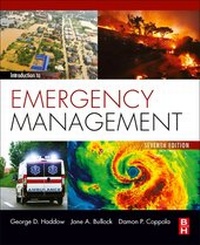
Introduction to Emergency Management
7th Edition
Published on 17. April 2020
Book
Paperback/Softback
560 pages
978-0-12-817139-4 (ISBN)
Description
Introduction to Emergency Management, Seventh Edition, sets the standard for excellence in the field and has educated a generation of emergency managers. This long-trusted resource provides a broad overview of the key aspects of the emergency management profession. Readers will gain an understanding of why the emergency management profession exists, what actions its professionals and practitioners are tasked with performing, and what achievements are sought through the conduct of these various efforts. Students and new professionals alike will further gain an enhanced understanding of key terminology and concepts that enable them to work with emergency management specialists.
Reviews / Votes
"The goal of risk management is to reduce risk-not to an unrealistic zero, but to an acceptable level. In the absence of critical thinking, fear-based decision making may occur. The seventh edition of Introduction to Emergency Management can help point the way to better risk decisions. Those responsible for emergency management are expected to manage crises quickly and efficiently, from planning to recovery. The COVID-19 pandemic is a good example, illustrating how an unexpected threat changed the way business is done throughout the world. Readers of this book will learn about the emergency management process, the tools to establish and manage crises, and what is and is not realistic. For students, the book includes a staggering amount of introductory information with plenty of detail-enough for various instructors to pick and choose what to focus on when presenting the material. Learning objectives, case studies, critical thinking questions, class exercises, additional references, and points of research enable learning. For the emergency planner, the book details the classic emergency management process of hazard identification via risk assessment and provides information on the mitigation, preparedness, response, and recovery stages. For the responder, discussions of the incident command system, communication (including social media), leadership, critical thinking, and partnering with the media will be useful. Contents are laid out in a logical manner, but the reader can also jump to one of the self-contained chapters. While most of the book has an American viewpoint, it does include occasional references to non-U.S. events, as well as a chapter on international disaster management. This book has almost everything a reader could want to know about the emergency management process." --Security ManagementMore details
Edition
7th edition
Language
English
Place of publication
Woburn
United States
Publishing group
Elsevier - Health Sciences Division
Target group
College/higher education
Undergraduate and graduate students of emergency management; professionals participating in continuing education; practicing professionals in emergency planning and risk management
Dimensions
Height: 235 mm
Width: 191 mm
Weight
1130 gr
ISBN-13
978-0-12-817139-4 (9780128171394)
Copyright in bibliographic data and cover images is held by Nielsen Book Services Limited or by the publishers or by their respective licensors: all rights reserved.
Schweitzer Classification
Other editions
New editions
George Haddow | Jane Bullock | Damon P. Coppola
Introduction to Emergency Management
Book
11/2024
8th Edition
Butterworth-Heinemann
€105.50
Shipment within 15-20 days
Additional editions
Jane Bullock | George Haddow | Damon P. Coppola
Introduction to Emergency Management
E-Book
03/2020
7th Edition
Butterworth-Heinemann
€91.95
Available for download
Previous edition
Jane Bullock | George Haddow | Damon Coppola
Introduction to Emergency Management
Book
03/2017
6th Edition
Butterworth-Heinemann
€91.60
Article exhausted; check for reprint
Persons
Jane A. Bullock served more than 20 years in support of Federal emergency management efforts, culminating as the Chief of Staff at the Federal Emergency Management Agency (FEMA) for Director James Lee Witt. In this position Ms. Bullock served as principal advisor to the Director on all Agency programmatic and administrative activities, provided advice and recommendations to the Director on policies required to carry out the mission of the agency; managed the day-to-day operations of the Agency; directed, monitored, and evaluated Agency strategic and communication processes; and oversaw administration of the Agency's resources, including the disaster relief fund. In 2001, Ms. Bullock co-founded the disaster management consulting firm Bullock & Haddow, LLC. She currently serves on the governing boards of the National Earthquake Hazards Program, the Earthquake Engineering Research Center, and others.
George Haddow currently serves as Senior Fellow at the Disaster Resilience Leadership Academy (DRLA) at Tulane University in New Orleans, LA and previously served as an Adjunct Faculty and Research Scientist, Institute for Crisis, Disaster and Risk Management, George Washington University in Washington, DC. at Prior to joining academia, Mr. Haddow worked for eight years in the Office of the Director of the Federal Emergency Management Agency (FEMA) as the White House Liaison and the deputy Chief of Staff. He is a founding partner of Bullock & Haddow LLC, a disaster management consulting firm.
Damon P. Coppola is the founder of Shoreline Risk LLC and a Partner with Bullock & Haddow LLC. He has extensive experience in disaster management capacity development, disaster risk management, and planning through his work with the United Nations; the World Bank Group; The US Federal Emergency Management Agency; and the US Army Corps of Engineers, among others. Mr. Coppola serves as a Senior Disaster Management Specialist at the Hawaii-based Pacific Disaster Center and is a faculty member at Loma Linda University and the University of Hawaii. He holds an M.E.M in Crisis, Emergency, and Risk Management from George Washington University and an A.R.M. from the American Institute for Chartered Property Casualty Underwriters.
George Haddow currently serves as Senior Fellow at the Disaster Resilience Leadership Academy (DRLA) at Tulane University in New Orleans, LA and previously served as an Adjunct Faculty and Research Scientist, Institute for Crisis, Disaster and Risk Management, George Washington University in Washington, DC. at Prior to joining academia, Mr. Haddow worked for eight years in the Office of the Director of the Federal Emergency Management Agency (FEMA) as the White House Liaison and the deputy Chief of Staff. He is a founding partner of Bullock & Haddow LLC, a disaster management consulting firm.
Damon P. Coppola is the founder of Shoreline Risk LLC and a Partner with Bullock & Haddow LLC. He has extensive experience in disaster management capacity development, disaster risk management, and planning through his work with the United Nations; the World Bank Group; The US Federal Emergency Management Agency; and the US Army Corps of Engineers, among others. Mr. Coppola serves as a Senior Disaster Management Specialist at the Hawaii-based Pacific Disaster Center and is a faculty member at Loma Linda University and the University of Hawaii. He holds an M.E.M in Crisis, Emergency, and Risk Management from George Washington University and an A.R.M. from the American Institute for Chartered Property Casualty Underwriters.
Content
1. The Historical Context of Emergency Management
2. Natural and Technological Hazards and Risk Assessment
3. The Disciplines of Emergency Management: Mitigation
4. The Disciplines of Emergency Management: Preparedness
5. Communications
6. The Disciplines of Emergency Management: Response
7. The Disciplines of Emergency Management: Recovery
8. International Disaster Management
9. Emergency Management and the Terrorist Threat
10. The Future of Emergency Management
2. Natural and Technological Hazards and Risk Assessment
3. The Disciplines of Emergency Management: Mitigation
4. The Disciplines of Emergency Management: Preparedness
5. Communications
6. The Disciplines of Emergency Management: Response
7. The Disciplines of Emergency Management: Recovery
8. International Disaster Management
9. Emergency Management and the Terrorist Threat
10. The Future of Emergency Management