

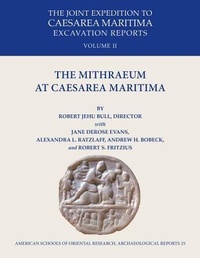
The Mithraeum at Caesarea Maritima
The Joint Expedition to Caesarea Maritima Excavation Reports Vol II
Published on 24. August 2017
Book
Hardback
113 pages
978-0-89757-097-8 (ISBN)
Description
Robert J. Bull began the excavation of a vault on the south side of the Inner Harbour of Caesarea Maritima, Israel. The vault was one of a row of warehouses built to store goods unloaded from the harbour built by Herod the Great.
Begins with an introduction to the excavation process; the study of the stratigraphy (analysis of the order and position of layers of archaeological remains) considers the later excavations of the adjoining vault, and includes new photographs, plans, and section drawings. The original construction phase, the vault's transformation into a Mithraeum (a sanctuary or temple of the god Mithras), abandonment, and final use as a "charnel house" are discussed in detail.
Also, includes detailed studies of the fragmentary wall paintings depicting Mithraic iconography, and of the medallion found inside the vault, in the context of the practices of Mithraism in the ancient world. The reconstruction of the ceiling splay and the interpretation in terms of astrological symbolism important to Mithraism are also detailed.
A second volume describing the structure of the vault and the material culture found is planned.
Begins with an introduction to the excavation process; the study of the stratigraphy (analysis of the order and position of layers of archaeological remains) considers the later excavations of the adjoining vault, and includes new photographs, plans, and section drawings. The original construction phase, the vault's transformation into a Mithraeum (a sanctuary or temple of the god Mithras), abandonment, and final use as a "charnel house" are discussed in detail.
Also, includes detailed studies of the fragmentary wall paintings depicting Mithraic iconography, and of the medallion found inside the vault, in the context of the practices of Mithraism in the ancient world. The reconstruction of the ceiling splay and the interpretation in terms of astrological symbolism important to Mithraism are also detailed.
A second volume describing the structure of the vault and the material culture found is planned.
Reviews / Votes
The authors are to be highly commended for assembling this volume under challenging circumstances. The book, most appropriate for a specialized audience, makes an important contribution to the study of the cult of Mithras in the eastern empire and serves as an appropriate tribute to Robert Bull's many years dedicated to study of the remains of Caesarea Maritima.Caroline Downing -- Caroline Downing * American Journal of Archaeology, Vol. 122, No. 3 (July 2018) *
More details
Series
Language
English
Place of publication
United States
Target group
College/higher education
Product notice
Laminated cover
Dimensions
Height: 284 mm
Width: 218 mm
Thickness: 6 mm
Weight
639 gr
ISBN-13
978-0-89757-097-8 (9780897570978)
Copyright in bibliographic data and cover images is held by Nielsen Book Services Limited or by the publishers or by their respective licensors: all rights reserved.
Schweitzer Classification
Persons
Robert Jehu Bull was the emeritus director of the Drew University's Institute for Archaeological Research, later the Joint Expeditions to Caesarea Maritima, where he excavated from 1971 to 1996, exposing major parts of the city's street plan, warehouse complex, a residential quarter, and parts of the hippodrome. Before excavating at Caesarea, he excavated and led excavations at Shechem, Balatah, Ai, Pella, Tell er-Ras, and Khirbet Shema'.
Andrew H. Bobeck His book "Techniques for Improving Digital Photographs" by OutSkirts Press covers in depth the graphics technique he used to recover the faded colours of the Caesarea fresco.
Jane DeRose Evans is a Professor of Art History and is affiliated with the Department of Greek and Latin Classics at Temple University. She has excavated in Greece, Italy, England, Israel, and France. Currently, she is the specialist numismatist for the Archaeological Exploration of Sardis (Harvard and Cornell universities) and Bir Madkhour (George Washington University).
Robert S. Fritzius has published the Introduction and First Part of an English translation of Walter Ritz's "Recherches critiques sur l'Electrodynamique Generale", and served as staff artist for the excavations at Elusa, Israel. He is a member of the American Astronomical Society, the Committee on Space Research, and the Venus Exploration and Analysis Group.
Alexandra L. Ratzlaff is a Fellow at the Albright Institute of Archaeological Research in Jerusalem and a University Postdoctoral Fellow in the Department of Maritime Civilizations at the University of Haifa. She recently completed a two-year Fulbright Postdoctoral Fellowship at the University of Haifa. Her research and publication projects focus on the Roman army, Roman and Byzantine ceramics, the Late Antique maritime economy and trade networks of the Mediterranean world.
Andrew H. Bobeck His book "Techniques for Improving Digital Photographs" by OutSkirts Press covers in depth the graphics technique he used to recover the faded colours of the Caesarea fresco.
Jane DeRose Evans is a Professor of Art History and is affiliated with the Department of Greek and Latin Classics at Temple University. She has excavated in Greece, Italy, England, Israel, and France. Currently, she is the specialist numismatist for the Archaeological Exploration of Sardis (Harvard and Cornell universities) and Bir Madkhour (George Washington University).
Robert S. Fritzius has published the Introduction and First Part of an English translation of Walter Ritz's "Recherches critiques sur l'Electrodynamique Generale", and served as staff artist for the excavations at Elusa, Israel. He is a member of the American Astronomical Society, the Committee on Space Research, and the Venus Exploration and Analysis Group.
Alexandra L. Ratzlaff is a Fellow at the Albright Institute of Archaeological Research in Jerusalem and a University Postdoctoral Fellow in the Department of Maritime Civilizations at the University of Haifa. She recently completed a two-year Fulbright Postdoctoral Fellowship at the University of Haifa. Her research and publication projects focus on the Roman army, Roman and Byzantine ceramics, the Late Antique maritime economy and trade networks of the Mediterranean world.
Content
List of Illustrations
List of Tables
Preface
Acknowledgements
Abbreviations
Chapter 1 - Introduction and Background
A. The Site: Physical Setting and Early History
B. The Backstory: Early Challenges for the Harvard Expedition
C. The Harvard Expedition: Excavation Strategy, Methods, and Ensuing Challenges
1. 1908 Fieldwork
2. 1909 Fieldwork
3. 1910 Fieldwork
D. Summary
Chapter 2 - Horizontal Axis: The Ostraca Building's Original Footprint and Surrounding Area
A. The Ostraca House
1. Wall A: Ahab's "Main Wall"
2. The Ostraca House: Entrance Halls, Storerooms, and Eastern Corridors (Long-Rooms)
3. Reconstructions
4. Later Additions (?)
B. The Osorkon House
C. Problems North and East of the Ostraca and Osorkon Houses
D. Summary
Chapter 3 - Vertical Axis: The Ostraca Building's Complex Depositional History
A. Stratigraphic Analysis: Summary of Sections Published by the Harvard Expedition
B. Stratigraphic Analysis: Discussion of Sections Relevant to the Ostraca House
1. Principal Longitudinal Section CD
2. Principal Lateral Section GH
3. Subsidiary Lateral Section AB
C. Summary
Chapter 4 - Ceramic Considerations
A. The Harvard Excavations and the Joint Expedition: Collating the Data
B. Reisner's Presentation of Pottery: A Meager Repertoire
C. The 1910 Ostraca: Spatial Distribution
D. The 1910 Ostraca: Typological Notes
E. The 1910 Ostraca-related Pottery: Typological Notes
F. The 1910 Ostraca and Ostraca-related Pottery: Comparative Ceramic Analysis
1. Epigraphic Pottery
2. Bowl Types Representing Parallels for Ostraca Pottery Forms
3. Non-epigraphic Pottery from the Same Findspots as the Ostraca
4. Comments on Some Jar Types Associated with Ostraca Pottery Forms
G. Summary
Chapter 5 - The Samaria Ostraca and Modern Scholarship
Chapter 6 - Back to the Backstory: The Characters and Concerns behind the Harvard Expedition to Samaria
Appendix A - Ostraca: Provenance Data and Vessel Descriptions
Appendix B - Ostraca: Sequence of Discovery
Appendix C - Non-epigraphic Pottery with Provenance Data Matching those of the Ostraca
Appendix D - D. G. Lyon's Report to the President of Harvard University for the Academic Year 1898-1899, Showing the Financial Generosity of Jakob Heinrich Schiff
Appendix E - Reisner's Field Drawings of Selected Ostraca
Plates
Bibliography
Indices
Biblical References
Author Index
Subject Index
List of Tables
Preface
Acknowledgements
Abbreviations
Chapter 1 - Introduction and Background
A. The Site: Physical Setting and Early History
B. The Backstory: Early Challenges for the Harvard Expedition
C. The Harvard Expedition: Excavation Strategy, Methods, and Ensuing Challenges
1. 1908 Fieldwork
2. 1909 Fieldwork
3. 1910 Fieldwork
D. Summary
Chapter 2 - Horizontal Axis: The Ostraca Building's Original Footprint and Surrounding Area
A. The Ostraca House
1. Wall A: Ahab's "Main Wall"
2. The Ostraca House: Entrance Halls, Storerooms, and Eastern Corridors (Long-Rooms)
3. Reconstructions
4. Later Additions (?)
B. The Osorkon House
C. Problems North and East of the Ostraca and Osorkon Houses
D. Summary
Chapter 3 - Vertical Axis: The Ostraca Building's Complex Depositional History
A. Stratigraphic Analysis: Summary of Sections Published by the Harvard Expedition
B. Stratigraphic Analysis: Discussion of Sections Relevant to the Ostraca House
1. Principal Longitudinal Section CD
2. Principal Lateral Section GH
3. Subsidiary Lateral Section AB
C. Summary
Chapter 4 - Ceramic Considerations
A. The Harvard Excavations and the Joint Expedition: Collating the Data
B. Reisner's Presentation of Pottery: A Meager Repertoire
C. The 1910 Ostraca: Spatial Distribution
D. The 1910 Ostraca: Typological Notes
E. The 1910 Ostraca-related Pottery: Typological Notes
F. The 1910 Ostraca and Ostraca-related Pottery: Comparative Ceramic Analysis
1. Epigraphic Pottery
2. Bowl Types Representing Parallels for Ostraca Pottery Forms
3. Non-epigraphic Pottery from the Same Findspots as the Ostraca
4. Comments on Some Jar Types Associated with Ostraca Pottery Forms
G. Summary
Chapter 5 - The Samaria Ostraca and Modern Scholarship
Chapter 6 - Back to the Backstory: The Characters and Concerns behind the Harvard Expedition to Samaria
Appendix A - Ostraca: Provenance Data and Vessel Descriptions
Appendix B - Ostraca: Sequence of Discovery
Appendix C - Non-epigraphic Pottery with Provenance Data Matching those of the Ostraca
Appendix D - D. G. Lyon's Report to the President of Harvard University for the Academic Year 1898-1899, Showing the Financial Generosity of Jakob Heinrich Schiff
Appendix E - Reisner's Field Drawings of Selected Ostraca
Plates
Bibliography
Indices
Biblical References
Author Index
Subject Index