

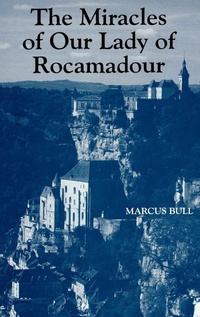
The Miracles of Our Lady of Rocamadour
Analysis and Translation
Published on 23. December 1999
Book
Hardback
236 pages
978-0-85115-765-8 (ISBN)
Description
Medieval miracle stories from a major pilgrim destination in 12c France.
In the second half of the twelfth century Rocamadour developed an international reputation as a centre of devotion to the Virgin Mary, drawing pilgrims from Spain, Italy, Germany, England and the Latin East as well as France, as witnessed by the 126 miracle stories written there in 1172-3, here translated for the first time. Reflecting and enhancing Rocamadour's status (aristocratic figures feature prominently), they throw light on many of the dangers faced by medieval men and women: illness and injury; imprisonment; warfare; arbitrary justice; and natural disasters.
In his introduction Marcus Bull identifies issues which the collection helps to elucidate, and assesses thevalue of the text as source material, particularly in view of the lack of other chronicles from southern France for the period. He makes comparisons with other texts, such as the miracle collection compiled at the shrine of Thomas Becket at Canterbury, and argues that the monks of Rocamadour asserted their importance through the miracles, in the face of competition from neighbouring monastic communities.
MARCUS BULL is Andrew W. Mellon Distinguished Professor of Medieval and Early Modern Studies at the University of North Carolina, Chapel Hill.
In the second half of the twelfth century Rocamadour developed an international reputation as a centre of devotion to the Virgin Mary, drawing pilgrims from Spain, Italy, Germany, England and the Latin East as well as France, as witnessed by the 126 miracle stories written there in 1172-3, here translated for the first time. Reflecting and enhancing Rocamadour's status (aristocratic figures feature prominently), they throw light on many of the dangers faced by medieval men and women: illness and injury; imprisonment; warfare; arbitrary justice; and natural disasters.
In his introduction Marcus Bull identifies issues which the collection helps to elucidate, and assesses thevalue of the text as source material, particularly in view of the lack of other chronicles from southern France for the period. He makes comparisons with other texts, such as the miracle collection compiled at the shrine of Thomas Becket at Canterbury, and argues that the monks of Rocamadour asserted their importance through the miracles, in the face of competition from neighbouring monastic communities.
MARCUS BULL is Andrew W. Mellon Distinguished Professor of Medieval and Early Modern Studies at the University of North Carolina, Chapel Hill.
Reviews / Votes
Elegant and fluent translation of a colourful collection of tales... The value of the text for those interested in monastic religion is obvious... All medieval historians will be united in ackn owledging the considerable debt they owe to Bull for opening up this text. * ENGLISH HISTORICAL REVIEW *More details
Language
English
Place of publication
Woodbridge
United Kingdom
Publishing group
Boydell & Brewer Ltd
Target group
Professional and scholarly
Product notice
Cloth over boards
Dimensions
Height: 240 mm
Width: 161 mm
Thickness: 18 mm
Weight
529 gr
ISBN-13
978-0-85115-765-8 (9780851157658)
Copyright in bibliographic data and cover images is held by Nielsen Book Services Limited or by the publishers or by their respective licensors: all rights reserved.
Schweitzer Classification
Other editions
Additional editions
E-Book
12/1999
1st Edition
Boydell & Brewer Ltd
€60.99
Available for download
Person
MARCUS BULL is Andrew W. Mellon Distinguished Professor of Medieval and Early Modern Studies at the University of North Carolina, Chapel Hill
Content
Analysis; introduction - questions and issues - the value of translated sources, the importance of "miracula" as part of medieval hagiographical culture, the paucity of chronicle sources for southern France in the 12th century; the miracles of Our Lady of Rocamadour - text and content - authorship, content and form, historical veracity; dating and purpose - problems, four comparable texts, chronological clues in the text, possible reasons behind the writing of the collection, the contemporary political and military context; conclusion - the miracles of Our Lady of Rocamadour.