

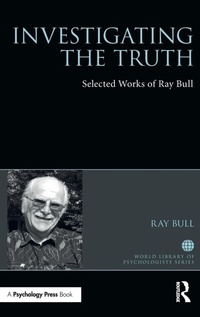
Investigating the Truth
Selected Works of Ray Bull
1st Edition
Published on 18. October 2018
Book
Hardback
290 pages
978-1-138-04886-7 (ISBN)
Description
In the World Library of Psychologists series, international experts present career-long collections of what they judge to be their finest pieces - extracts from books, key articles, salient research findings, and their major practical theoretical contributions.
The Selected Works of Professor Ray Bull include some of the most influential insights into the psychology of investigative interviewing. Whether it has been determining whether a suspect is lying or telling the truth, enabling children to provide reliable testimony, or understanding how the dynamics of the interview process itself can affect what is achieved, Professor Bull has been at the forefront in researching this fascinating area of applied psychology for over 40 years, his work informing practice internationally. An elected Honorary Fellow of the British Psychological Society and the first Honorary Life Member of the International Investigative Interviewing Research Group, Professor Bull also drafted parts of the government's Memorandum of Good Practice and of Achieving Best Evidence on Video Recorded Interviews with Child Witnesses for Criminal Proceedings.
Including a specially written introduction in which Professor Bull reflects on a wide-ranging career and contextualises how the field has evolved, this collection will be a valuable resource for students and researchers of forensic psychology.
The Selected Works of Professor Ray Bull include some of the most influential insights into the psychology of investigative interviewing. Whether it has been determining whether a suspect is lying or telling the truth, enabling children to provide reliable testimony, or understanding how the dynamics of the interview process itself can affect what is achieved, Professor Bull has been at the forefront in researching this fascinating area of applied psychology for over 40 years, his work informing practice internationally. An elected Honorary Fellow of the British Psychological Society and the first Honorary Life Member of the International Investigative Interviewing Research Group, Professor Bull also drafted parts of the government's Memorandum of Good Practice and of Achieving Best Evidence on Video Recorded Interviews with Child Witnesses for Criminal Proceedings.
Including a specially written introduction in which Professor Bull reflects on a wide-ranging career and contextualises how the field has evolved, this collection will be a valuable resource for students and researchers of forensic psychology.
More details
Series
Language
English
Place of publication
London
United Kingdom
Publishing group
Taylor & Francis Ltd
Target group
College/higher education
Illustrations
2 s/w Zeichnungen, 33 s/w Tabellen, 2 s/w Abbildungen
33 Tables, black and white; 2 Line drawings, black and white; 2 Illustrations, black and white
Dimensions
Height: 240 mm
Width: 161 mm
Thickness: 21 mm
Weight
617 gr
ISBN-13
978-1-138-04886-7 (9781138048867)
Copyright in bibliographic data and cover images is held by Nielsen Book Services Limited or by the publishers or by their respective licensors: all rights reserved.
Schweitzer Classification
Other editions
Additional editions
Book
05/2019
1st Edition
Routledge
€61.99
Shipment within 15-20 days
E-Book
10/2018
1st Edition
Routledge
€69.99
Available for download
Person
Ray Bull is Professor of Criminal Investigation at The University of Derby, UK. He has previously held the position of President of the European Association of Psychology and Law. In 2008 he received from the European Association of Psychology and Law the Award for Life-time Contribution to Psychology and Law. He regularly acts as an expert witness and conducts workshops/training on investigative interviewing.
Content
Introduction
Part 2 - Investigative Interviewing of suspects
Leahy-Harland, S., & Bull, R. (In press). Police strategies and suspect responses in real-life serious crime interviews
Bull, R. (2013). What is 'believed' or actually 'known' about characteristics that may contribute to being a good/effective interviewer?
Walsh, D., and Bull, R. (2012). Examining rapport in investigative interviews with suspects: Does its building and maintenance work?
Soukara, S., Bull, R., Vrij, A., Turner, M., & Cherryman, C. (2009). A study of what really happens in police interviews with suspects.
Part 3 - Investigative Interviewing of children
Bull, R. (2010). The investigative interviewing of children and other vulnerable witnesses: Psychological research and working/professional practice
Almerigogna, J., Ost, J., Bull, R., & Akehurst, L. (2007). A state of high anxiety: How unsupportive interviewers can increase the suggestibility of child witnesses
Flin, R., Bull, R., Boon, J., & Knox, A. (1993). Child witnesses in Scottish criminal trials
Part 4 - The 'Cognitive interview
Paulo, R., Albuquerque, P. B., & Bull, R. (2016). The Enhanced Cognitive Interview: Expressions of uncertainty, motivation and its relation with report accuracy.
Milne, R., & Bull, R. (2003). Does the cognitive interview help children to resist the effects of suggestive questioning?
Memon, A., Wark, L., Bull, R., & Koehnken, G. (1997). Isolating the effects of the cognitive interview techniques.
Part 5 - Detecting truth/lies
Dando, C., Bull, R., Ormerod, T., & Sandham, A. (2015). Helping to sort the liars from the truth-tellers: The gradual revelation of information during investigative interviews.
Dando, C., & Bull, R. (2011). Maximising opportunities to detect verbal deception: Training police officers to interview tactically.
Mann, S., Vrij, A., & Bull, R. (2004). Detecting true lies: Police officers' ability to detect suspects' lies.
Part 6 - Police
Bull, R., & Horncastle, P. (1994). Evaluation of police recruit training involving psychology
Bull, R., & Reid, R. L. (1975). Police officers' recall of information
Part 2 - Investigative Interviewing of suspects
Leahy-Harland, S., & Bull, R. (In press). Police strategies and suspect responses in real-life serious crime interviews
Bull, R. (2013). What is 'believed' or actually 'known' about characteristics that may contribute to being a good/effective interviewer?
Walsh, D., and Bull, R. (2012). Examining rapport in investigative interviews with suspects: Does its building and maintenance work?
Soukara, S., Bull, R., Vrij, A., Turner, M., & Cherryman, C. (2009). A study of what really happens in police interviews with suspects.
Part 3 - Investigative Interviewing of children
Bull, R. (2010). The investigative interviewing of children and other vulnerable witnesses: Psychological research and working/professional practice
Almerigogna, J., Ost, J., Bull, R., & Akehurst, L. (2007). A state of high anxiety: How unsupportive interviewers can increase the suggestibility of child witnesses
Flin, R., Bull, R., Boon, J., & Knox, A. (1993). Child witnesses in Scottish criminal trials
Part 4 - The 'Cognitive interview
Paulo, R., Albuquerque, P. B., & Bull, R. (2016). The Enhanced Cognitive Interview: Expressions of uncertainty, motivation and its relation with report accuracy.
Milne, R., & Bull, R. (2003). Does the cognitive interview help children to resist the effects of suggestive questioning?
Memon, A., Wark, L., Bull, R., & Koehnken, G. (1997). Isolating the effects of the cognitive interview techniques.
Part 5 - Detecting truth/lies
Dando, C., Bull, R., Ormerod, T., & Sandham, A. (2015). Helping to sort the liars from the truth-tellers: The gradual revelation of information during investigative interviews.
Dando, C., & Bull, R. (2011). Maximising opportunities to detect verbal deception: Training police officers to interview tactically.
Mann, S., Vrij, A., & Bull, R. (2004). Detecting true lies: Police officers' ability to detect suspects' lies.
Part 6 - Police
Bull, R., & Horncastle, P. (1994). Evaluation of police recruit training involving psychology
Bull, R., & Reid, R. L. (1975). Police officers' recall of information