

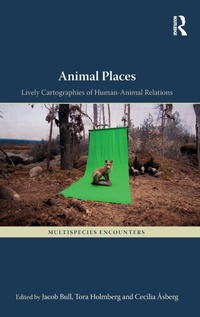
Animal Places
Lively Cartographies of Human-Animal Relations
1st Edition
Published on 20. November 2017
Book
Hardback
294 pages
978-1-4724-8324-9 (ISBN)
Description
Nonhuman animals are ubiquitous to our 'human' societies. Interdisciplinary human/animal research has - for 50 years - drawn attention to how animals are ever-present in what we think of as human spaces and cultures. Our societies are built with animals and through all kinds of multispecies interactions. From public spaces and laboratories to homes, farms and in the 'wilderness'; human and nonhuman animals meet to make space and place together, through webs of power relations. However, the very spaces of these interactions are not mute or passive themselves. The spaces where species meet matter, and shape human/animal relations.
This book takes as its starting point the relationship between place and human/animal interaction. It brings together the work of leading scholars in human/animal studies, from a variety of disciplinary and interdisciplinary backgrounds. With a distinct focus on place, physical space and biocultural geography, the authors of this volume consider the ways in which space, human and nonhuman animals co-constitute each other, how they make spaces together, produce meaning around them, struggle over access, how these places are storied and how stories of spaces matter. Presenting studies thematically and including a variety of nonhuman creatures in a range of settings, this book delivers new understandings of the importance of nonhuman animals to understandings of place - and the role of places in shaping our interactions with nonhuman creatures. As pets, as laboratory animals, as exhibits, as parasites, as livestock, as quarry, as victims of disaster or objects of folklore, this book offers insights into human/animal intermingling at locales and settings of great relevance to many areas of research, including geography, sociology, science and technology studies, gender studies, history and anthropology. This book meets the evolving interest in human/animal interaction, anthrozoology, and the environmental humanities in relation to the research on space and place that currently informs the humanities and the social sciences.
This book takes as its starting point the relationship between place and human/animal interaction. It brings together the work of leading scholars in human/animal studies, from a variety of disciplinary and interdisciplinary backgrounds. With a distinct focus on place, physical space and biocultural geography, the authors of this volume consider the ways in which space, human and nonhuman animals co-constitute each other, how they make spaces together, produce meaning around them, struggle over access, how these places are storied and how stories of spaces matter. Presenting studies thematically and including a variety of nonhuman creatures in a range of settings, this book delivers new understandings of the importance of nonhuman animals to understandings of place - and the role of places in shaping our interactions with nonhuman creatures. As pets, as laboratory animals, as exhibits, as parasites, as livestock, as quarry, as victims of disaster or objects of folklore, this book offers insights into human/animal intermingling at locales and settings of great relevance to many areas of research, including geography, sociology, science and technology studies, gender studies, history and anthropology. This book meets the evolving interest in human/animal interaction, anthrozoology, and the environmental humanities in relation to the research on space and place that currently informs the humanities and the social sciences.
More details
Series
Language
English
Place of publication
London
United Kingdom
Publishing group
Taylor & Francis Ltd
Target group
College/higher education
Professional and scholarly
Illustrations
29 s/w Abbildungen, 25 s/w Photographien bzw. Rasterbilder, 4 s/w Zeichnungen
4 Line drawings, black and white; 25 Halftones, black and white; 29 Illustrations, black and white
Dimensions
Height: 240 mm
Width: 161 mm
Thickness: 21 mm
Weight
611 gr
ISBN-13
978-1-4724-8324-9 (9781472483249)
Copyright in bibliographic data and cover images is held by Nielsen Book Services Limited or by the publishers or by their respective licensors: all rights reserved.
Schweitzer Classification
Other editions
Additional editions
Jacob Bull | Tora Holmberg | Cecilia Asberg
Animal Places
Lively Cartographies of Human-Animal Relations
Book
04/2019
1st Edition
Routledge
€65.70
Shipment within 15-20 days
Jacob Bull | Tora Holmberg | Cecilia Asberg
Animal Places
Lively Cartographies of Human-Animal Relations
E-Book
11/2017
Routledge
€59.49
Available for download
Jacob Bull | Tora Holmberg | Cecilia Asberg
Animal Places
Lively Cartographies of Human-Animal Relations
E-Book
11/2017
Routledge
€59.49
Available for download
Persons
Jacob Bull is coordinator of the Humanimal research group at the Centre for Gender Research, Uppsala University, Sweden. He is the editor of Animal Movements - Moving Animals: Essays in Direction, Velocity and Agency in Humanimal Encounters and co-editor of Illdisciplined Gender: Engaging Questions of Nature/Culture and Transgressive Encounters.
Tora Holmberg is Professor of Sociology, Uppsala University, Sweden. With a cultural sociology approach, her studies and publications combined Animal Studies with STS (Science and Technology Studies) and feminist theory. Holmberg's books include Urban Animals. Crowding in ZooCities (Routledge 2015). She is research leader for the Cultural Matters group, Uppsala, and Chair of the Swedish Sociological Association.
Cecilia Asberg is Professor of Gender, nature, culture at Linkoeping University, Sweden, and founding director of the Posthumanities Hub and the Seed Box: an Environmental Humanities Collaboratory. She is the author and co-editor of several publications, including A Feminist Companion to the Posthumanities (Springer 2017, with Rosi Braidotti).
Tora Holmberg is Professor of Sociology, Uppsala University, Sweden. With a cultural sociology approach, her studies and publications combined Animal Studies with STS (Science and Technology Studies) and feminist theory. Holmberg's books include Urban Animals. Crowding in ZooCities (Routledge 2015). She is research leader for the Cultural Matters group, Uppsala, and Chair of the Swedish Sociological Association.
Cecilia Asberg is Professor of Gender, nature, culture at Linkoeping University, Sweden, and founding director of the Posthumanities Hub and the Seed Box: an Environmental Humanities Collaboratory. She is the author and co-editor of several publications, including A Feminist Companion to the Posthumanities (Springer 2017, with Rosi Braidotti).
Content
Introducing Animals, Places and Lively Cartographies (Jacob Bull and Tora Holmberg) Part I: Humanimal Place Making: Cartographies of Convivial Life 1. Sheep-Shaped (Philip Armstrong) 2. 'Moving quietly in the shadows': On Feral Feeding in Kolkata (Tora Holmberg) 3. Felines on the Fault Line: Cats and the Christchurch Earthquakes (Donelle Gadenne and Annie Potts) 4. Intimate cartographies: creating place with companion animals (Rebekah Fox) Part II: Mapping (Sym)Biographies of Humanimal Relations 5. Sharing the Condition of Abandonment: The Beastly Topology of Condolence Cards for Bereaved Pet Owners (David Redmalm) 6. Curating the Body Politic: The Spatiality of the Zoo and the Symbolic Construction of German Nationhood (Berlin 1933-1961) (Mieke Roscher) 7. Zoo/mbie Spaces: Museums as Humanimal Places (Anna Samuelsson) 8. Model Territories: Choreographies of Laboratory Flies (Tara Mehrabi and Cecilia Asberg) Part III: Animal (Sym)Biographies: Unsettling Spaces of Human-Animal Cohabitation 9. Microbiogeographies: the Lively Cartographies of Homo microbis (Jamie Lorimer) 10. A Foray into the Geographies of Ticks and People (Jacob Bull) 11. Following the Animal. Place, Space, and Literature (Ann-Sofie Loenngren) 12. Shoring: Contemporary Fictions of Indigenous Cetacean Killing (Susan McHugh) Index