

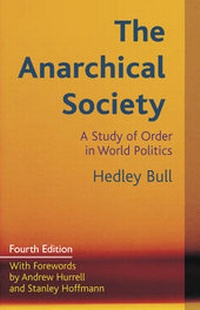
The Anarchical Society
A Study of Order in World Politics
4th Edition
Published on 3. July 2012
Book
Paperback/Softback
368 pages
978-0-231-16129-9 (ISBN)
Description
In this fundamental text, Hedley Bull explores three key questions: What is the nature of order in world politics? How is it maintained within the contemporary states system? And do desirable and feasible alternatives to the states system exist? Contrary to common claims, Bull asserts that the sovereign states system is not in decline. Rather, it persists and thrives, as it is essential to maintaining an international world order.
More than three decades after its publication, Bull's classic work continues to define and direct research in international relations. In this thirty-fifth anniversary edition, the text has been updated and includes a new interpretive foreword by the world's leading expert on Bull and his contributions to the theory, structures, and practices of world politics. The Anarchical Society identifies and confronts the unwritten rules supporting the international order across history, despite sweeping changes in laws and institutions. It considers and rejects the idea that the states system is giving way to an alternative world government or some method of neo-medieval rule or that the states system has ceased to be viable or compatible with objectives such as peace, economic justice, and ecological control. Bull also reviews and comments upon a variety of proposals for states system reform.
More than three decades after its publication, Bull's classic work continues to define and direct research in international relations. In this thirty-fifth anniversary edition, the text has been updated and includes a new interpretive foreword by the world's leading expert on Bull and his contributions to the theory, structures, and practices of world politics. The Anarchical Society identifies and confronts the unwritten rules supporting the international order across history, despite sweeping changes in laws and institutions. It considers and rejects the idea that the states system is giving way to an alternative world government or some method of neo-medieval rule or that the states system has ceased to be viable or compatible with objectives such as peace, economic justice, and ecological control. Bull also reviews and comments upon a variety of proposals for states system reform.
Reviews / Votes
A masterful analysis of the problem of international order in contemporary society and of the feasibility of such alternative models as disarmament, global organization, a highly proliferated world, and a radical redistribution of wealth and power. Foreign Affairs Bull has written that rarest of books: it is not the last, but the first word on its subject. Political Science Quarterly An important book likely to be read with profit for a long time to come. Times Literary SupplementA masterful analysis of the problem of international order in contemporary society and of the feasibility of such alternative models as disarmament, global organization, a highly proliferated world, and a radical redistribution of wealth and power. Foreign Affairs Bull has written that rarest of books: it is not the last, but the first word on its subject. Political Science Quarterly An important book likely to be read with profit for a long time to come. Times Literary Supplement
More details
Product info
Print PDF
Series
Edition
fourth edition
Language
English
Place of publication
New York
United States
Target group
Professional and scholarly
Product notice
Paperback (trade)
Dimensions
Height: 216 mm
Width: 140 mm
Weight
454 gr
ISBN-13
978-0-231-16129-9 (9780231161299)
Schweitzer Classification
Other editions
Additional editions
Book
07/2012
4th Edition
Columbia University Press
€96.58
Article exhausted; check different version
Book
06/2012
4th Edition
Red Globe Press
€62.40
Shipment within 15-20 days
Persons
Hedley Bull (1932;1985) was Montague Burton Professor of International Relations at Oxford University. He also taught at the Australian National University and the London School of Economics.
Andrew Hurrell is Montague Burton Professor of International Relations and a fellow of Balliol College, Oxford University. He is the author of On Global Order: Power, Values, and the Constitution of International Society and coeditor of Order and Justice in International Relations, Hedley Bull on International Society, and Inequality, Globalization, and World Politics.
Stanley Hoffman is the Paul and Catherine Buttenwieser University Professor of International Relations at Harvard University. His many books include Chaos and Violence: What Globalization, Failed States, and Terrorism Mean for U.S. Foreign Policy and Gulliver Unbound: America's Imperial Temptation and the War in Iraq.
Andrew Hurrell is Montague Burton Professor of International Relations and a fellow of Balliol College, Oxford University. He is the author of On Global Order: Power, Values, and the Constitution of International Society and coeditor of Order and Justice in International Relations, Hedley Bull on International Society, and Inequality, Globalization, and World Politics.
Stanley Hoffman is the Paul and Catherine Buttenwieser University Professor of International Relations at Harvard University. His many books include Chaos and Violence: What Globalization, Failed States, and Terrorism Mean for U.S. Foreign Policy and Gulliver Unbound: America's Imperial Temptation and the War in Iraq.
Content
Foreword to the Fourth Edition by Andrew HurrellForeword to the Second Edition by Stanley HoffmannIntroductionPart I. The Nature of Order in World Politics1. The Concept of Order in World Politics2. Does Order Exist in World Politics?3. How is Order Maintained in World Politics?4. Order versus Justice in World PoliticsPart II. Order in the Contemporary International System5. The Balance of Power and International Order6. International Law and International Order7. Diplomacy and International Order8. War and International Order9. The Great Powers and International OrderPart III. Alternative Paths to World Order10. Alternatives to the Contemporary States System11. The Decline of the States System?12. The Obsolescence of the States System13. The Reform of the States System?14. ConclusionNotes and ReferencesIndex