

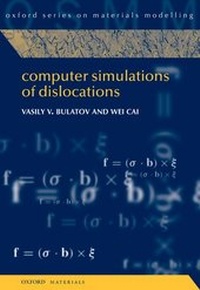
Computer Simulations of Dislocations
Published on 2. November 2006
Book
Hardback
300 pages
978-0-19-852614-8 (ISBN)
Description
This book presents a broad collection of models and computational methods - from atomistic to continuum - applied to crystal dislocations. Its purpose is to help students and researchers in computational materials sciences to acquire practical knowledge of relevant simulation methods. Because their behavior spans multiple length and time scales, crystal dislocations present a common ground for an in-depth discussion of a variety of computational approaches, including their relative strengths, weaknesses and inter-connections. The details of the covered methods are presented in the form of "numerical recipes" and illustrated by case studies. A suite of simulation codes and data files is made available on the book's website to help the reader "to learn-by-doing" through solving the exercise problems offered in the book.
Reviews / Votes
This book presents a collection of models and computational methods applied to crystal dislocations, to help researchers in materials science gain a practical knowledge of simulation. Materials World, November 2007. An outstanding book. * Robert Rudd, Lawrence Livermore National Laboratory * Reads very well, with a very informal but highly informative style. * Adrian P. Sutton, Imperial College London *More details
Series
Language
English
Place of publication
Oxford
United Kingdom
Target group
Professional and scholarly
Illustrations
88 Zeichnungen, 4 Fotos bzw. Rasterbilder
88 line drawings, 4 halftones
Dimensions
Height: 245 mm
Width: 170 mm
Thickness: 20 mm
Weight
676 gr
ISBN-13
978-0-19-852614-8 (9780198526148)
Copyright in bibliographic data and cover images is held by Nielsen Book Services Limited or by the publishers or by their respective licensors: all rights reserved.
Schweitzer Classification
Other editions
Additional editions
Vasily Bulatov | Wei Cai
Computer Simulations of Dislocations
Book
06/2013
Oxford University Press
€86.66
Shipment within 15-20 days
Vasily Bulatov | Wei Cai
Computer Simulations of Dislocations
E-Book
11/2006
OUP eBook
€55.49
Available for download
Persons
Vasily V Bulatov, Lawrence Livermore National Laboratory
Education:
B. Sc., theoretical physics, Moscow Physical Engineering Inst. (1979)
Ph. D., materials physics, USSR Academy of Sciences (1986)
Appointments:
Senior scientist, Inst. of Chemical Physics, Moscow (1997)
Research scientist, Massachusetts Institute of Technology (1990-1998)
Visiting scientist, Harvard University (1996-1997)
Staff scientist, senior scientist, Lawrence Livermore National Laboratory (1999-present)
Awards:
Edward Teller Fellow (2006)
Fellow of the American Physical Society (2005)
Alcoa Foundation Award (1996), UK Institute of Physics fellow (2001)
William and Mary Greve Foundation fellow (1990),
Wei Cai, Department of Mechanical Engineering, Stanford University
Education:
B.Sc., optoelectronics, Huazhong University, PRC (1995)
Ph. D., nuclear engineering, Massachusetts Institute of Technology (2001)
Appointments:
Lawrence Fellow, Lawrence Livermore National Laboratory (2001-2004)
Assistant Professor, Stanford University (2004-present)
Awards:
NSF Career Award (2006) Manson Benedict Fellow, Department of Nuclear Engineering, MIT (1999)
Graduate Student Award, Materials Research Society (2000)
The Lawrence Fellowship, Lawrence Livermore National Laboratory (2001)
Presidential Early Career Award for Scientists and Engineers (2004)
Frederick E. Terman Fellowship, Stanford University (2004-2007)
Education:
B. Sc., theoretical physics, Moscow Physical Engineering Inst. (1979)
Ph. D., materials physics, USSR Academy of Sciences (1986)
Appointments:
Senior scientist, Inst. of Chemical Physics, Moscow (1997)
Research scientist, Massachusetts Institute of Technology (1990-1998)
Visiting scientist, Harvard University (1996-1997)
Staff scientist, senior scientist, Lawrence Livermore National Laboratory (1999-present)
Awards:
Edward Teller Fellow (2006)
Fellow of the American Physical Society (2005)
Alcoa Foundation Award (1996), UK Institute of Physics fellow (2001)
William and Mary Greve Foundation fellow (1990),
Wei Cai, Department of Mechanical Engineering, Stanford University
Education:
B.Sc., optoelectronics, Huazhong University, PRC (1995)
Ph. D., nuclear engineering, Massachusetts Institute of Technology (2001)
Appointments:
Lawrence Fellow, Lawrence Livermore National Laboratory (2001-2004)
Assistant Professor, Stanford University (2004-present)
Awards:
NSF Career Award (2006) Manson Benedict Fellow, Department of Nuclear Engineering, MIT (1999)
Graduate Student Award, Materials Research Society (2000)
The Lawrence Fellowship, Lawrence Livermore National Laboratory (2001)
Presidential Early Career Award for Scientists and Engineers (2004)
Frederick E. Terman Fellowship, Stanford University (2004-2007)
Content
1. Introduction to crystal dislocations ; Atomistic Models ; 2. Fundamentals of atomistic simulations ; 3. Case study of static simulation ; 4. Case study of dynamic simulation ; 5. More about periodic boundary conditions ; 6. Free energy calculations ; 7. Finding transition pathways ; PART 2 ; Continuum Models ; 8. Peierls-Nabarro model of dislocations ; 9. Kinetic Monte Carlo method ; 10. Line Dislocation Dynamics ; 11. The Phase Field method