

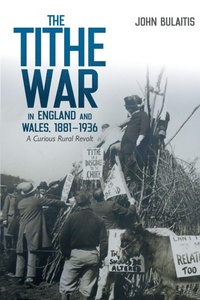
The Tithe War in England and Wales, 1881-1936
A Curious Rural Revolt
Will be published approx. on 7. April 2026
Book
Paperback/Softback
354 pages
978-1-83765-358-4 (ISBN)
Description
Brings to life a fascinating page of history in a scholarly but highly readable account of the "tithe war".
Co-WINNER: 2025 Thirsk Prize (British Agricultural History Society)
During the 1930s, farming communities waged a campaign of "passive resistance" against Tithe Rentcharge, the modern version of medieval tithe. Led by the National Tithepayers' Association, farmers refused to pay the charge, disrupted auctions of seized stock and joined demonstrations to prevent action by bailiffs. The National Government condemned their "unconstitutional action", ruled out changes in the law and mobilised police to support the titheowners. Meanwhile, the Church of England and lay titheowners - including Oxford and Cambridge colleges, public schools and major landowners - sought to vindicate their right to tithe; in a particularly shameful episode, the Church established a secret company to buy taken produce and remove it from farms.
This "tithe war" was fought outside farms, in the courts, in the press and in the wider arena of public opinion. It posed problems for the Church, legal system, and every political party; split the National Farmers' Union; and provided opportunities for the British Union of Fascists and other sections of the extreme right to cause disturbance.
Drawing on extensive archival research, accounts in local newspapers, and private papers, John Bulaitis traces the evolution of what has been described as this "curious rural revolt", from the late nineteenth century to its climax in 1936, when the Tithe Act brought an end to this form of tax.
Co-WINNER: 2025 Thirsk Prize (British Agricultural History Society)
During the 1930s, farming communities waged a campaign of "passive resistance" against Tithe Rentcharge, the modern version of medieval tithe. Led by the National Tithepayers' Association, farmers refused to pay the charge, disrupted auctions of seized stock and joined demonstrations to prevent action by bailiffs. The National Government condemned their "unconstitutional action", ruled out changes in the law and mobilised police to support the titheowners. Meanwhile, the Church of England and lay titheowners - including Oxford and Cambridge colleges, public schools and major landowners - sought to vindicate their right to tithe; in a particularly shameful episode, the Church established a secret company to buy taken produce and remove it from farms.
This "tithe war" was fought outside farms, in the courts, in the press and in the wider arena of public opinion. It posed problems for the Church, legal system, and every political party; split the National Farmers' Union; and provided opportunities for the British Union of Fascists and other sections of the extreme right to cause disturbance.
Drawing on extensive archival research, accounts in local newspapers, and private papers, John Bulaitis traces the evolution of what has been described as this "curious rural revolt", from the late nineteenth century to its climax in 1936, when the Tithe Act brought an end to this form of tax.
More details
Series
Language
English
Place of publication
Woodbridge
United Kingdom
Publishing group
Boydell & Brewer Ltd
Target group
Professional and scholarly
Product notice
Paperback (trade)
Illustrations
1 map and 11 b/w illus.
Dimensions
Height: 234 mm
Width: 156 mm
Thickness: 19 mm
Weight
538 gr
ISBN-13
978-1-83765-358-4 (9781837653584)
Copyright in bibliographic data and cover images is held by Nielsen Book Services Limited or by the publishers or by their respective licensors: all rights reserved.
Schweitzer Classification
Other editions
Additional editions
E-Book
06/2024
1st Edition
Boydell & Brewer
€48.99
Available for download
E-Book
06/2024
1st Edition
De Gruyter
€48.99
Available for download
Book
06/2024
Boydell Press
€120.20
Shipment within 3-4 weeks
Person
JOHN BULAITIS is Senior Lecturer in Modern History at Canterbury Christ Church University, UK.
Content
List of Illustrations
Acknowledgments
List of Abbreviations
Prologue: The Battle of the Ducks
Introduction
1. The 1836 Tithe Commutation Act
2. Hops, Pantomime and Martyrs, 1881-86
3. Wales and Southern England, 1886-91
4. Tithe after the Great War
5. The Settlement Unravels, 1927-31
6. The Bounty and General Dealers
7. English Agrarianism and Fascism
8. Pressures for a Settlement
9. Royal Commission
10. Aftermath
Conclusion: A 'Curious Rural Revolt'?
Sources and Bibliography
Index
Acknowledgments
List of Abbreviations
Prologue: The Battle of the Ducks
Introduction
1. The 1836 Tithe Commutation Act
2. Hops, Pantomime and Martyrs, 1881-86
3. Wales and Southern England, 1886-91
4. Tithe after the Great War
5. The Settlement Unravels, 1927-31
6. The Bounty and General Dealers
7. English Agrarianism and Fascism
8. Pressures for a Settlement
9. Royal Commission
10. Aftermath
Conclusion: A 'Curious Rural Revolt'?
Sources and Bibliography
Index