

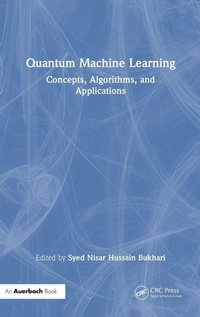
Quantum Machine Learning
Concepts, Algorithms, and Applications
1st Edition
Published on 22. April 2026
Book
Hardback
330 pages
978-1-041-13662-0 (ISBN)
Description
In the exploration of new frontiers in data-driven solutions, the potential of quantum-enhanced machine learning has become too important to overlook. Quantum machine learning, though still in its formative stages, holds the promise to tackle some of the most complex problems that lie beyond the reach of classical computing. Quantum Machine Learning: Concepts, Algorithms, and Applications is a guide to understanding such quantum principles as superposition and entanglement and how they can enhance learning algorithms and data-processing capabilities. The book features a carefully structured progression from foundational concepts and core algorithms to application-driven case studies and emerging directions for future exploration.
The book provides a broad and in-depth treatment of topics ranging from quantum data encoding and quantum neural networks to hybrid models and optimization frameworks. Emphasis has also been placed on real-world use cases and the practical tools available for implementation, thereby ensuring that this book serves not only as a reference but also as a springboard for experimentation and innovation. Highlights include the following:
Implementing quantum neural networks on near-term quantum hardware
Quantum variational optimization for machine learning
Quantum-accelerated neural imputations with large language models
Emerging trends, addressing hardware limitations, algorithm optimization, and ethical considerations
This book serves as both a primer and an advanced guide by providing essential knowledge for understanding and implementing quantum-enhanced AI solutions in various professional contexts. It equips readers to become active participants in the quantum revolution transforming machine learning.
The book provides a broad and in-depth treatment of topics ranging from quantum data encoding and quantum neural networks to hybrid models and optimization frameworks. Emphasis has also been placed on real-world use cases and the practical tools available for implementation, thereby ensuring that this book serves not only as a reference but also as a springboard for experimentation and innovation. Highlights include the following:
Implementing quantum neural networks on near-term quantum hardware
Quantum variational optimization for machine learning
Quantum-accelerated neural imputations with large language models
Emerging trends, addressing hardware limitations, algorithm optimization, and ethical considerations
This book serves as both a primer and an advanced guide by providing essential knowledge for understanding and implementing quantum-enhanced AI solutions in various professional contexts. It equips readers to become active participants in the quantum revolution transforming machine learning.
More details
Language
English
Place of publication
London
United Kingdom
Publishing group
Taylor & Francis Ltd
Target group
College/higher education
Professional and scholarly
Professional Practice & Development and Undergraduate Advanced
Product notice
sewn/stitched
Cloth over boards
Illustrations
71 s/w Abbildungen, 71 s/w Zeichnungen, 33 s/w Tabellen
33 Tables, black and white; 71 Line drawings, black and white; 71 Illustrations, black and white
Dimensions
Height: 234 mm
Width: 156 mm
Thickness: 21 mm
Weight
667 gr
ISBN-13
978-1-041-13662-0 (9781041136620)
Copyright in bibliographic data and cover images is held by Nielsen Book Services Limited or by the publishers or by their respective licensors: all rights reserved.
Schweitzer Classification
Other editions
Additional editions
E-Book
04/2026
Auerbach
€104.99
Available for download
E-Book
04/2026
Auerbach
€104.99
Available for download
Book
04/2026
1st Edition
Auerbach
€113.60
Shipment within 15-20 days
Person
Dr. Syed Nisar Hussain Bukhari is an accomplished academician and researcher, currently serving as Scientist D at the National Institute of Electronics and Information Technology (NIELIT), Srinagar, an institute under the Ministry of Electronics and Information Technology, Government of India. He brings over 12 years of experience in teaching, research, and institutional leadership, with a specialized focus on artificial intelligence, machine learning, deep learning, and their interdisciplinary applications.
Dr. Bukhari completed his bachelor's and master's degrees in computer applications from the University of Kashmir and earned his doctorate in machine learning from the University Institute of Computing, Chandigarh University, in 2022. His research contributions have been published in several high-impact journals, including IEEE Transactions, Nature, Springer, and MDPI. In addition to being published in academic journals, his works have been widely cited in international conferences and book chapters.
He has received multiple best paper awards at various international forums and holds patents for his research innovations. His editorial engagements include authoring and editing books published by CRC Press, Taylor & Francis Group. He is a reviewer for leading journals, such as Scientific Reports (Nature), Computers in Biology and Medicine (Elsevier), and Briefings in Bioinformatics (Oxford University Press), and regularly serves as a session chair in Scopus-indexed international conferences. He serves as an academic editor for PLOS One, a prestigious high-impact-factor journal, where he contributes to the peer review and curation of high-quality interdisciplinary research. Additionally, he served as a guest editor for two thematic collections of the Journal of Visualized Experiments titled "Recent Advancements in Computational Biology and Bioinformatics" and "Next-Gen Computational Techniques in Medical Imaging and Signal Processing," highlighting his engagement with emerging research trends and editorial leadership in the field.
As a faculty member, Dr. Bukhari has taught a wide range of technical subjects, including machine learning, Python, web technologies, and data structures to postgraduate students. He has also led training initiatives in artificial intelligence and emerging technologies for engineering students, professionals, and government stakeholders. Dr. Bukhari headed the Department of Information Technology at NIELIT Srinagar, where he played a key role in strengthening academic undergraduate and postgraduate programs and in providing strategic consultancy to government departments in Jammu and Kashmir on various e-governance initiatives. He is currently serving as Academic Head at NIELIT, Srinagar, and Head, Department of Computer Science and Applications at NIELIT (Deemed-to-Be University), Srinagar Campus.
Known for his collaborative spirit, Dr. Bukhari maintains active research partnerships with institutions across India and abroad. He is a member of the Institution of Electronics and Telecommunication Engineers (IETE) and the International Association of Engineers (IAENG). His professional journey reflects a sustained commitment to research excellence, academic mentorship, and the development of impactful, technology-driven solutions.
Dr. Bukhari completed his bachelor's and master's degrees in computer applications from the University of Kashmir and earned his doctorate in machine learning from the University Institute of Computing, Chandigarh University, in 2022. His research contributions have been published in several high-impact journals, including IEEE Transactions, Nature, Springer, and MDPI. In addition to being published in academic journals, his works have been widely cited in international conferences and book chapters.
He has received multiple best paper awards at various international forums and holds patents for his research innovations. His editorial engagements include authoring and editing books published by CRC Press, Taylor & Francis Group. He is a reviewer for leading journals, such as Scientific Reports (Nature), Computers in Biology and Medicine (Elsevier), and Briefings in Bioinformatics (Oxford University Press), and regularly serves as a session chair in Scopus-indexed international conferences. He serves as an academic editor for PLOS One, a prestigious high-impact-factor journal, where he contributes to the peer review and curation of high-quality interdisciplinary research. Additionally, he served as a guest editor for two thematic collections of the Journal of Visualized Experiments titled "Recent Advancements in Computational Biology and Bioinformatics" and "Next-Gen Computational Techniques in Medical Imaging and Signal Processing," highlighting his engagement with emerging research trends and editorial leadership in the field.
As a faculty member, Dr. Bukhari has taught a wide range of technical subjects, including machine learning, Python, web technologies, and data structures to postgraduate students. He has also led training initiatives in artificial intelligence and emerging technologies for engineering students, professionals, and government stakeholders. Dr. Bukhari headed the Department of Information Technology at NIELIT Srinagar, where he played a key role in strengthening academic undergraduate and postgraduate programs and in providing strategic consultancy to government departments in Jammu and Kashmir on various e-governance initiatives. He is currently serving as Academic Head at NIELIT, Srinagar, and Head, Department of Computer Science and Applications at NIELIT (Deemed-to-Be University), Srinagar Campus.
Known for his collaborative spirit, Dr. Bukhari maintains active research partnerships with institutions across India and abroad. He is a member of the Institution of Electronics and Telecommunication Engineers (IETE) and the International Association of Engineers (IAENG). His professional journey reflects a sustained commitment to research excellence, academic mentorship, and the development of impactful, technology-driven solutions.
Content
1. Introduction to Quantum Computing 2. Principles, Algorithms, and Technologies behind Quantum Computing 3. An Overview of Machine Learning: Concepts, Algorithms, and Practices 4. Quantum Information Theory 5. Quantum Machine Learning from Theory to Data-Driven Implementations 6. A Mathematical Perspective on Quantum Information Theory 7. Quantum Neural Networks 8. Implementing Quantum Neural Networks on Near-Term Quantum Hardware 9. A Comparative Analysis of Classical and Quantum Approaches for Heart Attack Prediction 10. Quantum Optimization for Machine Learning 11. Quantum Variational Optimization for Machine Learning 12. Latest Developments in Quantum Optimization for Machine Learning 13. Quantum Generative Adversarial Networks 14. Heart Disease Prediction Analysis using Quantum-Enhanced Features with Classical and Quantum Machine Learning Models 15. Quantum-Accelerated Neural Imputation with Large Language Models (LLMs) 16. Quantum Key Distribution Beyond 5G and 6G: Hybrid Integrations, Testbeds, and Future Directions