

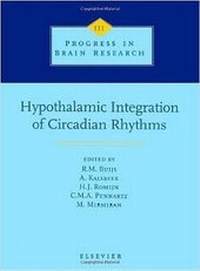
Hypothalamic Integration of Circadian Rhythms: Volume 111
Published on 3. December 1996
Book
Hardback
388 pages
978-0-444-82443-1 (ISBN)
Description
The International Summer School of Brain Research, on which this book is based, was organized by the Netherlands Institute for Brain research (NIBR), which has a rich history dating back to the beginning of the century.The focus of interest in this present volume of Progress in Brain Research are the few thousand neurons at the base of the hypothalamus that form the biological clock. Attention is focused on the mechanisms underlying the generation of circadian rhythmicity within our biological clock, which is still far from understood. Contributions originating from many disciplines give updates on the latest theories on the molecular and electrophysiological basis of the pacemaker mechanism, and the various approaches used in different species. Attention is also paid to the way the signal of the biological clock is transferred to the rest of the central nervous system. New data on the role of the suprachiasmatic nucleus and its impact on the functioning of the human being is presented. Altogether an excellent volume which will further the understanding of this elusive material.
More details
Series
Language
English
Place of publication
Oxford
United Kingdom
Publishing group
Elsevier Science & Technology
Target group
Professional and scholarly
Weight
1210 gr
ISBN-13
978-0-444-82443-1 (9780444824431)
Copyright in bibliographic data and cover images is held by Nielsen Book Services Limited or by the publishers or by their respective licensors: all rights reserved.
Schweitzer Classification
Other editions
Additional editions
R. M. Buijs | A. Kalsbeek | H. J. Romijn
Hypothalamic Integration of Circadian Rhythms
E-Book
12/1996
Elsevier
€215.00
Available for download
Persons
Content
List of Contributors. Preface. Acknowledgements. Section I. Molecular and Cellular Mechanisms of Circadian Pacemakers. The sixth C.U. Ariens Kappers lecture. 1. The biological clock: it's all in the genes (J.S. Takahashi). 2. The genetic and molecular dissection of a prototypic circadian system (J.C. Dunlap et al). 3. The Drosophila genes timeless and period collaborate to promote cycles of gene expression composing a circadian pacemaker (M.W. Young). 4. Excitatory and inhibitory amino acids and synaptic transmission in the suprachiasmatic nucleus (A.N. van den Pol, G.J. Strecker, F.E. Dudek). 5. Astrocytes in the mammalian circadian clock: putative roles (J. Serviere, M. Lavialle). 6. Circadian rhythms of neuropeptides in the suprachiasmatic nucleus (S.-I.T. Inouye). Section II. Entrainment of the Circadian Timing System. 7. Circadian rhythm generation, expression and entrainment in a molluscan model system (G.D. Block et al.). 8. Entrainment pathways and the functional organization of the circadian system (R.Y. Moore). 9. Regulation of entrainment pathways by the suprachiasmatic circadian clock: sensitivities to second messengers (M.U. Gillette). 10. Light entrainment and activation of signal transduction pathways in the SCN (J.M. Kornhauser et al.). 11. Entrainment of the circadian clock (M.H. Hastings et al.). 12. Light entrainment of the mammalian biological clock (J.H. Meijer et al.). 13. Regulation and integration in the mammalian circadian system (M.R. Ralph et al.). 14. The role of melatonin and light in the human circadian system (A.J. Lewy, R.L. Sack). 15. Perinatal development of human circadian rhythms (M. Mirmiran, S. Lunshof). Section III. Hypothalamic Integration of Circadian Rhythms. 16. The anatomical basis for the expression of circadian rhythms: the efferent projections of the suprachiasmatic nucleus (R.M. Buijs). 17. Electrophysiology of suprachiasmatic nucleus projections to hypothalamic paraventricular nucleus neurons (M.L.H.J. Hermes, R.M. Buijs, L.P. Renaud). 18. SCN output drives the autonomic nervous system: with special reference to the autonomic function related to the regulation of glucose metabolism (K. Nagai et al.). 19. Rhythms of inhibitory and excitatory output from the circadian timing system as revealed by in vivo microdialysis (A. Kalsbeek, R.M. Buijs). 20. Circadian control of reproduction in the female rat (E.M. van der Beek). 21. A "clock for all seasons" in the human brain (T.A. Wehr). 22. Sleep regulation: relation to photoperiod, sleep duration, waking activity, and torpor (A.A. Borbely and I. Tobler). 23. Biological rhythms in the human life cycle and their relationship to functional changes in the suprachiasmatic nucleus (D.F. Swaab et al.). 24. The suprachiasmatic nucleus: the biological clock of all seasons (P. Pevet et al). Subject Index.