

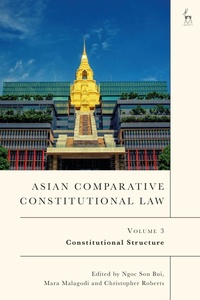
Asian Comparative Constitutional Law, Volume 3
Constitutional Structure
Will be published approx. on 4. December 2025
Book
Hardback
512 pages
978-1-5099-4977-9 (ISBN)
Description
This is the third in a four-volume set that provides the definitive account of the major issues of comparative constitutional law in Asia.
Volume 3 looks at the both the formal and functional aspects of constitutional structure in 18 Asian jurisdictions. It considers formal aspects such as:
- legislative-executive relations;
- the court system;
- constitutional review (including specialist, ordinary judicial review, and non-judicial institutions of constitutional review);
- central-local relations and federalism;
- the role of the political parties;
- the role of the military; and
- independent institutions, such as audit, election, and anti-corruption institutions.
It also answers questions about functional aspects of constitutional structure including:
- How do these structural institutions work in practice?
- What are the factors, such as political dynamics, local culture, ethnic diversity, and social structure, influence their operation?
The jurisdictions covered are: Bangladesh, China, Hong Kong, Indonesia, Japan, Laos, Macau, Malaysia, Mongolia, Myanmar, North Korea, Pakistan, the Philippines, Singapore, South Korea, Sri Lanka, Taiwan and Thailand.
Volume 3 looks at the both the formal and functional aspects of constitutional structure in 18 Asian jurisdictions. It considers formal aspects such as:
- legislative-executive relations;
- the court system;
- constitutional review (including specialist, ordinary judicial review, and non-judicial institutions of constitutional review);
- central-local relations and federalism;
- the role of the political parties;
- the role of the military; and
- independent institutions, such as audit, election, and anti-corruption institutions.
It also answers questions about functional aspects of constitutional structure including:
- How do these structural institutions work in practice?
- What are the factors, such as political dynamics, local culture, ethnic diversity, and social structure, influence their operation?
The jurisdictions covered are: Bangladesh, China, Hong Kong, Indonesia, Japan, Laos, Macau, Malaysia, Mongolia, Myanmar, North Korea, Pakistan, the Philippines, Singapore, South Korea, Sri Lanka, Taiwan and Thailand.
More details
Language
English
Place of publication
Oxford
United Kingdom
Publishing group
Bloomsbury Publishing PLC
Target group
Professional and scholarly
College/higher education
Product notice
sewn/stitched
Cloth over boards
With dust jacket
Dimensions
Height: 234 mm
Width: 156 mm
Thickness: 25 mm
Weight
454 gr
ISBN-13
978-1-5099-4977-9 (9781509949779)
Copyright in bibliographic data and cover images is held by Nielsen Book Services Limited or by the publishers or by their respective licensors: all rights reserved.
Schweitzer Classification
Persons
Ngoc Son Bui is Associate Professor of Asian Law at the Faculty of Law, University of Oxford, UK.
Mara Malagodi is Assistant Professor at the Faculty of Law and Christopher Roberts is Assistant Professor and Deputy Director of the LLB Programme, both at the Chinese University of Hong Kong.
Mara Malagodi is Assistant Professor at the Faculty of Law and Christopher Roberts is Assistant Professor and Deputy Director of the LLB Programme, both at the Chinese University of Hong Kong.
Content
Introduction, Ngoc Son Bui (University of Oxford, UK), Mara Malagodi (University of Warwick, UK), and Christopher Roberts (The Chinese University of Hong Kong)
Part I: East Asia
1. Changing Constitutional Structures in Japan, Akiko Ejima (Meiji University, Japan)
2. Constitutional Structure of South Korea: Law and Politics, Jeong-In Yun (Korea University)
3. Characteristics of the State Organ System under the North Korean Socialist Constitution, Jeong Won Park (Kookmin University, South Korea)
4. Constitutional Structure of Mongolia: Legal Regulation and Practice, Gunbileg Boldbaatar (Pennsylvania State University, USA)
5. The Constitutional Structure of the People's Republic of China, Ryan Martinez Mitchell (The Chinese University of Hong Kong)
6. A Patchwork Constitutional Structure in Taiwan, Chien-Chih Lin (Academia Sinica, Taiwan)
7. China's Hong Kong and Hong Kong, China: More than a City under 'One Country, Two Systems', Pui-Yin Lo (University of Hong Kong)
8. The Macau Special Administrative Region at Halftime: An Assessment of the First 25 Years of Reconstruction under the People's Republic of China, Jason Buhi (Barry University, USA)
Part II: Southeast Asia
9. Malaysia: Government Structure and Unification in a Divided Polity, Andrew Harding (University of Reading, Malaysia)
10. 'The Main Thing About the Constitution is that it Must Work': Securing Good Governance and Managing the Pace of Political Change Through Institutional (Re-)Design, Eugene K B Tan (Singapore Management University)
11. Constitutional Structure in Myanmar: Unresolved Legacies for a Constitutional Future, Jonathan Liljeblad (Australian National University)
12. Philippine Constitutional Structure: Text and Practice, Bryan Dennis G Tiojanco (University of Tokyo, Japan)
13. Between Two Worlds: Indonesia and the Spectre of the Dharmic-Infused Constitutional Structure, Abdurrachman Satrio (Trisakti University, Indonesia)
14. The Separation of Powers under a Royalist Regime: Lessons from Thailand's Binary-Star Scenario, Rawin Leelapatana (Chulalongkorn University, Thailand)
15. Constitutional Structure of The Lao People's Democratic Republic, Kazuo (Kaz) Fukuda (Kansai Gaidai University, Japan)
Part III: South Asia
16. From Colonial Legacy to Modern Praetorianism - Pakistan's Constitutional Structure, Sadaf Aziz and Marva Khan Cheema (University of Lahore, Pakistan)
17. The Failure of Bangladesh's Constitutional Design, Jashim Ali Chowdhury (University of Hull, UK)
18. Striking a Constitutional Balance in Sri Lanka, Mario Gomez (International Centre for Ethnic Studies, Sri Lanka)
Part IV: Conclusion
19. Constitutional Structures in Asia: A Comparative Framework, Ngoc Son Bui (University of Oxford, UK), Mara Malagodi (University of Warwick, UK), and Christopher Roberts (The Chinese University of Hong Kong)
Part I: East Asia
1. Changing Constitutional Structures in Japan, Akiko Ejima (Meiji University, Japan)
2. Constitutional Structure of South Korea: Law and Politics, Jeong-In Yun (Korea University)
3. Characteristics of the State Organ System under the North Korean Socialist Constitution, Jeong Won Park (Kookmin University, South Korea)
4. Constitutional Structure of Mongolia: Legal Regulation and Practice, Gunbileg Boldbaatar (Pennsylvania State University, USA)
5. The Constitutional Structure of the People's Republic of China, Ryan Martinez Mitchell (The Chinese University of Hong Kong)
6. A Patchwork Constitutional Structure in Taiwan, Chien-Chih Lin (Academia Sinica, Taiwan)
7. China's Hong Kong and Hong Kong, China: More than a City under 'One Country, Two Systems', Pui-Yin Lo (University of Hong Kong)
8. The Macau Special Administrative Region at Halftime: An Assessment of the First 25 Years of Reconstruction under the People's Republic of China, Jason Buhi (Barry University, USA)
Part II: Southeast Asia
9. Malaysia: Government Structure and Unification in a Divided Polity, Andrew Harding (University of Reading, Malaysia)
10. 'The Main Thing About the Constitution is that it Must Work': Securing Good Governance and Managing the Pace of Political Change Through Institutional (Re-)Design, Eugene K B Tan (Singapore Management University)
11. Constitutional Structure in Myanmar: Unresolved Legacies for a Constitutional Future, Jonathan Liljeblad (Australian National University)
12. Philippine Constitutional Structure: Text and Practice, Bryan Dennis G Tiojanco (University of Tokyo, Japan)
13. Between Two Worlds: Indonesia and the Spectre of the Dharmic-Infused Constitutional Structure, Abdurrachman Satrio (Trisakti University, Indonesia)
14. The Separation of Powers under a Royalist Regime: Lessons from Thailand's Binary-Star Scenario, Rawin Leelapatana (Chulalongkorn University, Thailand)
15. Constitutional Structure of The Lao People's Democratic Republic, Kazuo (Kaz) Fukuda (Kansai Gaidai University, Japan)
Part III: South Asia
16. From Colonial Legacy to Modern Praetorianism - Pakistan's Constitutional Structure, Sadaf Aziz and Marva Khan Cheema (University of Lahore, Pakistan)
17. The Failure of Bangladesh's Constitutional Design, Jashim Ali Chowdhury (University of Hull, UK)
18. Striking a Constitutional Balance in Sri Lanka, Mario Gomez (International Centre for Ethnic Studies, Sri Lanka)
Part IV: Conclusion
19. Constitutional Structures in Asia: A Comparative Framework, Ngoc Son Bui (University of Oxford, UK), Mara Malagodi (University of Warwick, UK), and Christopher Roberts (The Chinese University of Hong Kong)