

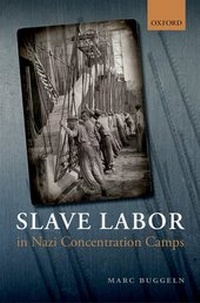
Slave Labor in Nazi Concentration Camps
Published on 18. December 2014
Book
Hardback
352 pages
978-0-19-870797-4 (ISBN)
Description
Slave Labor in Nazi Concentration Camps examines the slave labor carried out by concentration camp prisoners from 1942 and the effect this had on the German wartime economy. This work goes far beyond the sociohistorical 'reconstructions' that dominate Holocaust studies - it combines cultural history with structural history, drawing relationships between social structures and individual actions. It also considers the statements of both perpetrators and victims, and takes the biographical approach as the only possible way to confront the destruction of the individual in the camps after the fact.
The first chapter presents a comparative analysis of slave labor across the different concentration camps, including Auschwitz, Buchenwald, and Dachau. The subsequent chapters analyse the similarities and differences between various subcamps where prisoners were utilised for the wartime economy, based on the example of the 86 subcamps of Neuengamme concentration camp, which were scattered across northern Germany. The most significant difference between conditions at the various subcamps was that in some, hardly any prisoners died, while in others, almost half of them did. This work carries out a systematic comparison of the subcamp system, a kind of study which does not exist for any other camp system. This is of great significance, because by the end of the war most concentration camps had placed over 80 percent of their prisoners in subcamps. This work therefore offers a comparative framework that is highly useful for further examinations of National Socialist concentration camps, and may also be of benefit to comparative studies of other camp systems, such as Stalin's gulags.
The first chapter presents a comparative analysis of slave labor across the different concentration camps, including Auschwitz, Buchenwald, and Dachau. The subsequent chapters analyse the similarities and differences between various subcamps where prisoners were utilised for the wartime economy, based on the example of the 86 subcamps of Neuengamme concentration camp, which were scattered across northern Germany. The most significant difference between conditions at the various subcamps was that in some, hardly any prisoners died, while in others, almost half of them did. This work carries out a systematic comparison of the subcamp system, a kind of study which does not exist for any other camp system. This is of great significance, because by the end of the war most concentration camps had placed over 80 percent of their prisoners in subcamps. This work therefore offers a comparative framework that is highly useful for further examinations of National Socialist concentration camps, and may also be of benefit to comparative studies of other camp systems, such as Stalin's gulags.
Reviews / Votes
Praise for the German edition The book is an object-lesson in the historical gold standard of deep and meticulous empirical research and openness to multifactorial analysis. No other such system of concentration camps has been subjected to anything like this degree of intensive comparative study, and this is the great originality of this work. * Jane Caplan, University of Oxford * This is a hugely stimulating and rich study, full of new insights and arguments. It is a must for everyone interested in Nazi terror. * Nikolaus Wachsmann, University of London * Buggeln's work convinces through multi-perspectivity. * Thomas Kuehne, Strassler Family Professor in the Study of Holocaust History at Clark University * This study is not only at the height of current research, but it will shape future research strongly. * Michael Wildt, Humboldt University Berlin * A ground-breaking study on one of the key components in the Nazi terror system. * Juergen Matthaeus, co-author of Jewish Responses to Persecution, 1933-1938 * Buggeln comes to his topic steadily from different perspectives. He develops out of many single pieces a mosaic, which develops a picture of the whole subcamp system. Methodically and textually this approach is successful and for the further research of the Nazi Concentration Camps, ground-breaking. * Jan Erik Schulte, Hannah Arendt Institute for the Study of Totalitarianism, Dresden * Buggeln delievers a multi-perspective study with many important impulses for the research on the concentration camps: especially convincing is his praxeological approach. * Elissa Mailaender, University of Paris * This work, with its sophisticated and profound theoretical procedures, sets standards. * Karin Orth, University of Freiburg * Buggeln's work is an extraordinary and important study which describes the development of the living conditions in the subcamps of the concentration camps in a competent and profound way. * Hermann Kaienburg, KZ-Gedenkstaette Sachsenhausen * [a] meticulous study ... [Buggeln] has cogently extracted revealing patterns about the relationship of violence, gender, race, and ideology to survival and conditions within the camps, findings that are applicable to other camps and their satellites. * Dr Christine Schmidt van der Zanden, Holocaust Studies * Slave Labor in Nazi Concentration Camps is an important, encyclopedically informed study about the Third Reich's camps, slave labour in twentieth-century Europe, racism, modernity, efficiency and profit. In this sense, the book offers a timely read in the age of austerity and globalization. * Anna Hajkova, History * [The book is] highly welcome and promises to make important scholarship available to a wider audience ... Buggeln's analysis yields important correctives to received wisdom on mortality patterns in the camps. * Christopher Dillon, Sehepunkte * The author gives many new insights and figures about the functioning of the Nazi concentration camps and especially the subcamps in the German war economy ... essential reading ... a fine study. * Martijn Lak, European History Quarterly * The fact that the reader is left craving more detail is a sign of the excellence of the research and analysis behind this book ... In Buggeln's first-rate study -- not of a single camp but of a system -- scholars of the Holocaust will find a useful methodological guide to similar works on systems elsewhere * Waitman Wade Beorn, Holocaust and Genocide Studies * Buggeln's prizewinning book is an extensively researched, well-argued, and original monograph that will influence future research ... The book offers a comparative framework that will be useful for further studies of National Socialist concentration camps and for other camp systems such as the Gulag ... The high quality of the translation by Paul Cohen should be noted: it is fluent, reliable, and readable * Alan Kramer, Journal of Modern History *More details
Language
English
Place of publication
Oxford
United Kingdom
Target group
College/higher education
Professional and scholarly
Dimensions
Height: 237 mm
Width: 162 mm
Thickness: 26 mm
Weight
674 gr
ISBN-13
978-0-19-870797-4 (9780198707974)
Copyright in bibliographic data and cover images is held by Nielsen Book Services Limited or by the publishers or by their respective licensors: all rights reserved.
Schweitzer Classification
Other editions
Additional editions
Marc Buggeln
Slave Labor in Nazi Concentration Camps
E-Book
12/2014
1st Edition
OUP eBook
€61.99
Available for download
Persons
Marc Buggeln is research assistant at the Humboldt-University in Berlin. He received his Ph.D. at the University of Bremen in 2008 with a study on the subcamp system of the CC Neuengamme. Currently he is working on a history of public finance in West Germany.
Content
Introduction ; 1. Slave Labor in the Nazi Concentration Camps, 1941-45 ; 2. Industry and Slave Labor - The SS as Junior Partner ; 3. Structures of the Subcamp System ; 4. Comparing Subcamps: Labor, Race, and Gender ; 5. The Prisoners and Their Community ; 6. The Perpetrators and Their Crimes: Violence and Courses of Action in the Subcamps ; 7. The Subcamps and the Local Population ; 8. The Death Marches and the Northern Cities and Enterprises