

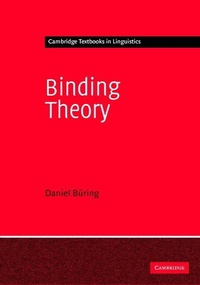
Binding Theory
Published on 27. January 2005
Book
Hardback
294 pages
978-0-521-81280-1 (ISBN)
Description
Binding theory seeks to explain how different kinds of nominal expressions such as names, noun phrases and pronouns have anaphoric relations amongst one another, and how they come to have reference to things in the world. This textbook provides a thorough and comprehensive introduction to modern binding theory. Starting at a very basic level, it introduces the reader to a huge variety of nominal and especially pronominal expressions from the world's languages, the ways they can be used, and current theorising about their grammatical properties and their interpretation. Daniel Buering discusses a wide range of cross-linguistic data and theoretical approaches, and unlike in existing introductions, pairs the discussion of syntactic facts with a detailed introduction to the semantic interpretation of binding structures. Written in a clear and accessible style, and with numerous exercises and examples, this textbook will be invaluable to graduate and advanced undergraduate students of syntax and semantics.
More details
Series
Language
English
Place of publication
Cambridge
United Kingdom
Target group
Professional and scholarly
College/higher education
Dimensions
Height: 250 mm
Width: 175 mm
Thickness: 20 mm
Weight
690 gr
ISBN-13
978-0-521-81280-1 (9780521812801)
Copyright in bibliographic data and cover images is held by Nielsen Book Services Limited or by the publishers or by their respective licensors: all rights reserved.
Schweitzer Classification
Other editions
Additional editions
Daniel Buering
Binding Theory
E-Book
01/2005
1st Edition
Cambridge University Press
€41.49
Available for download
Daniel Buering
Binding Theory
Book
01/2005
Cambridge University Press
€77.00
Shipment within 15-20 days
Person
Daniel Buering is Associate Professor of Linguistics at the University of California, Los Angeles.
Content
1. The ABC of binding theory; 2. Interpreting indexed structures; 3. Domains and orientation; 4. Binding versus co-reference; 5. Other cases of semantic binding; 6. The co-reference rule; 7. Descriptive pronouns and individual concepts; 8. Semantic binding and c-command; 9. Plurals; 10. Reciprocals; 11. Exempt anaphora and reflexivity; 12. Binding and movement.