

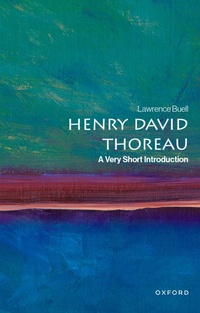
Henry David Thoreau
A Very Short Introduction
Published on 24. July 2025
Book
Paperback/Softback
168 pages
978-0-19-754818-9 (ISBN)
Description
"When I wrote the following pages, or rather the bulk of them, I lived alone, in the woods, a mile from any neighbor, in a house which I had built myself, on the shore of Walden Pond..."
Henry David Thoreau (1817-1862) was a leading figure in the American Transcendentalist movement and the era of U. S. literary emergence, an intellectual with worldwide influence as essayist, social thinker, naturalist-environmentalist, and sage. Thoreau's Walden, an autobiographical narrative of his two-year sojourn in a self-built lakeside cabin, is one of the most widely studied works of American literature. It has generated scores of literary imitations and thousands of neo-Walden experiments in back-to-basics living, both rural and urban. Thoreau's great essay, "Civil Disobedience," is a classic of American political activism and a model for nonviolent reform movements around the world. Thoreau also stands as an icon of modern American environmentalism, the father of American nature writing, a forerunner of modern ecology, and a harbinger of freelance spirituality combining the wisdom of west and east.
Thoreau is also a controversial figure. From his day to ours, he has provoked sharply opposite reactions ranging from reverence to dismissal. Scholars have regularly offered conflicting assessments of the significance of his work, the evolution of his thought, even the facts of his life. Some disagreements are in the eye of the beholder, but many follow from challenges posed by his own cross-grained idiosyncrasies. He was an advocate for individual self-sufficiency who never broke away from home, a self-professed mystic now also acclaimed as a pioneer natural and applied scientist, and a seminal theorist of nonviolent protest who defended the most notorious guerrilla fighter of his day. All told, he remains a rather enigmatic figure both despite and because we know so much about him, beginning with the two-million-word journal he kept throughout his adult life. The esteemed Thoreau scholar Lawrence Buell gives due consideration to all these aspects of Thoreau's art and thought, framing key issues and complexities in historical and literary context.
Henry David Thoreau (1817-1862) was a leading figure in the American Transcendentalist movement and the era of U. S. literary emergence, an intellectual with worldwide influence as essayist, social thinker, naturalist-environmentalist, and sage. Thoreau's Walden, an autobiographical narrative of his two-year sojourn in a self-built lakeside cabin, is one of the most widely studied works of American literature. It has generated scores of literary imitations and thousands of neo-Walden experiments in back-to-basics living, both rural and urban. Thoreau's great essay, "Civil Disobedience," is a classic of American political activism and a model for nonviolent reform movements around the world. Thoreau also stands as an icon of modern American environmentalism, the father of American nature writing, a forerunner of modern ecology, and a harbinger of freelance spirituality combining the wisdom of west and east.
Thoreau is also a controversial figure. From his day to ours, he has provoked sharply opposite reactions ranging from reverence to dismissal. Scholars have regularly offered conflicting assessments of the significance of his work, the evolution of his thought, even the facts of his life. Some disagreements are in the eye of the beholder, but many follow from challenges posed by his own cross-grained idiosyncrasies. He was an advocate for individual self-sufficiency who never broke away from home, a self-professed mystic now also acclaimed as a pioneer natural and applied scientist, and a seminal theorist of nonviolent protest who defended the most notorious guerrilla fighter of his day. All told, he remains a rather enigmatic figure both despite and because we know so much about him, beginning with the two-million-word journal he kept throughout his adult life. The esteemed Thoreau scholar Lawrence Buell gives due consideration to all these aspects of Thoreau's art and thought, framing key issues and complexities in historical and literary context.
More details
Series
Language
English
Place of publication
New York
United States
Dimensions
Height: 182 mm
Width: 113 mm
Thickness: 34 mm
Weight
134 gr
ISBN-13
978-0-19-754818-9 (9780197548189)
Copyright in bibliographic data and cover images is held by Nielsen Book Services Limited or by the publishers or by their respective licensors: all rights reserved.
Schweitzer Classification
Other editions
Additional editions
E-Book
04/2025
OUP USA
€9.49
Available for download
E-Book
04/2025
OUP USA
€9.49
Available for download
Previous edition
Book
01/2024
Oxford University Press Inc
€19.17
Shipment within 15-20 days
Person
Lawrence Buell is Powell M. Cabot Professor of American Literature Emeritus at Harvard University. Considered one of the founders of the ecocriticism movement, he has written and lectured worldwide on Transcendentalism, American studies, and the environmental humanities. He is the author of many books, including The Environmental Imagination: Thoreau, Nature Writing, and the Invention of American Culture, Writing for Literary Transcendentalism, Tan Endangered World, and Emerson.
Content
1. Life and mythmaking
2. Essential Thoreau
3. Contexts: antebellum America, transcendentalism, Emerson
4. The writer
5. The turn to science
6. The political Thoreau
7. Matters of faith
Acknowledgments
References
Further Reading
2. Essential Thoreau
3. Contexts: antebellum America, transcendentalism, Emerson
4. The writer
5. The turn to science
6. The political Thoreau
7. Matters of faith
Acknowledgments
References
Further Reading