

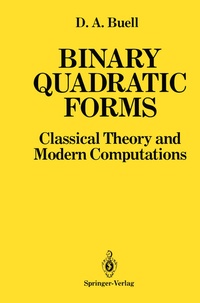
Binary Quadratic Forms
Classical Theory and Modern Computations
Published on 25. August 1989
Book
Hardback
X, 248 pages
978-0-387-97037-0 (ISBN)
Description
The first coherent exposition of the theory of binary quadratic forms was given by Gauss in the Disqnisitiones Arithmeticae. During the nine teenth century, as the theory of ideals and the rudiments of algebraic number theory were developed, it became clear that this theory of bi nary quadratic forms, so elementary and computationally explicit, was indeed just a special case of a much more elega,nt and abstract theory which, unfortunately, is not computationally explicit. In recent years the original theory has been laid aside. Gauss's proofs, which involved brute force computations that can be done in what is essentially a two dimensional vector space, have been dropped in favor of n-dimensional arguments which prove the general theorems of algebraic number the ory. In consequence, this elegant, yet pleasantly simple, theory has been neglected even as some of its results have become extremely useful in certain computations. I find this neglect unfortunate, because binary quadraticforms have two distinct attractions. First, the subject involves explicit computa tion and many of the computer programs can be quite simple. The use of computers in experimenting with examples is both meaningful and enjoyable; one can actually discover interesting results by com puting examples, noticing patterns in the "data," and then proving that the patterns result from the conclusion of some provable theorem.
More details
Edition
1989 ed.
Language
English
Place of publication
New York
United States
Target group
Professional and scholarly
Research
Illustrations
X, 248 p.
Dimensions
Height: 241 mm
Width: 160 mm
Thickness: 19 mm
Weight
565 gr
ISBN-13
978-0-387-97037-0 (9780387970370)
DOI
10.1007/978-1-4612-4542-1
Schweitzer Classification
Other editions
Additional editions
Book
09/2011
Springer
€160.49
Shipment within 15-20 days
Content
1 Elementary Concepts.- 2 Reduction of Positive Definite Forms.- 3 Indefinite Forms.- 3.1 Reduction, Cycles.- 3.2 Automorphs, Pell's Equation.- 3.3 Continued Fractions and Indefinite Forms.- 4 The Class Group.- 4.1 Representation and Genera.- 4.2 Composition Algorithms.- 4.3 Generic Characters Revisited.- 4.4 Representation of Integers.- 5 Miscellaneous Facts.- 5.1 Class Number Computations.- 5.2 Extreme Cases and Asymptotic Results.- 6 Quadratic Number Fields.- 6.1 Basic Algebraic Definitions.- 6.2 Algebraic Numbers and Quadratic Fields.- 6.3 Ideals in Quadratic Fields.- 6.4 Binary Quadratic Forms and Classes of Ideals.- 6.5 History.- 7 Composition of Forms.- 7.1 Nonfundamental Discriminants.- 7.2 The General Problem of Composition.- 7.3 Composition in Different Orders.- 8 Miscellaneous Facts II.- 8.1 The Cohen-Lenstra Heuristics.- 8.2 Decomposing Class Groups.- 8.3 Specifying Subgroups of Class Groups.- 9 The 2-Sylow Subgroup.- 9.1 Classical Results on the Pell Equation.- 9.2 ModernResults.- 9.3 Reciprocity Laws.- 9.4 Special References for Chapter 9.- 10 Factoring with Binary Quadratic Forms.- 10.1 Classical Methods.- 10.2 SQUFOF.- 10.3 CLASNO.- 10.4 SPAR.- 10.5 CFRAC.- 10.6 A General Analysis.- Appendix 1:Tables, Negative Discriminants.- Appendix 2:Tables, Positive Discriminants.