

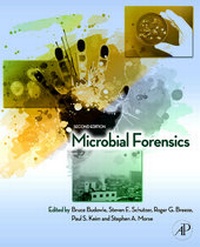
Microbial Forensics
2nd Edition
Published on 27. October 2010
Book
Hardback
744 pages
978-0-12-382006-8 (ISBN)
Description
Microbial Forensics is a rapidly evolving scientific discipline. In the last decade, and particularly due to the anthrax letter attacks in the United States, microbial forensics has become more formalized and has played an increasingly greater role in crime investigations. This has brought renewed interest, development and application of new technologies, and new rules of forensic and policy engagement. It has many applications ranging from biodefense, criminal investigations, providing intelligence information, making society more secure, and helping protect precious resources, particularly human life. A combination of diverse areas is investigated, including the major disciplines of biology, microbiology, medicine, chemistry, physics, statistics, population genetics, and computer science.
Microbial Forensics, Second Edition is fully revised and updated and serves as a complete reference of the discipline. It describes the advances, as well as the challenges and opportunities ahead, and will be integral in applying science to help solve future biocrimes.
Microbial Forensics, Second Edition is fully revised and updated and serves as a complete reference of the discipline. It describes the advances, as well as the challenges and opportunities ahead, and will be integral in applying science to help solve future biocrimes.
Reviews / Votes
"The second edition of Microbial Forensics provides a comprehensive overview of this emerging field, highlighting how epidemiological investigations must be conducted to provide evidence that can be used in legal proceedings where attribution is key. The book provides valuable insights into investigations of prior attempts to spread disease intentionally and needed guidance for investigating future incidents. This book will be of great value to microbiologists and epidemiologists as well as to law enforcement officials for bringing emerging molecular methodologies into investigations of disease outbreaks, especially those that are intentional criminal and terrorist acts." --Dr. Ronald M. Atlas, University of Louisville, KY, USAMore details
Edition
2nd edition
Language
English
Place of publication
San Diego
United States
Publishing group
Elsevier Science Publishing Co Inc
Target group
Professional and scholarly
Primary: Forensic scientists, researchers and practitioners in microbial forensics laboratories
Secondary: Microbiology researchers; attorneys, law enforcement and intelligence communities; post-graduate students of forensic science and the international community involved with Biological Weapons Treaties
Dimensions
Height: 235 mm
Width: 191 mm
Weight
1410 gr
ISBN-13
978-0-12-382006-8 (9780123820068)
Copyright in bibliographic data and cover images is held by Nielsen Book Services Limited or by the publishers or by their respective licensors: all rights reserved.
Schweitzer Classification
Other editions
New editions
Bruce Budowle | Steven E. Schutzer | Stephen A. Morse
Microbial Forensics
Book
12/2019
3rd Edition
Academic Press
€166.50
Shipment within 15-20 days
Additional editions
Bruce Budowle | Steven E. Schutzer | Roger G. Breeze
Microbial Forensics
E-Book
10/2010
2nd Edition
Academic Press
€78.95
Available for download
Previous edition
Bruce Budowle | Steven E. Schutzer | Roger G. Breeze
Microbial Forensics
Book
05/2005
Academic Press
€154.75
Article exhausted; check for reprint
Persons
Dr. Budowle has a lengthy CV and career. Some of his efforts over the last 15 years also are in counter terrorism, including identification of victims from mass disasters and in efforts involving microbial forensics and bioterrorism. Dr. Budowle was an advisor to New York State in the effort to identify the victims from the WTC attack. In the area of microbial forensics, Dr. Budowle has been the chair of the Scientific Working Group on Microbial Genetics and Forensics, whose mission was to set QA guidelines, develop criteria for biologic and user databases, set criteria for a National Repository, and develop forensic genomic applications. He also has served on the Steering Committee for the Colloquium on Microbial Forensics sponsored by American Society of Microbiology, an organizer of four Microbial Forensics Meetings held at The Banbury Center in the Cold Spring Harbor Laboratory, and on steering committees for NAS sponsored meetings. Dr. Budowle has published approximately 600 articles, made more than 720 presentations (many of which were as an invited speaker at national and international meetings), and testified in well over 250 criminal cases in the areas of molecular biology, population genetics, statistics, quality assurance, and forensic biology. In addition, he has authored or co-authored books on molecular biology techniques, electrophoresis, protein detection, and microbial forensics. Steven Schutzer, MD is a physician-scientist who trained and was on the faculty at Cornell University Medical College, New York Hospital, and Rockefeller University, before joining New Jersey Medical School. His research has focused on the interface of the immune system and microbes. Particular areas of research interest are Lyme and Tick diseases, neuroimmunology, and immunology. Dr. Schutzer is board certified in Internal Medicine, Allergy and Clinical Immunology, and Clinical Laboratory Immunology. Dr. Schutzer's research is funded by the National Institutes of Health and other organizations. Dr. Morse attended graduate school at the School of Public Health, University of North Carolina at Chapel Hill where he received his M.S.P.H. ('66) in environmental chemistry and biology and a Ph.D. ('69) in microbiology. In 1984, he joined the Centers for Disease Control and Prevention (CDC) as Director of the Sexually Transmitted Diseases (STDs) Research Program, National Center for Infectious Diseases (NCID); and in 1996, became the Associate Director for Science of the newly created Division of AIDS, STDs and Tuberculosis Laboratory Research. From 1999 - 2007, he served as the Associate Director for Science, Division of Bioterrorism Preparedness and Response where he worked on national and international bioterrorism-related issues. In 2008, he became the Associate Director for Environmental Microbiology, CDC. He has published 325 peer reviewed articles, books and chapters.
Editor
Center for Human Identification, Department of Microbiology, Immunology, and Genetics, University of North Texas Health Science Center, Ft Worth, TX, USA
Department of Medicine, Rutgers New Jersey Medical School, Newark, New Jersey, USA
Centaur Science Group, Washington, DC
Center for Microbial Genetics and Genomics, Northern Arizona University, Flagstaff, AZ
National Center for Emerging and Zoonotic Infectious Diseases, Centers for Disease Control and Prevention, Atlanta, GA, USA
Content
Introduction - The Rapidly Evolving Discipline of Microbial Forensics;
PART 1 INVESTIGATIVE GENETICS - A. Criminal;
The Kameido anthrax incident: A microbial forensics case study; Microbial Forensic Investigation of the Anthrax-Letter Attacks;
B. Civilian;
Foodborne Outbreaks: What's New, What's Not, and Where Do We Go from Here?; Genotype and Geography; the global distribution of bovine tuberculosis; Tracing meat products through production and distribution chain from farm to consumer; Microbial Forensics of RNA Viruses: Foot-and-Mouth Disease Virus; Forensic Plant Pathology;
PART 2 EMERGING INFECTIONS
Influenza Forensics; Keeping Track of Viruses; Microbial Forensic Analysis of Trace and Unculturable Specimens; Molecular Microbial Surveillance and Discovery in Bioforensics;
PART 3 BIOSECURITY
Assessment of the Threat; The Select Agent Regulations; Biosurety in the Post-9/11 Era; Forensic public health: epidemiologic & microbiologic investigations for biosecurity
PART 4 SUBJECT AREAS
Forensic Analysis in Bacterial Pathogens; Rickettsia and Coxiella; Forensics and Epidemiology of Fungal Pathogens; Ricin Forensics: Comparisons to Microbial Forensics; Forensic Aspects of Biologic Toxins;
PART 5 METHODS
The Use of Host Factors in Microbial Forensics; Collection and Preservation of Microbial Forensic Samples; Sampling for Microbial Forensic Investigations; Toxin Analysis Using Mass Spectrometry; Electron Beam-Based Methods for Bioforensic Investigations; Proteomics Development and Application for Bioforensics; High-throughput Sequencing; Genomics; The Design of Genomic Signatures for Pathogen Identification and Characterization; Non-Biological Measurements on Biological Agents; Inferential Validation and Evidence Interpretation; Microbial Forensic Investigations in the Context of Bacterial Population Genetics; Population Genetic Considerations in Statistical Interpretation of Microbial Forensic Data; Biorepositories and their Foundations - Microbial Forensic Considerations;
PART 6 NATIONAL LEVEL CAPABILITIES
A U.S. Research Strategy for Microbial Forensics: From Genesis to Implementation; The National Bioforensic Analysis Center; Microbial Forensics in Australia - The Australian Federal Police Perspective; Validation of Microbial Forensics in the Scientific, Legal and Policy Contexts;
PART 7 MICROBIAL FORENSICS CURRICULA AND TRAINING
Microbial Forensics: Educating the Workforce and the Community; So You Really Want to be an Expert Witness? A Primer for the Occasional Expert Witness; Conclusion - Microbial Forensics, What Next?
PART 1 INVESTIGATIVE GENETICS - A. Criminal;
The Kameido anthrax incident: A microbial forensics case study; Microbial Forensic Investigation of the Anthrax-Letter Attacks;
B. Civilian;
Foodborne Outbreaks: What's New, What's Not, and Where Do We Go from Here?; Genotype and Geography; the global distribution of bovine tuberculosis; Tracing meat products through production and distribution chain from farm to consumer; Microbial Forensics of RNA Viruses: Foot-and-Mouth Disease Virus; Forensic Plant Pathology;
PART 2 EMERGING INFECTIONS
Influenza Forensics; Keeping Track of Viruses; Microbial Forensic Analysis of Trace and Unculturable Specimens; Molecular Microbial Surveillance and Discovery in Bioforensics;
PART 3 BIOSECURITY
Assessment of the Threat; The Select Agent Regulations; Biosurety in the Post-9/11 Era; Forensic public health: epidemiologic & microbiologic investigations for biosecurity
PART 4 SUBJECT AREAS
Forensic Analysis in Bacterial Pathogens; Rickettsia and Coxiella; Forensics and Epidemiology of Fungal Pathogens; Ricin Forensics: Comparisons to Microbial Forensics; Forensic Aspects of Biologic Toxins;
PART 5 METHODS
The Use of Host Factors in Microbial Forensics; Collection and Preservation of Microbial Forensic Samples; Sampling for Microbial Forensic Investigations; Toxin Analysis Using Mass Spectrometry; Electron Beam-Based Methods for Bioforensic Investigations; Proteomics Development and Application for Bioforensics; High-throughput Sequencing; Genomics; The Design of Genomic Signatures for Pathogen Identification and Characterization; Non-Biological Measurements on Biological Agents; Inferential Validation and Evidence Interpretation; Microbial Forensic Investigations in the Context of Bacterial Population Genetics; Population Genetic Considerations in Statistical Interpretation of Microbial Forensic Data; Biorepositories and their Foundations - Microbial Forensic Considerations;
PART 6 NATIONAL LEVEL CAPABILITIES
A U.S. Research Strategy for Microbial Forensics: From Genesis to Implementation; The National Bioforensic Analysis Center; Microbial Forensics in Australia - The Australian Federal Police Perspective; Validation of Microbial Forensics in the Scientific, Legal and Policy Contexts;
PART 7 MICROBIAL FORENSICS CURRICULA AND TRAINING
Microbial Forensics: Educating the Workforce and the Community; So You Really Want to be an Expert Witness? A Primer for the Occasional Expert Witness; Conclusion - Microbial Forensics, What Next?