


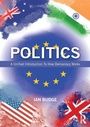
Politics
A Unified Introduction to How Democracy Works
1st Edition
Published on 4. June 2019
Book
Hardback
476 pages
978-0-367-02508-3 (ISBN)
Description
This comprehensive introduction to politics provides an essential template for assessing the health and workings of present day democracy by exploring how democratic processes bring public policy into line with popular preferences. Incorporating the latest findings from Big Data across the world, it provides a crucial framework showing students how to deploy these for themselves, providing straightforward, practical orientation to the scope and methods of modern political science.
Key features:
Everyday politics is explained through concrete applications to democracies across the world;
Predictive theories illuminate what goes on at various levels of democracy;
Outlines - in easy to understand terms - the basic statistical approaches that enable empirically-informed analysis;
Rich textual features include chapter summaries, reviews, key points, illustrative briefings, key concepts, project and essay suggestions, relevant reading all clearly explained in 'How to Use This Book';
Provides a firm basis for institutional and normative approaches to democratic politics;
Concluding section reviews other approaches to explaining politics, assessing their strengths and weaknesses.
Politics is an essential resource for students of political science and of key interest to economics, public policy analysis and more broadly the social sciences.
Key features:
Everyday politics is explained through concrete applications to democracies across the world;
Predictive theories illuminate what goes on at various levels of democracy;
Outlines - in easy to understand terms - the basic statistical approaches that enable empirically-informed analysis;
Rich textual features include chapter summaries, reviews, key points, illustrative briefings, key concepts, project and essay suggestions, relevant reading all clearly explained in 'How to Use This Book';
Provides a firm basis for institutional and normative approaches to democratic politics;
Concluding section reviews other approaches to explaining politics, assessing their strengths and weaknesses.
Politics is an essential resource for students of political science and of key interest to economics, public policy analysis and more broadly the social sciences.
Reviews / Votes
"This is a superb text, one that builds on what political scientists have learned and yet integrates and illuminates it. Politics: A Unified Introduction to How Democracy Works makes sense of the political world and how it really works in modern democratic politics, and I heartily recommend it." - Christopher Wlezien, University of Texas at Austin, USA."This book is lively, engaging and accessible to anyone who has even a passing interest in politics, policy and government. The chapters cover a wide range of important issues, concepts and foundational ideas in politics." - Zareh Ghazarian, Monash University, Australia.
"This book is a marvellous and useful introduction to modern political science. Professor Ian Budge has produced a fresh approach to study and analyse 'Democratic Politics'. By means of 'predictive theory' the student can understand and explain the political process in full. I am convinced that this introduction fills a void and is an asset for any student of political science, be it a freshman or advanced in this field." - Hans Keman, VU University Amsterdam, The Netherlands.
"For any student interested in a systematic and rigorous introduction to a science of politics, this book is a must-read" - Edoardo Bressanelli, King's College London, UK.
"Terrific systematic presentation which specifies the conditions under which contemporary democracies operate clearly and concisely both for students and the general public." - Jean Blondel, Founding Professor, Department of Government, University of Essex, UK, and Founding Director of the European Consortium for Political Research (ECPR).
More details
Language
English
Place of publication
London
United Kingdom
Publishing group
Taylor & Francis Ltd
Target group
College/higher education
Illustrations
40 s/w Abbildungen, 40 s/w Zeichnungen, 31 s/w Tabellen
31 Tables, black and white; 40 Line drawings, black and white; 40 Illustrations, black and white
Dimensions
Height: 260 mm
Width: 183 mm
Thickness: 30 mm
Weight
1086 gr
ISBN-13
978-0-367-02508-3 (9780367025083)
Copyright in bibliographic data and cover images is held by Nielsen Book Services Limited or by the publishers or by their respective licensors: all rights reserved.
Schweitzer Classification
Other editions
New editions

Book
approx. 06/2026
2nd Edition
Routledge
€191.50
Not yet published
Additional editions
Book
05/2019
1st Edition
Routledge
€62.90
Shipment within 15-20 days

E-Book
05/2019
1st Edition
Routledge
€53.99
Available for download

E-Book
05/2019
1st Edition
Routledge
€53.99
Available for download
Person
Ian Budge is Emeritus Professor in the Department of Government, University of Essex UK, and well known internationally as author of numerous research articles and textbooks on democratic politics.
Content
Preface: Explaining Politics Systematically. Introduction: Politics and Policy What Do We Want to Explain and How? Part I: Processes. Elections alternate party-based governments with different preferences and priorities thus bringing public policy into line with centrist popular preferences in the long run: Overview 1. Why Politics? Making Policies to Provide Public Goods 2. How Popular Preferences Develop 3. Measuring Electoral Preferences 4. Electors' Policy Thinking: From a Joined Up Left-Right Perspective to Issue-by-Issue Reactions 5. Party Policy Thinking: Framing Policy Targets and Election-Based Estimates of Majority Preferences 6. Matching Public Policy to Popular Preferences 7. The 'Web of Explanation': Relating Process Theories to each other Within a General Political Science Context. Part II: Rules. Rules designate - but may misrepresent - majority preferences, thus biasing policy outcomes: Overview 8. Majority Choice of Policies: Voting Paradoxes and Attempted Solutions 9. General Elections and Election Systems: Finalizing Collective Choice of Policies. Part III: Protagonists. Parties and governments shape popular preferences and reflect them in public policies: Overview 10. Citizens, Parties and Governments: Interactive Preference Formation 11. Parties: Ideological Policy-Carriers 12. Governments: Prime Participants in Policy Making 13. Ministries: Separating out Policy Areas. Part IV: States. Collective action without binding rules: Overview 14. Globalization and World Democracy. Part V: Explanation. Explaining politics by specifying its processes so as to predict outcomes. Overview: Theory-Driven Data-Analysis 15. Generating 'Big Data': Sources, Procedures, Error Checks 16. Simplifying 'Big Data': Dimensions, Majorities and the (Missing?) Middle 17. Managing 'Big Data': Theoretical Explanation and Statistical Analysis 18. Developing Political Science by Explaining Democracy