

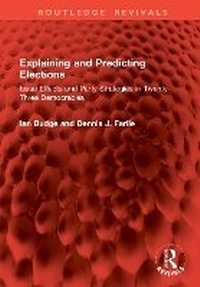
Explaining and Predicting Elections
Issue Effects and Party Strategies in Twenty-Three Democracies
1st Edition
Published on 1. August 2025
Book
Hardback
244 pages
978-1-041-08446-4 (ISBN)
Description
First published in 1983, Explaining and Predicting Elections is the first cross-national and comprehensive explanation of election results. It considers why one election differs from another and attempts to account for party gains and losses in the elections which have taken place in twenty-three democracies in the post-war period. Budge and Farlie base their study on a radically new view of party behaviour-Parties not arguing or debating over the same issues but 'talking past each other'. Their book shows why it is in the parties' interest to do this, how parties might improve their appeal, and how electors react in a broadly 'rational' manner by supporting one party alternative rather than another. The discussion also considers important topics-for example whether electors are abandoning old partisan loyalties and becoming more volatile.
The usefulness of these ideas is measured and checked against new evidence from twenty-three countries. These ideas are then used to produce advance predictions of ten elections in different countries which are then checked against actual results. The reader can use the methods to make his own predictions for elections which interest him. In many ways this makes Explaining and Predicting Elections the most comprehensive and useful investigation of the election process yet produced. It will interest the general reader, political practitioner, historians, and election and area specialists.
The usefulness of these ideas is measured and checked against new evidence from twenty-three countries. These ideas are then used to produce advance predictions of ten elections in different countries which are then checked against actual results. The reader can use the methods to make his own predictions for elections which interest him. In many ways this makes Explaining and Predicting Elections the most comprehensive and useful investigation of the election process yet produced. It will interest the general reader, political practitioner, historians, and election and area specialists.
More details
Series
Language
English
Place of publication
London
United Kingdom
Publishing group
Taylor & Francis Ltd
Target group
College/higher education
Professional and scholarly
General, Postgraduate, and Professional Reference
Dimensions
Height: 246 mm
Width: 174 mm
Weight
610 gr
ISBN-13
978-1-041-08446-4 (9781041084464)
Copyright in bibliographic data and cover images is held by Nielsen Book Services Limited or by the publishers or by their respective licensors: all rights reserved.
Schweitzer Classification
Other editions
Additional editions
Ian Budge | Dennis J. Farlie
Explaining and Predicting Elections
Issue Effects and Party Strategies in Twenty-Three Democracies
E-Book
08/2025
Routledge
€73.99
Available for download
Ian Budge | Dennis J. Farlie
Explaining and Predicting Elections
Issue Effects and Party Strategies in Twenty-Three Democracies
E-Book
08/2025
Routledge
€73.99
Available for download
Persons
Ian Budge is a political scientist who has pioneered the use of quantitative methods to study party democracy across countries. Currently Emeritus Professor of the Department of Government, University of Essex, he has been Professor at the European University Institute, Florence, and visiting professor at various institutions in five other countries.
Dennis J. Farlie
Dennis J. Farlie
Content
Introduction 1. Previous Work 2. Saliency Theory 3. Issues and Votes 4. Predicting Elections 5. Electoral Volatility 6. Party Appeals 7. General Theory References Appendix A: Postwar Votes in Twenty-Three Democracies Appendix B: Issues and Scorings for Individual Postwar Elections in Twenty-Three Democracies Appendix C: The Coding of Issues: Procedures and their Validity Appendix D: Scoring Election Issues: Assumptions and Performance of Alternative schemes