


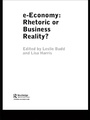
e-Economy
Rhetoric or Business Reality?
1st Edition
Published on 30. September 2004
Book
Hardback
248 pages
978-0-415-33954-4 (ISBN)
Description
As dot.com became dot.bomb, the hype that surrounded the meteoric growth of the network economy has given way to realism, or even scepticism, about the potential of ICT as a source of new business models. It is now appropriate to reflect critically on the e-economy hype, and to use this as a way of looking forward to new, more realistic possibilities.
Using a business and socio-economic framework, this book investigates a range of challenges for restructuring the e-economy. This framework includes operations management, human resource management, e-learning, e-retailing, e-marketing, e-government, enterprise culture and digital divide. Divided into four themes (the changing business environment, knowledge management, learning in the public domain and e-business practices within and between organizations), each chapter considers the international context and critically explores a key aspect of the e-economy.
Rigorous yet still retaining the accessible format which distinguishes all the volumes in this series, this book provides a thorough critique of the prospects facing businesses in the new economy and will be of interest to anyone studying e-business/commerce.
Using a business and socio-economic framework, this book investigates a range of challenges for restructuring the e-economy. This framework includes operations management, human resource management, e-learning, e-retailing, e-marketing, e-government, enterprise culture and digital divide. Divided into four themes (the changing business environment, knowledge management, learning in the public domain and e-business practices within and between organizations), each chapter considers the international context and critically explores a key aspect of the e-economy.
Rigorous yet still retaining the accessible format which distinguishes all the volumes in this series, this book provides a thorough critique of the prospects facing businesses in the new economy and will be of interest to anyone studying e-business/commerce.
Reviews / Votes
'In demystifying and making sense, as the chapters in this book do, of what we mean by the so-called 'new' and 'e-economy', it is the underlying continuities that emerge as more enlightening than the breathless assertions of change...'From the Foreword by Simon Caulkin, Management Correspondent of The Observer
More details
Series
Language
English
Place of publication
London
United Kingdom
Publishing group
Taylor & Francis Ltd
Target group
College/higher education
Illustrations
6 s/w Zeichnungen
6 Line drawings, black and white
Dimensions
Height: 240 mm
Width: 161 mm
Thickness: 18 mm
Weight
534 gr
ISBN-13
978-0-415-33954-4 (9780415339544)
Copyright in bibliographic data and cover images is held by Nielsen Book Services Limited or by the publishers or by their respective licensors: all rights reserved.
Schweitzer Classification
Other editions
Additional editions

Book
11/2004
1st Edition
Routledge
€48.10
Shipment within 15-20 days
E-Book
09/2004
1st Edition
Routledge
€41.99
Available for download
E-Book
09/2004
Routledge
€41.99
Available for download
Persons
Lisa Harris is a Chartered Marketer and Lecturer in Marketing at Brunel University. She is founder of the university's e-commerce research group and is Course Director for the BSc in e-commerce. She is the author of Marketing the e-Business (Routledge 2002) and co-editor of the Routledge e-business series.
Leslie Budd is a Lecturer at the Open University Business School where he teaches in Accounting & Finance and Non-profit management.
Leslie Budd is a Lecturer at the Open University Business School where he teaches in Accounting & Finance and Non-profit management.
Content
1. Death of the 'New'? Re-Materialising the Economy 2. Entrepreneurial Chaos, Entrepreneurial Order and the Dotcom Bubble 3. Social Shaping of Government: What Can be Learned from the Adoption of Mobile-Mediated Communications? 4. e-Leadership: Challenges of New Governance Models 5. e-Management and Workforce Diversity 6. ICT and Institutional Change at the British Library 7. Coerced Evolution:A Study of the Integration of e-Mediated Learning into a Traditional University 8. e-Government: From Utopian Rhetoric to Practical Realism 9. e-Retail: Paradoxes for Suppliers and Consumers and 10. e-Business Processes: Information and Operations for Competitive Advantage 11. Building Trust in Stakeholder Relationships: Are Call Centres Sweat Shops or Massage Parlours?