

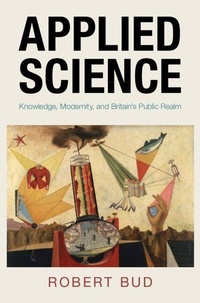
Applied Science
Knowledge, Modernity, and Britain's Public Realm
Published on 28. March 2024
Book
Hardback
342 pages
978-1-009-36523-9 (ISBN)
Description
For almost two centuries, the category of 'applied science' was widely taken to be both real and important. Then, its use faded. How could an entire category of science appear and disappear? By taking a longue duree approach to British attitudes across the nineteenth and twentieth centuries, Robert Bud explores the scientific and cultural trends that led to such a dramatic rise and fall. He traces the prospects and consequences that gave the term meaning, from its origins to its heyday as an elixir to cure many of the economic, cultural, and political ills of the UK, eventually overtaken by its competitor, 'technology'. Bud examines how 'applied science' was shaped by educational and research institutions, sociotechnical imaginaries, and political ideologies and explores the extent to which non-scientific lay opinion, mediated by politicians and newspapers, could become a driver in the classification of science.
Reviews / Votes
'In scope, conceptual finesse, and wide-ranging erudition, this is a ground-breaking book. Building on its core theme of the fashioning, deployment, and eventual fading, since the 1960s, of the concept of applied science, it offers insights of profound importance not only for historians of modern Britain but also for decision-makers and commentators concerned with the direction of research policy in our own day.' Robert Fox, University of Oxford 'Bud has given us a deliciously complicated story about the origins in the early nineteenth century of 'applied science' in Britain and its subsequent long-term history up to the end of the twentieth century. Changing meanings had vast implications for the development of government, educational and research institutions, industry, and an enlightened public.' Bernard Lightman, York University 'Born on the same day as Frankenstein's monster, the term Applied Science has captured many people's hopes and fears ... Robert Bud, for the first time, in a rich and nuanced historical study, reveals what Applied Science meant, and why it mattered in the British context.' Jon Agar, University College London 'The study of science in society since the Industrial Revolution has revealed many ways of describing the pursuit and uses of natural knowledge. In Applied Science: Knowledge, Modernity and Britain's Public Realm, Robert Bud takes us on a fascinating journey through the adoption and abandonment of concepts that have shaped science policy for generations. This is a thoughtful, beautifully researched, and timely book for the historian, policymaker and practitioner alike.' Roy MacLeod, University of Sydney '... required reading for anyone interested in the connections between science and technology in the modern world. ... Essential.' J. D. Martin, Choice 'A definitive study of 'applied science' in Britain ... Bud's artfully constructed monograph provides a model for scholarship in the conceptual history of scientific and technological concepts, a young field that may still be struggling for acceptance among historians of technology ... it is an exemplar of conceptual history that deserves wide readership.' Eric Schatzberg, Technology and CultureMore details
Series
Language
English
Place of publication
Cambridge
United Kingdom
Product notice
sewn/stitched
Cloth over boards
Illustrations
Worked examples or Exercises
Dimensions
Height: 229 mm
Width: 152 mm
Thickness: 21 mm
Weight
626 gr
ISBN-13
978-1-009-36523-9 (9781009365239)
Copyright in bibliographic data and cover images is held by Nielsen Book Services Limited or by the publishers or by their respective licensors: all rights reserved.
Schweitzer Classification
Other editions
Additional editions
E-Book
03/2024
Cambridge University Press
€105.99
Available for download
Person
Robert Bud is Emeritus Keeper at London's Science Museum. He has led science, medicine, and curatorial research at the Museum, writing and editing books across chemical, biotechnological, and scientific instrument history.
Content
Introduction: the biography of a concept; Stage 1. Origins and Pedagogy in the Nineteenth Century; 1. Applied science conceived: the early nineteenth century; 2. Applied science Institutionalised: the Liberal Science College; 3. Competing concepts of applied science and technology; Stage 2. Research in the Early Twentieth Century; 4. The dawn of the twentieth century; 5. From the magi to industrial function; 6. 'Western civilisation' and applied science; Stage 3. After World War Two; 7. Co-existence through growth; 8. From applied science to technological innovation; Conclusion.