

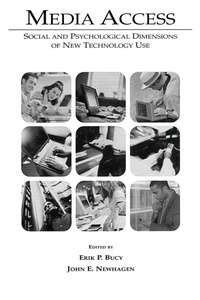
Media Access
Social and Psychological Dimensions of New Technology Use
Published on 1. November 2003
Book
Paperback/Softback
316 pages
978-0-8058-4110-7 (ISBN)
Description
In Media Access: Social and Psychological Dimensions ofNew Technology Use, editors Erik P. Bucy and John E. Newhagen present the latest work, theoretical explorations, and original research findings on media access from a team of internationally renowned media and technology researchers. Chapters develop expanded definitions and conceptual understandings of access to stimulate further research, offer new perspectives on policy discussions, and facilitate media participation among those at risk of being left behind.
Broadening our understanding of information technology use, this collection offers:
*Novel perspectives--chapters demonstrate new methods of addressing persistent questions regarding motivation, cultural context, socioeconomic resources, technical knowledge, and psychological skills required for effectual use of information and communication technologies.
*Conceptual integration--each chapter addresses a vital aspect of media access and summarizes pertinent findings, weaving together results to provide much-needed integration across communication and technology studies.
*Multidisciplinary approaches--chapters represent a variety of conceptual and methodological approaches, deriving social explanations from large-scale survey data, psychological explanations from experimental data, and cultural explanations from depth interviews and ethnographic methods.
*Shifting the policy and research agenda--this volume extends and redirects aspects of the digital divide debate while elaborating the "media access" approach to studying new technology use.
Taken as a whole, Media Access reveals complications associated with full access to new communication technologies and proposes analytical frameworks that open new avenues of scholarly investigation and policy consideration. It is intended for scholars and graduate students in journalism, mass communication, telecommunications, media studies, information science, public policy, psychology, sociology, informatics, human-computer interaction, and other disciplines concerned with the issue of media access.
Broadening our understanding of information technology use, this collection offers:
*Novel perspectives--chapters demonstrate new methods of addressing persistent questions regarding motivation, cultural context, socioeconomic resources, technical knowledge, and psychological skills required for effectual use of information and communication technologies.
*Conceptual integration--each chapter addresses a vital aspect of media access and summarizes pertinent findings, weaving together results to provide much-needed integration across communication and technology studies.
*Multidisciplinary approaches--chapters represent a variety of conceptual and methodological approaches, deriving social explanations from large-scale survey data, psychological explanations from experimental data, and cultural explanations from depth interviews and ethnographic methods.
*Shifting the policy and research agenda--this volume extends and redirects aspects of the digital divide debate while elaborating the "media access" approach to studying new technology use.
Taken as a whole, Media Access reveals complications associated with full access to new communication technologies and proposes analytical frameworks that open new avenues of scholarly investigation and policy consideration. It is intended for scholars and graduate students in journalism, mass communication, telecommunications, media studies, information science, public policy, psychology, sociology, informatics, human-computer interaction, and other disciplines concerned with the issue of media access.
More details
Series
Language
English
Place of publication
New York
United States
Publishing group
Taylor & Francis Inc
Target group
Professional and scholarly
Dimensions
Height: 229 mm
Width: 152 mm
Thickness: 17 mm
Weight
463 gr
ISBN-13
978-0-8058-4110-7 (9780805841107)
Copyright in bibliographic data and cover images is held by Nielsen Book Services Limited or by the publishers or by their respective licensors: all rights reserved.
Schweitzer Classification
Other editions
Additional editions
Erik P. Bucy | John E. Newhagen
Media Access
Social and Psychological Dimensions of New Technology Use
E-Book
12/2003
1st Edition
Routledge
€63.49
Available for download
Erik P. Bucy | John E. Newhagen
Media Access
Social and Psychological Dimensions of New Technology Use
E-Book
12/2003
Routledge
€63.49
Available for download
Erik P. Bucy | John E. Newhagen
Media Access
Social and Psychological Dimensions of New Technology Use
E-Book
12/2003
1st Edition
Routledge
€67.59
Available for download
Erik P. Bucy | John E. Newhagen
Media Access
Social and Psychological Dimensions of New Technology Use
Book
11/2003
Routledge
€206.10
Shipment within 10-20 days
Persons
Erik P. Bucy, John E. Newhagen
Content
Contents: E.P. Bucy, J.E. Newhagen, Preface: The New Thinking About Media Access. Part I:Introduction.J.E. Newhagen, E.P. Bucy, Routes to Media Access. Part II:Psychological Dimensions of Media Access.M.E. Grabe, R. Kamhawi, Cognitive Access to New and Traditional Media: Evidence From Different Strata of the Social Order. E.P. Bucy, The Interactivity Paradox: Closer to the News but Confused. S. Finn, A.R. Korukonda, Avoiding Computers: Does Personality Play a Role? K. Bessiere, I. Ceaparu, J. Lazar, J. Robinson, B. Shneiderman, Social and Psychological Influences on Computer User Frustration. Part III:Social and Cultural Dimensions of Media Access.V. Rojas, J. Straubhaar, D. Roychowdhury, O. Okur, Communities, Cultural Capital, and the Digital Divide. J. Youtie, P. Shapira, G. Laudeman, Reducing Barriers to Access via Public Information Infrastructure: The LaGrange Public Internet Initiative. L.A. Jackson, G. Barbatsis, F.A. Biocca, A. von Eye, Y. Zhao, H.E. Fitzgerald, Home Internet Use in Low-Income Families: Is Access Enough to Eliminate the Digital Divide? Part IV:Media Access to the Public Sphere.J.H. McCrery, J.E. Newhagen, Conceptual Elasticity of the Public Sphere: Tracking Media and Psychological Determinants of Access. C.R. Hofstetter, The Skills and Motivations of Interactive Media Participants: The Case of Political Talk Radio. J. van Dijk, Divides in Succession: Possession, Skills, and Use of New Media for Societal Participation. B. Shneiderman, Universal Usability: Pushing Human-Computer Interaction Research to Empower Every Citizen. Part V:Conclusions and Connections.L.A. Lievrouw, Integrating the Research on Media Access: A Critical Overview.