

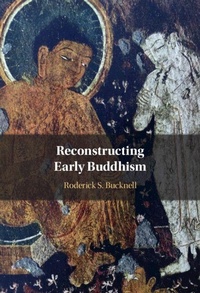
Reconstructing Early Buddhism
Published on 20. October 2022
Book
Hardback
306 pages
978-1-009-23652-2 (ISBN)
Description
Buddhist origins and discussion of the Buddha's teachings are amongst the most controversial and contested areas in the field. This bold and authoritative book tackles head-on some of the key questions regarding early Buddhism and its primary canon of precepts. Noting that the earliest texts in Pali, Sanskrit and Chinese belong to different Buddhist schools, Roderick S. Bucknell addresses the development of these writings during the period of oral transmission between the Buddha's death and their initial redaction in the first century BCE. A meticulous comparative analysis reveals the likely original path of meditative practice applied and taught by Gautama. Fresh perspectives now emerge on both the Buddha himself and his Enlightenment. Drawing on his own years of meditative experience as a Buddhist monk, the author offers here remarkable new interpretations of advanced practices of meditation, as well as of Buddhism itself. It is a landmark work in Buddhist Studies.
Reviews / Votes
This book proposes a radical and new understanding of the Buddha's path to awakening (based on a detailed analysis of the earliest textual sources available to us) that will undoubtedly prove provocative and controversial. It will certainly generate much discussion in scholarly circles, within Buddhist communities, and among those interested in understanding the Buddha's teaching and engaging in its practice. Mark Allon, University of Sydney This book is the culmination of fifty years of Roderick Bucknell's Buddhist Studies scholarship, in which he has explored issues in the nature of the path of practice in early Buddhism, especially by comparing a range of parallel texts in Pali and Chinese. The work is clear, informative, well written and well referenced. It contains illuminating analyses of details of the Buddhist path - and of how they relate together, and evolved in different forms - in the first few centuries of Buddhism. It is thought provoking and thus includes controversial aspects with which other scholars may not agree. It will prompt deeper thought on the nature of the path of Buddhist practice, and be of great interest both to scholars of Buddhist Studies and Buddhist meditators. Peter Harvey, University of Sunderland 'This excellent book sheds fresh light on the early Buddhist tradition.' Hu?nh Cao Nh?t Quang, Religious Studies ReviewMore details
Language
English
Place of publication
Cambridge
United Kingdom
Illustrations
Worked examples or Exercises
Dimensions
Height: 159 mm
Width: 236 mm
Thickness: 27 mm
Weight
600 gr
ISBN-13
978-1-009-23652-2 (9781009236522)
Copyright in bibliographic data and cover images is held by Nielsen Book Services Limited or by the publishers or by their respective licensors: all rights reserved.
Schweitzer Classification
Other editions
Additional editions
Roderick S. Bucknell
Reconstructing Early Buddhism
E-Book
10/2022
Cambridge University Press
€92.49
Available for download
Roderick S. Bucknell
Reconstructing Early Buddhism
E-Book
10/2022
Cambridge University Press
€92.49
Available for download
Person
Roderick S. Bucknell holds a doctorate in Chinese linguistics and is an Honorary Associate Professor of Religious Studies at the University of Queensland, where for eighteen years - prior to his retirement - he taught Chinese and Buddhist studies. Having become interested in the techniques of insight meditation on an earlier visit to the country, he was formerly (from 1967-71) a bhikkhu (Buddhist monk) based in Thailand. His previous works include The Twilight Language: Explorations in Buddhist Meditation and Symbolism (1995, co-authored with Martin Stuart-Fox, who has edited and provided the Postscript to the present volume) and Sanskrit Manual: A Quick Reference Guide to the Phonology and Grammar of Classical Sanskrit (2010).
Content
Part I. Background and Context: 1. Introducing the project; 2. The Sa?gha and the oral transmission; 3. Scriptural sources; Part II. The Path: 4. The stepwise training; 5. Derivative accounts of the path; 6. The eightfold path; Part III. The Practice: 7. Mindfulness; 8. Concentration; 9. The three knowledges; Part IV. In Conclusion: 10. Summary and implications.