

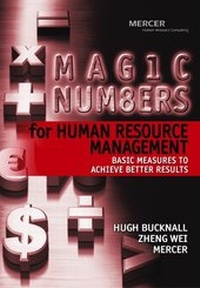
Magic Numbers for Human Resource Management
Basic Measures to Achieve Better Results
1st Edition
Published on 17. January 2006
Book
Hardback
192 pages
978-0-470-82161-9 (ISBN)
Description
MAG1C NUM8ERS
for HUMAN RESORUCE MANAGEMENT
Good companies believe in measurement - particularly in the vital "soft" area of people management. This practical book is a fine guide on how to get started and how to use those metrics - from staffing rations to calculating stock options to measuring important intangibles such as employee engagement. - Paul Evans, The Shell Chaired Professor of Human Resources and Organizational Development, INSEAD
HR managers often fall into a bind when trying to catch up with industry norms or competitors in benchmarking initiatives. Magic Numbers for Human Resource Management: Basic Measures to Achieve Better Results is a useful book that lays the foundation for HR managers seeking to put some method to the madness of chasing elusive HR numbers. There are step-by-step explanations on how to build the data to calculate over 30 HR metrics, and pointers on how to implement a system to monitor the success or failure of certain programs. it is the definitive guide for every HR department. - Ng Ee Leng, Regional Compensation & Benefits Manager, FujiXerox Asia Pacific Pte Ltd
Measuring the core element that shapes our business: our people, has always been a huge challenge. This challenge will not disappear with the knowledge from this book. However, it will help us understand how to better manage the HR component of our business. This book is for every leader who is convinced that "people come before strategy". - Erik H.M. Geilenkirchen, CEO, Philips Domestic Appliances and Personal Care, Asia Pacific
More details
Edition
1., Auflage
Language
English
Place of publication
Chichester
United Kingdom
Publishing group
John Wiley and Sons Ltd
Target group
Professional and scholarly
Illustrations
Illustrations
Dimensions
Height: 26.1 cm
Width: 19.1 cm
Thickness: 22 mm
Weight
564 gr
ISBN-13
978-0-470-82161-9 (9780470821619)
Schweitzer Classification
Persons
Hugh Bucknall
Hugh is a Worldwide Partner of Mercer Human Resource Consulting and the Asia Pacific leader for Mercer's Human Capital Advisory Services Business. In his current role, he sets the strategic direction for the business in Asia Pacific and provides technical leadership for major projects across the region.
He has worked extensively in Asia and Australia in the areas of reward strategy, job classification, team building, group facilitation, assessment centers, performance management, organization review, and job design. His wide client base includes multinationals and domestic companies across a number of industry sectors such as health, hi-tech, retail, and the public sector. On the topic of Asian HRM trends and issues, Hugh has spoken at a number of international forums and client events.
Prior to joining Mercer, High worked in the areas of HRM, computer systems, and management consultancy over a period of 14 years with Myer Stores, BHP, the Australian Public Service Board, The Australian Bureau of Statistics, and the Victorian Department of Conservation among others.
Zheng Wei
Dr. Zheng, is an associate director of Mercer Human Resource Consulting's Beijing office. He leads the Human Capital Advisory Services business in North China. He is an economist specializing in performance measurement, incentives, and financial analysis.
His main work involves helping both Chinese and global clients with alignment of their human capital strategy with business strategy. he also helps organizations identify and measure their essential productivity drivers, and project the economic gains for making changes in those factors.
He has worked on performance measures for a variety of clients spanning many industries including manufacturing, telecommunications, and financial services industries. His telecommunications clients include Aliant, Vodafone Group, Verizon Communications, Windstar, and China Netcom Group.
Content
I. The value of Numbers in HR - the demon of benchmarking
2. State of the nation HR numbers - multiple short sections/sub-chapters
3. Measuring the added value of HR - multiple short sections/sub-chapters
4. Constructing an HR dashboard - making sense of the vital signs
Specific Definitions/Numbers to be dealt with include (but not limited to):
HR staff as a percentage of total staff
Payroll staff as a percentage of total staff
Training staff as a percentage of total staff
Finance staff as a percentage of total staff
IT staff as a percentage of total staff
Marketing staff as a percentage of total staff
Sales staff as a percentage of total staff
Training expenditure per employee
Training costs as a percentage of base salary costs
Percentage of staff provided with training
Voluntary turnover
Involuntary turnover
Total staff turnover
Sick days per employee
Sick leave rate
HR function budget per employee
HR budget as a percentage of revenue
Payroll function budget per employee
Payroll budget as a percentage of revenue
Hours overtime
Days to fill vacancy by class of employee
Recruitment costs by class of employee
Base salary costs per employee
Employee benefits as a percentage of base salary costs
Bonuses/short term incentives by class of employee
Long term rewards/share plan value per class of employee
Profit per employee
Black Scholes method of calculating share option values
Employee satisfaction index
Link between employee satisfaction index and Customer Satisfaction index
Each definition described around 6 headings
* The definition
* The formula
* The components
* Where's the data
* Calculating it - an example
* What it means