

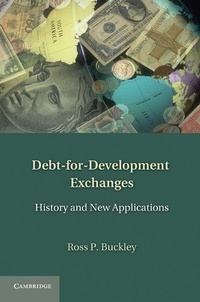
Debt-for-Development Exchanges
History and New Applications
1st Edition
Published on 25. April 2011
Book
Hardback
342 pages
978-1-107-00942-4 (ISBN)
Description
Debt-for-development exchanges are an important financing tool for development. They make debt relief more politically and practically attractive to donor countries and serve the development of recipient countries through the cancellation of external debt and the funding of important development projects. This book commences by chronicling the emergence of debt-for-development exchanges from their forebears, debt-equity exchanges, and analyzes why debt for development suffers from very few of the problems that plagued debt equity. The book analyzes the different types of debt-for-development exchanges and the different ways they have been used by all donor nations that have made use of them. The book then explores a range of critical perspectives on exchanges and concludes by considering a wide range of new and innovative uses for the funds generated by exchanges.
More details
Language
English
Place of publication
Cambridge
United Kingdom
Target group
Professional and scholarly
Illustrations
5 Halftones, unspecified; 14 Line drawings, unspecified
Dimensions
Height: 235 mm
Width: 157 mm
Thickness: 23 mm
Weight
647 gr
ISBN-13
978-1-107-00942-4 (9781107009424)
Copyright in bibliographic data and cover images is held by Nielsen Book Services Limited or by the publishers or by their respective licensors: all rights reserved.
Schweitzer Classification
Other editions
Additional editions
Book
02/2013
Cambridge University Press
€46.60
Shipment within 15-20 days
E-Book
05/2011
1st Edition
Cambridge University Press
€32.49
Available for download
E-Book
04/2011
Cambridge University Press
€26.99
Available for download
Person
Ross P. Buckley is a Professor of Law at University of New South Wales, a Fellow of the Asian Institute of International Financial Law of the University of Hong Kong, and a Fellow of Australia21, a national research organization. He is the founding series editor of the Global Trade Law Series; series co-editor of the International Banking and Finance Law Series, and founding editor of the Overseas Law column in the Australian Law Journal. He has written or edited eight books, and authored more than 90 book chapters and articles.
Content
Part I. Types of Exchanges and their Development Over Time: 1. The early years - the evolution of the technique Ross P. Buckley; 2. Debt-for-nature exchanges Ross P. Buckley and Steven Freeland; 3. Other debt-for-development exchanges Ross P. Buckley; Part II. Exchanges by Donor Countries: 4. United States debt exchanges Ross P. Buckley and Steven Freeland; 5. Italian exchanges Ross P. Buckley; 6. German exchanges Ross P. Buckley; 7. French exchanges Ross P. Buckley; 8. Other donor nations' exchanges Ross P. Buckley; 9. Debt-for-development in Australia: past, present and future Luke Fletcher and Adele Webb; Part III. Critiques of Exchanges: 10. Debt audits as the necessary precondition to credible exchanges Julia Roy; 11. A different view on the use of illegitimate debt in exchanges: reflections on an all too real case Juergen Kaiser; 12. The human rights dimension in exchanges Gillian Moon; 13. Bangladesh's experience with exchanges: liability to potentia M. D. Shamsuddoha; 14. The Philippines experience with exchanges Joffre Balce; Part IV. New and Innovative Applications of Exchanges: 15. Farmer managed natural regeneration: a land rehabilitaton technique well adapted to funding by exchanges Tony Rinaudo; 16. Restoring mangroves in the Philippines Ross P. Buckley; 17. Poverty reduction through social protection: a potential form of debt-for-development exchange John Langmore; 18. Climate change adaptation exchanges: an exploration of the possibilities and risks Philip Ireland; 19. Climate change and food security: building resilience by means of climate field schools Alicia C. Qian and Tanvir Uddin; 20. Debt-for-security exchanges Ross P. Buckley; 21. Promoting good governance through ICT systems: improving transparency and reducing corruption Emmanuel T. Laryea; 22. Promoting citizen action and voice through exchanges Bill Walker; 23. Conclusion Ross P. Buckley.