

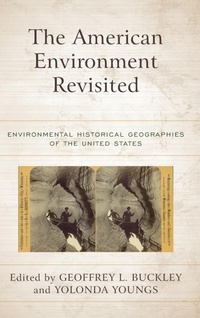
The American Environment Revisited
Environmental Historical Geographies of the United States
Published on 1. March 2018
Book
Hardback
382 pages
978-1-4422-6996-5 (ISBN)
Description
This innovative book provides a dynamic-and often surprising-view of the range of environmental issues facing the United States today. A distinguished group of scholars examines the growing temporal, spatial, and thematic breadth of topics historical geographers are now exploring. Seventeen original chapters examine topics such as forest conservation, mining landscapes, urban environment justice, solid waste, exotic species, environmental photography, national and state park management, recreation and tourism, and pest control. Commemorating the twenty-fifth anniversary of the publication of the seminal work The American Environment: Interpretations of Past Geographies, the book clearly shows much has changed since 1992. Indeed, not only has the range of issues expanded, but an increasing number of geographers are forging links with environmental historians, promoting a level of intellectual cross-fertilization that benefits both disciplines. As a result, environmental historical geographies today are richer and more diverse than ever. The American Environment Revisited offers a comprehensive overview that gives both specialist and general readers a fascinating look at our changing relationships with nature over time.
Reviews / Votes
The book is worth reading whether you are a devotee of environmental historical geography or not quite sure you've heard of this subfield of the larger discipline . . . Buckley and Youngs accomplish quite a bit more than simply revisiting the U.S. environment. They challenge us in diverse ways to rethink our human relationship with a broadly construed 'nature,' and they remind us how richly connected history and contemporary experience remain. The contributing authors, as a whole, succeed nicely in situating their work within a tradition of environmental historical geography while also extending the boundaries of this field to redefine and reinvigorate it. As DeLyser notes in the book's final chapter, 'Environments of the Imagination,' these environments-and perhaps more ambitiously, the ideas of the book-'are everywhere with us' (p. 332). It's refreshing to find a resource that reminds us why it is important to continue to engage as fully as possible with them. * AAG Review of Books * By exploring the complex links between humans and nature, the intriguing case studies in this landmark collection offer surprising and valuable insight into humanity's role in shaping the world. -- Graeme Wynn, emeritus, University of British Columbia Essential reading! Buckley and Youngs have assembled a powerful collection of work by the nation's leading scholars in environmental historical geography. Like this volume's namesake, The American Environment Revisited is certain to influence an entire generation of students and scholars wishing to explore the intersection of nature, geography, and history. Offering critical insights on topics ranging from invasive species to pesticide risk and from urban land use disputes to public land accessibility, these essays provide a snapshot of the current breadth and depth of the field. Academically robust, yet thoroughly engaging and highly readable, this is a must-read resource for anyone seeking a contextualized understanding of the nation's environment. -- Randall Wilson, Gettysburg College A robust reminder of how the 'environmental turn' has transformed historical geography, integrating nature, in complex and subtle ways, into stories about how places and people have changed over time. The result is the creation of yet another disciplinary classic. . . .The essays are empirically rich, theoretically informed, and grounded in narratives about particular places and how they have changed over time. . . . The volume's impressive array of contributors will be a 'Who's Who List' of dominant thinkers and writers in this field for a long time to come. We are fortunate that Buckley and Youngs have brought them together in this impressive new volume, and their collective effort should go a long way to continue energizing a vibrant, growing subfield within the discipline. -- William Wyckoff, Montana State University (from the afterword)More details
Language
English
Place of publication
United States
Publishing group
Bloomsbury Publishing Plc
Target group
Professional and scholarly
Illustrations
72 b/w photos; 2 tables;
Dimensions
Height: 235 mm
Width: 157 mm
Thickness: 25 mm
Weight
706 gr
ISBN-13
978-1-4422-6996-5 (9781442269965)
Copyright in bibliographic data and cover images is held by Nielsen Book Services Limited or by the publishers or by their respective licensors: all rights reserved.
Schweitzer Classification
Other editions
Additional editions
Geoffrey L. Buckley | Yolonda Youngs
The American Environment Revisited
Environmental Historical Geographies of the United States
E-Book
03/2018
1st Edition
Rowman & Littlefield Publishers
€50.49
Available for download
Persons
Geoffrey L. Buckley is professor of geography at Ohio University. Yolonda Youngs is associate professor in the department of geography and environmental studies at California State University, San Bernardino.
Content
Preface
Craig E. Colten and Lary M. Dilsaver
Introduction
Geoffrey L. Buckley and Yolonda Youngs
Part I: Nature Gone Wild
Chapter 1: Toward a Historical Geography of Human-Invasive Species Relations: How Kudzu Came to Belong in the American South
Derek H. Alderman
Chapter 2: Unruly Domestic Environments: Do-It-Yourself Pesticides, Gender, and Regulation in Post-World War II Homes
Dawn Biehler
Chapter 3: From Noble Stag to Suburban Vermin: The Return of Deer to the Northeast United States
Bob Wilson
Part II: Parks and Recreation
Chapter 4: Wild, Unpredictable, and Dangerous: A Historical Geography of Hazards and Risks in U.S. National Parks
Yolonda Youngs
Chapter 5: Migration and Social Justice in Wilderness Creation
Katie Algeo and Collins Eke
Chapter 6: Racialized Assemblages and State Park Design in the Jim Crow South
William E. O'Brien
Chapter 7: Shredding Mountain Lines: GoPro, Mobility, and the Spatial Politics of Outdoor Sports
Annie Gilbert Coleman
Part III: Living i
Craig E. Colten and Lary M. Dilsaver
Introduction
Geoffrey L. Buckley and Yolonda Youngs
Part I: Nature Gone Wild
Chapter 1: Toward a Historical Geography of Human-Invasive Species Relations: How Kudzu Came to Belong in the American South
Derek H. Alderman
Chapter 2: Unruly Domestic Environments: Do-It-Yourself Pesticides, Gender, and Regulation in Post-World War II Homes
Dawn Biehler
Chapter 3: From Noble Stag to Suburban Vermin: The Return of Deer to the Northeast United States
Bob Wilson
Part II: Parks and Recreation
Chapter 4: Wild, Unpredictable, and Dangerous: A Historical Geography of Hazards and Risks in U.S. National Parks
Yolonda Youngs
Chapter 5: Migration and Social Justice in Wilderness Creation
Katie Algeo and Collins Eke
Chapter 6: Racialized Assemblages and State Park Design in the Jim Crow South
William E. O'Brien
Chapter 7: Shredding Mountain Lines: GoPro, Mobility, and the Spatial Politics of Outdoor Sports
Annie Gilbert Coleman
Part III: Living i