

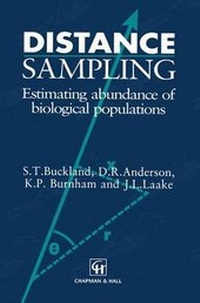
Distance Sampling
Estimating Abundance of Biological Populations
Published in May 1993
Book
Hardback
464 pages
978-0-412-42660-5 (ISBN)
Description
This study concerns the use of distance sampling to estimate the density or abundance of biological populations. Line and point transect sampling are the primary distance methods. Here, lines or points are surveyed in the field and the observer records a distance to those objects of interest that are detected. The sample data are the set of distances of detected objects and any relevant covariates; however, many objects may remain undetected during the course of the survey. Distance sampling provides a way to obtain reliable estimates of density of objects under fairly mild assumptions. Distance sampling is an extension of plot sampling methods where it is assumed that all objects within sample plots are counted. The objective of this book is to provide a comprehensive treatment of distance sampling theory and application. It covers the theory and application of distance sampling with emphasis on line and point transects. Specialized applications are noted briefly, such as trapping webs and cue counts. General considerations are given to the design of distance sampling surveys.
More details
Series
Language
English
Place of publication
London
United Kingdom
Target group
College/higher education
Professional and scholarly
Dimensions
Height: 234 mm
Width: 156 mm
Weight
750 gr
ISBN-13
978-0-412-42660-5 (9780412426605)
Copyright in bibliographic data and cover images is held by Nielsen Book Services Limited or by the publishers or by their respective licensors: all rights reserved.
Schweitzer Classification
Other editions
Additional editions
S.T. Buckland | D.R. Anderson | K.P. Burnham
Distance Sampling
Estimating abundance of biological populations
Book
10/2012
Springer
€96.29
Article exhausted; check different version
Persons
Content
Introductory concepts; conceptual background; statistical theory; line transects; point transects; extensions and related work; study design and field methods; illustrative examples.