

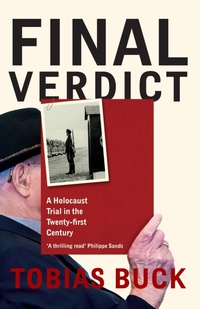
Final Verdict
A Holocaust Trial in the Twenty-first Century
Published on 7. March 2024
Book
Hardback
336 pages
978-1-3996-0425-3 (ISBN)
Description
'[A] gripping and fascinating book' JAMES HOLLAND, DAILY TELEGRAPH, 5* review
'A brilliant book . . . timely . . . gripping' RACHEL COOKE, OBSERVER
'A thrilling read ' PHILIPPE SANDS, author of EAST WEST STREET
***
On 17 October 2019, in Hamburg's imposing criminal justice building, a trial laden with extraordinary historical weight begins to unfold. Bruno Dey stands accused of being involved in a crime committed over seven decades ago: the murder of at least 5,230 inmates at Stutthof, the Nazi concentration camp in present-day Poland. Only seventeen at the time, Dey was a member of the SS unit responsible for administering the camp. Though he concedes to his role as a guard, he adamantly denies responsibility for the killings.
Dey's trial comes at a poignant moment. As the last members of the war generation - both victims and perpetrators - disappear, so does their first-hand knowledge of the Holocaust's horrors. Beyond its immediate legal implications, the trial stirs profound questions that resonate not only within the realms of German history, politics and collective memory but also within the author's own family. Tobias Buck revisits the silence that surrounds his family's experience during the Nazi period - and his German grandfather's role and responsibility. Through the lens of this riveting courtroom drama, Final Verdict explores the trial's broader significance, both on a political and personal level, and invites us to grapple with the question of whether it is right to prosecute Bruno Dey more than seven decades after he stood guard at Stutthof, and, perhaps more importantly, what we might have done in his place.
'A brilliant book . . . timely . . . gripping' RACHEL COOKE, OBSERVER
'A thrilling read ' PHILIPPE SANDS, author of EAST WEST STREET
***
On 17 October 2019, in Hamburg's imposing criminal justice building, a trial laden with extraordinary historical weight begins to unfold. Bruno Dey stands accused of being involved in a crime committed over seven decades ago: the murder of at least 5,230 inmates at Stutthof, the Nazi concentration camp in present-day Poland. Only seventeen at the time, Dey was a member of the SS unit responsible for administering the camp. Though he concedes to his role as a guard, he adamantly denies responsibility for the killings.
Dey's trial comes at a poignant moment. As the last members of the war generation - both victims and perpetrators - disappear, so does their first-hand knowledge of the Holocaust's horrors. Beyond its immediate legal implications, the trial stirs profound questions that resonate not only within the realms of German history, politics and collective memory but also within the author's own family. Tobias Buck revisits the silence that surrounds his family's experience during the Nazi period - and his German grandfather's role and responsibility. Through the lens of this riveting courtroom drama, Final Verdict explores the trial's broader significance, both on a political and personal level, and invites us to grapple with the question of whether it is right to prosecute Bruno Dey more than seven decades after he stood guard at Stutthof, and, perhaps more importantly, what we might have done in his place.
Reviews / Votes
In this informed, thoughtful work [Buck] skilfully weaves together his investigation into his own family's Nazi past - and their attempts to disguise it - with broader themes of historical justice and culpability . . . [a] masterly account -- Adam LeBor * THE TIMES * Final Verdict tells the story of a 21st-century trial that raises vital questions about how we remember the Holocaust. [A] gripping and fascinating book -- James Holland * THE DAILY TELEGRAPH, 5* review * Timely . . . gripping. A narrative that wrestles - calmly and very elegantly - with huge questions. This is a brilliant book. I learned a lot from it, and I was glad of Buck's unshowy, measured style: on the page, he makes complicated things (the law, especially) straightforward. Above all, I found it - and this feeling has only grown since I finished it - to be important . . . books such as Final Verdict have never been more necessary -- Rachel Cooke * THE OBSERVER * Excellent . . . a timely, wise and fair-minded meditation on a singular crime -- Lawrence Douglas * TLS * Final Verdict is a thrilling read. It is a book that raises a myriad of fascinating questions and human dramas, beautifully constructed and enticingly written -- PHILIPPE SANDS, author of EAST WEST STREET Discursive and engaging . . . Buck deftly outlines the legal procedures while also expanding his narrative to take in other late Holocaust trials and testimonies from survivors * IRISH TIMES * Through a riveting account of the trial of 93-year-old Bruno Dey, a guard at Stutthof concentration camp when he was 17 in 1944, "the smallest of small cogs" in the SS hierarchy, Buck compellingly shows how History is always present, never past -- CATRINE CLAY, author of THE GOOD GERMANS The author provides a powerful guide to the proceedings and their context . . . Final Verdict provide[s] a fresh perspective on how Germans have negotiated their sense of historical and individual responsibility * THE WALL STREET JOURNAL * Timely and deeply thought-provoking, The Last Verdict examines how German courts let hundreds of thousands of Holocaust perpetrators off the hook until only a few low-level concentration camp guards remained alive to prosecute. Tobias Buck navigates the thicket of thorny questions surrounding this vexed and vexing history with great scope and sensitivity -- PHILIP GOUREVITCH, author of WE WISH TO INFORM YOU THAT TOMORROW WE WILL BE KILLED WITH OUR FAMILIES Absorbing . . . his insightful book examines questions of guilt, complicity and collaboration -- Colin Shindler * JEWISH CHRONICLE * [A] lucid account . . . Buck crisply explains the legal hurdles that thwarted prosecution of alleged German perpetrators in West German courts * HISTORY TODAY * A gripping read from first to last . . . Buck's deep research into his subject makes his book highly informative and thought-provoking. Final Verdict is an important contribution to understanding the impact of the Holocaust on the nation from which it emanated. This is a book that deserves to be read * THE JERUSALEM POST *More details
Language
English
Place of publication
London
United Kingdom
Publishing group
Orion Publishing Co
Product notice
Trade binding
Dimensions
Height: 243 mm
Width: 165 mm
Thickness: 35 mm
Weight
556 gr
ISBN-13
978-1-3996-0425-3 (9781399604253)
Copyright in bibliographic data and cover images is held by Nielsen Book Services Limited or by the publishers or by their respective licensors: all rights reserved.
Schweitzer Classification
Person
Tobias Buck is the Managing Editor of the Financial Times. Born in Germany, he studied law in Berlin before joining the FT as a graduate trainee in 2002. He went on to serve as the FT's correspondent in Brussels, Jerusalem, Madrid and Berlin. His first book, After the Fall: Crisis, Recovery and the Making of a New Spain, was published in 2019.