

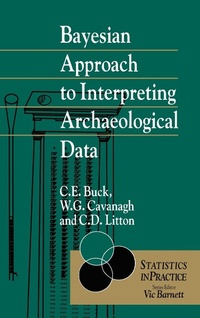
Bayesian Approach to Intrepreting Archaeological Data
1st Edition
Published on 17. April 1996
Book
Hardback
404 pages
978-0-471-96197-0 (ISBN)
Description
Statistics in Practice A new series of practical books outliningthe use of statistical techniques in a wide range of applicationareas:
Human and Biological Sciences
Earth and Environmental Sciences
Industry, Commerce and Finance
The authors of this important text explore the processes throughwhich archaeologists analyse their data and how these can be mademore rigorous and effective by sound statistical modelling. Theyassume relatively little previous statistical or mathematicalknowledge. Introducing the idea underlying the Bayesian approach tothe statistical analysis of data and their subsequentinterpretation, the authors demonstrate the major advantage of thisapproach, i.e. that it allows the incorporation of relevant priorknowledge or beliefs into the analysis. By doing so it provides alogical and coherent way of updating beliefs from those held beforeobserving the data to those held after taking the data intoaccount. To illustrate the power and effectiveness of mathematicaland statistical modelling within the Bayesian framework, a varietyof real case studies are presented covering areas of commoninterest to archaeologists. These case studies cover applicationsin areas such as radiocarbon dating, spatial analysis, provenancestudies and other dating methods. Background to these case studiesis provided for those readers not so familiar with the subject.Thus, the book provides an examination of the theoretical andpractical consequences of Bayesian analysis for examining problemsin archaeology. Students of archaeology and related disciplines andprofessional archaeologists will find the book an informative andpractical introduction to the subject.
Human and Biological Sciences
Earth and Environmental Sciences
Industry, Commerce and Finance
The authors of this important text explore the processes throughwhich archaeologists analyse their data and how these can be mademore rigorous and effective by sound statistical modelling. Theyassume relatively little previous statistical or mathematicalknowledge. Introducing the idea underlying the Bayesian approach tothe statistical analysis of data and their subsequentinterpretation, the authors demonstrate the major advantage of thisapproach, i.e. that it allows the incorporation of relevant priorknowledge or beliefs into the analysis. By doing so it provides alogical and coherent way of updating beliefs from those held beforeobserving the data to those held after taking the data intoaccount. To illustrate the power and effectiveness of mathematicaland statistical modelling within the Bayesian framework, a varietyof real case studies are presented covering areas of commoninterest to archaeologists. These case studies cover applicationsin areas such as radiocarbon dating, spatial analysis, provenancestudies and other dating methods. Background to these case studiesis provided for those readers not so familiar with the subject.Thus, the book provides an examination of the theoretical andpractical consequences of Bayesian analysis for examining problemsin archaeology. Students of archaeology and related disciplines andprofessional archaeologists will find the book an informative andpractical introduction to the subject.
More details
Series
Language
English
Place of publication
New York
United States
Target group
Professional and scholarly
Product notice
sewn/stitched
Cloth over boards
Dimensions
Height: 235 mm
Width: 157 mm
Thickness: 28 mm
Weight
806 gr
ISBN-13
978-0-471-96197-0 (9780471961970)
Copyright in bibliographic data and cover images is held by Nielsen Book Services Limited or by the publishers or by their respective licensors: all rights reserved.
Schweitzer Classification
Persons
Caitlin E. Buck is a British archaeologist and statistician specialising the application of Bayesian statistics to archaeology, and known for her work in radiocarbon dating. She is a professor in the Department of Mathematics and Statistics at the University of Sheffield.
William G. Cavanagh is the author of Bayesian Approach to Intrepreting Archaeological Data, published by Wiley.
Cliff D. Litton is the author of Bayesian Approach to Intrepreting Archaeological Data, published by Wiley.
William G. Cavanagh is the author of Bayesian Approach to Intrepreting Archaeological Data, published by Wiley.
Cliff D. Litton is the author of Bayesian Approach to Intrepreting Archaeological Data, published by Wiley.
Content
The Bayesian Approach to Statistical Archaeology.
Outline of the Approach.
Modelling in Archaeology.
Quantifying Uncertainty: The Probability Concept.
Statistical Modelling.
Bivariate and Multivariate Distributions.
Bayesian Inference.
Implementation Issues.
Interpretation of Radiocarbon Results.
Spatial Analysis.
Sourcing and Provenancing.
Application to Other Dating Methods.
The Way Forward.
References.
Index.
Outline of the Approach.
Modelling in Archaeology.
Quantifying Uncertainty: The Probability Concept.
Statistical Modelling.
Bivariate and Multivariate Distributions.
Bayesian Inference.
Implementation Issues.
Interpretation of Radiocarbon Results.
Spatial Analysis.
Sourcing and Provenancing.
Application to Other Dating Methods.
The Way Forward.
References.
Index.