

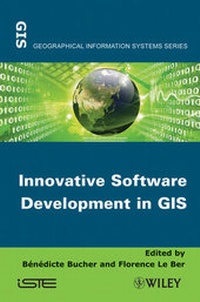
Innovative Software Development in GIS
Will be published approx. on 11. May 2012
Book
Hardback
346 pages
978-1-84821-364-7 (ISBN)
Description
At a time when people use more and more geographic information and tools, the management of geographical information in software systems still holds many challenges and motivates researchers from different backgrounds to propose innovative solutions.
Representing geographical space beyond our mere perception is key to making relevant decisions, whether it is with respect to sustainable development or to the planning of everyday activities. Designing, sharing and exploiting such representations entails many challenges.
This book presents recent software design projects, led in teams, which sometimes have different backgrounds, to address these challenges. It analyzes the specificities of these projects in terms of motivation, data models and analysis methods. Proposals are also put forward to improve resource sharing in this domain.
Contents
1. Introduction, Bénédicte Bucher and Florence Le Ber.
Part 1. Software Presentation
2. ORBISGIS: Geographical Information System Designed by and for Research, Erwan Bocher and Gwendall Petit.
3. GEOXYGENE: an Interoperable Platform for Geographical Application Development, Éric Grosso, Julien Perret and Mickaël Brasebin.
4. Spatiotemporal Knowledge Representation in AROM-ST, Bogdan Moisuc, Alina Miron, Marlène Villanova-Olivier and Jérôme Gensel.
5. GENGHIS: an Environment for the Generation of Spatiotemporal Visualization Interfaces, Paule-Annick Davoine, Bogdan Moisuc and Jérôme Gensel.
6. GEOLIS: a Logical Information System to Organize and Search Geo-Located Data, Olivier Bedel, Sébastien Ferré and Olivier Ridoux.
7. GENEXP-LANDSITES: a 2D Agricultural Landscape Generating Piece of Software, Florence Le Ber and Jean-François Mari.
8. MDWEB: Cataloging and Locating Environmental Resources, Jean-Christophe Desconnets and Thérèse Libourel.
9. WEBGEN: Web Services to Share Cartographic Generalization Tools, Moritz Neun, Nicolas Regnauld and Robert Weibel.
Part 2. Summary and Suggestions
10. Analysis of the Specificities of Software Development in Geomatics Research, Florence Le Ber and Bénédicte Bucher.
11. Challenges and Proposals for Software Development Pooling in Geomatics, Bénédicte Bucher, Julien Gaffuri, Florence Le Ber and Thérèse Libourel.
More details
Product info
gebunden
Edition
1. Auflage
Language
English
Place of publication
London
United Kingdom
Target group
Professional and scholarly
Product notice
sewn/stitched
Cloth over boards
Dimensions
Height: 249 mm
Width: 164 mm
Thickness: 25 mm
Weight
656 gr
ISBN-13
978-1-84821-364-7 (9781848213647)
Schweitzer Classification
Other editions
Additional editions
Benedicte Bucher | Florence Le Ber
Innovative Software Development in GIS
E-Book
05/2013
Wiley-ISTE
€140.99
Available for download
Benedicte Bucher | Florence Le Ber
Innovative Software Development in GIS
E-Book
03/2013
Wiley-ISTE
€140.99
Available for download
Persons
Benedicte Bucher is a senior scientist in geographic information science and computer science, council member for the French research cluster on geographic information methods and applications (MAGIS) and council member for the Association of Geographic Information Laboratories in Europe (AGILE). She is also in charge of the IGN (French National Mapping Agency) research department.
Florence Le Ber is a senior scientist in computer science, and also council member for the French research cluster on geographic information methods and applications (MAGIS). She is involved in several research projects with agronomists, geographers and hydrologists.
Florence Le Ber is a senior scientist in computer science, and also council member for the French research cluster on geographic information methods and applications (MAGIS). She is involved in several research projects with agronomists, geographers and hydrologists.
Content
Chapter 1. Introduction 1
Benedicte BUCHER and Florence LE BER
1.1. Geomatics software 2
1.2. Pooling 12
1.3. Book outline 17
1.4. Bibliography 18
PART 1. SOFTWARE PRESENTATION 23
Chapter 2. ORBISGIS: Geographical Information System Designed by and for Research 25
Erwan BOCHER and Gwendall PETIT
2.1. Introduction 25
2.2. Background history 26
2.3. Major functionalities 30
2.4. Architecture and graphical interface 39
2.5. Examples of use 48
2.6. Community 61
2.7. Conclusion and perspectives 63
2.8. Acknowledgments 64
2.9. Bibliography 64
Chapter 3. GEOXYGENE: an Interoperable Platform for Geographical Application Development 67
Eric GROSSO, Julien PERRET and Mickael BRASEBIN
3.1. Introduction 67
3.2. Background history 68
3.3. Major functionalities and examples of use 69
3.4. Architecture 75
3.5. Communities 84
3.6. Conclusion 86
3.7. Bibliography 88
Chapter 4. Spatiotemporal Knowledge Representation in AROM-ST 91
Bogdan MOISUC, Alina MIRON, Marlene VILLANOVA-OLIVIER and Jerome GENSEL
4.1. Introduction 91
4.2. From AROM to AROM-ST 93
4.3. AROM-ST 100
4.4. From AROM-OWL to ONTOAST 112
4.5. Architecture 113
4.6. Community 115
4.7. Conclusions and prospects 116
4.8. Bibliography 117
Chapter 5. GENGHIS: an Environment for the Generation of Spatiotemporal Visualization Interfaces 121
Paule-Annick DAVOINE, BogdanMOISUC and Jerome GENSEL
5.1. Introduction 121
5.2. Context 122
5.3. Functionalities linked to the generation of geovisualization applications 127
5.4. Functionalities of the geovisualization application generated by GENGHIS 133
5.5. Architecture 140
5.6. Scope and user communities 141
5.7. Conclusion and perspectives 147
5.8. Acknowledgments 148
5.9. Bibliography 149
Chapter 6. GEOLIS: a Logical Information System to Organize and Search Geo-Located Data 151
Olivier BEDEL, Sebastien FERRE and Olivier RIDOUX
6.1. Introduction 151
6.2. Background history 152
6.3. Main functionalities and use cases 153
6.4. Architecture 182
6.5. Users and developers 184
6.6. Conclusion 186
6.7. Bibliography 186
Chapter 7. GENEXP-LANDSITES: a 2D Agricultural Landscape Generating Piece of Software 189
Florence LE BER and Jean-Francois MARI
7.1. Introduction 189
7.2. Context 190
7.3. Major functionalities 193
7.4. Case uses 201
7.5. Architecture 204
7.6. Communities 207
7.7. Conclusion 209
7.8. Acknowledgments 209
7.9. Bibliography 210
Chapter 8. MDWEB: Cataloging and Locating Environmental Resources 215
Jean-Christophe DESCONNETS and Therese LIBOUREL
8.1. Introduction 215
8.2. Context 216
8.3. Major functionalities and case uses 220
8.4. Cataloging functionality 224
8.5. Locating functionality 238
8.6. Administration functionality 244
8.7. Architecture 247
8.8. User community 249
8.9. Conclusion 251
8.10. Bibliography 253
Chapter 9. WEBGEN: Web Services to Share Cartographic Generalization Tools 257
Moritz NEUN, Nicolas REGNAULD and Robert WEIBEL
9.1. Introduction 257
9.2. Historical background 258
9.3. Major functionalities 262
9.4. Area of use 265
9.5. Architecture 273
9.6. Associated communities 276
9.7. Conclusion and outlook 277
9.8. Acknowledgments 279
9.9. Bibliography 279
PART 2. SUMMARY AND SUGGESTIONS 283
Chapter 10. Analysis of the Specificities of Software Development in Geomatics Research 285
Florence LE BER and Benedicte BUCHER
10.1. Origin and motivations 286
10.2. Major functionalities, fields, and reusability 288
Chapter 11. Challenges and Proposals for Software Development Pooling in Geomatics 293
Benedicte BUCHER, Julien GAFFURI, Florence LE BER and Therese LIBOUREL
11.1. Requirements and challenges 294
11.2. Solutions 303
11.3. Conclusion 311
11.4. Bibliography 313
Glossary 317
List of Authors 325
Index 329
Benedicte BUCHER and Florence LE BER
1.1. Geomatics software 2
1.2. Pooling 12
1.3. Book outline 17
1.4. Bibliography 18
PART 1. SOFTWARE PRESENTATION 23
Chapter 2. ORBISGIS: Geographical Information System Designed by and for Research 25
Erwan BOCHER and Gwendall PETIT
2.1. Introduction 25
2.2. Background history 26
2.3. Major functionalities 30
2.4. Architecture and graphical interface 39
2.5. Examples of use 48
2.6. Community 61
2.7. Conclusion and perspectives 63
2.8. Acknowledgments 64
2.9. Bibliography 64
Chapter 3. GEOXYGENE: an Interoperable Platform for Geographical Application Development 67
Eric GROSSO, Julien PERRET and Mickael BRASEBIN
3.1. Introduction 67
3.2. Background history 68
3.3. Major functionalities and examples of use 69
3.4. Architecture 75
3.5. Communities 84
3.6. Conclusion 86
3.7. Bibliography 88
Chapter 4. Spatiotemporal Knowledge Representation in AROM-ST 91
Bogdan MOISUC, Alina MIRON, Marlene VILLANOVA-OLIVIER and Jerome GENSEL
4.1. Introduction 91
4.2. From AROM to AROM-ST 93
4.3. AROM-ST 100
4.4. From AROM-OWL to ONTOAST 112
4.5. Architecture 113
4.6. Community 115
4.7. Conclusions and prospects 116
4.8. Bibliography 117
Chapter 5. GENGHIS: an Environment for the Generation of Spatiotemporal Visualization Interfaces 121
Paule-Annick DAVOINE, BogdanMOISUC and Jerome GENSEL
5.1. Introduction 121
5.2. Context 122
5.3. Functionalities linked to the generation of geovisualization applications 127
5.4. Functionalities of the geovisualization application generated by GENGHIS 133
5.5. Architecture 140
5.6. Scope and user communities 141
5.7. Conclusion and perspectives 147
5.8. Acknowledgments 148
5.9. Bibliography 149
Chapter 6. GEOLIS: a Logical Information System to Organize and Search Geo-Located Data 151
Olivier BEDEL, Sebastien FERRE and Olivier RIDOUX
6.1. Introduction 151
6.2. Background history 152
6.3. Main functionalities and use cases 153
6.4. Architecture 182
6.5. Users and developers 184
6.6. Conclusion 186
6.7. Bibliography 186
Chapter 7. GENEXP-LANDSITES: a 2D Agricultural Landscape Generating Piece of Software 189
Florence LE BER and Jean-Francois MARI
7.1. Introduction 189
7.2. Context 190
7.3. Major functionalities 193
7.4. Case uses 201
7.5. Architecture 204
7.6. Communities 207
7.7. Conclusion 209
7.8. Acknowledgments 209
7.9. Bibliography 210
Chapter 8. MDWEB: Cataloging and Locating Environmental Resources 215
Jean-Christophe DESCONNETS and Therese LIBOUREL
8.1. Introduction 215
8.2. Context 216
8.3. Major functionalities and case uses 220
8.4. Cataloging functionality 224
8.5. Locating functionality 238
8.6. Administration functionality 244
8.7. Architecture 247
8.8. User community 249
8.9. Conclusion 251
8.10. Bibliography 253
Chapter 9. WEBGEN: Web Services to Share Cartographic Generalization Tools 257
Moritz NEUN, Nicolas REGNAULD and Robert WEIBEL
9.1. Introduction 257
9.2. Historical background 258
9.3. Major functionalities 262
9.4. Area of use 265
9.5. Architecture 273
9.6. Associated communities 276
9.7. Conclusion and outlook 277
9.8. Acknowledgments 279
9.9. Bibliography 279
PART 2. SUMMARY AND SUGGESTIONS 283
Chapter 10. Analysis of the Specificities of Software Development in Geomatics Research 285
Florence LE BER and Benedicte BUCHER
10.1. Origin and motivations 286
10.2. Major functionalities, fields, and reusability 288
Chapter 11. Challenges and Proposals for Software Development Pooling in Geomatics 293
Benedicte BUCHER, Julien GAFFURI, Florence LE BER and Therese LIBOUREL
11.1. Requirements and challenges 294
11.2. Solutions 303
11.3. Conclusion 311
11.4. Bibliography 313
Glossary 317
List of Authors 325
Index 329