

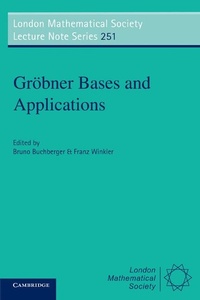
Groebner Bases and Applications
Published on 26. February 1998
Book
Paperback/Softback
564 pages
978-0-521-63298-0 (ISBN)
Description
The theory of Groebner bases, invented by Bruno Buchberger, is a general method by which many fundamental problems in various branches of mathematics and engineering can be solved by structurally simple algorithms. The method is now available in all major mathematical software systems. This book provides a short and easy-to-read account of the theory of Groebner bases and its applications. It is in two parts, the first consisting of tutorial lectures, beginning with a general introduction. The subject is then developed in a further twelve tutorials, written by leading experts, on the application of Groebner bases in various fields of mathematics. In the second part are seventeen original research papers on Groebner bases. An appendix contains the English translations of the original German papers of Bruno Buchberger in which Groebner bases were introduced.
Reviews / Votes
'This book provides a short and easy-to-read account of the theory of Groebner bases and its applications.' L'Enseignment Mathematique 'The book is warmly recommended ...' European Mathematical SocietyMore details
Series
Language
English
Place of publication
Cambridge
United Kingdom
Target group
Professional and scholarly
Product notice
Paperback (trade)
Illustrations
Worked examples or Exercises
Dimensions
Height: 229 mm
Width: 152 mm
Thickness: 33 mm
Weight
905 gr
ISBN-13
978-0-521-63298-0 (9780521632980)
Copyright in bibliographic data and cover images is held by Nielsen Book Services Limited or by the publishers or by their respective licensors: all rights reserved.
Schweitzer Classification
Other editions
Additional editions
Bruno Buchberger | Franz Winkler
Groebner Bases and Applications
E-Book
05/2012
1st Edition
Cambridge University Press
€106.99
Available for download
Persons
Content
Preface; 1. Programme committee; Introduction to Groebner bases B. Buchberger; 2. Groebner bases, symbolic summation and symbolic integration F. Chyzak; 3. Groebner bases and invariant theory W. Decker and T. de Jong; 4. Groebner bases and generic monomial ideals M. Green and M. Stillman; 5. Groebner bases and algebraic geometry G. M. Greuel; 6. Groebner bases and integer programming S. Hosten and R. Thomas; 7. Groebner bases and numerical analysis H. M. Moeller; 8. Groebner bases and statistics L. Robbiano; 9. Groebner bases and coding theory S. Sakata; 10. Janet bases for symmetry groups F. Schwarz; 11. Groebner bases in partial differential equations D. Struppa; 12. Groebner bases and hypergeometric functions B. Sturmfels and N. Takayama; 13. Introduction to noncommutative Groebner bases theory V. Ufnarovski; 14. Groebner bases applied to geometric theorem proving and discovering D. Wang; 15. The fractal walk B. Amrhein and O. Gloor; 16. Groebner bases property on elimination ideal in the noncommutative case M. A. Borges and M. Borges; 17. The CoCoA 3 framework for a family of Buchberger-like algorithms A. Capani and G. Niesi; 18. Newton identities in the multivariate case: Pham systems M.-J. Gonzalez-Lopez and L. Gonzalez-Vega; 19. Groebner bases in rings of differential operators M. Insa and F. Pauer; 20. Canonical curves and the Petri scheme J. B. Little; 21. The Buchberger algorithm as a tool for ideal theory of polynomial rings in constructive mathematics H. Lombardi and H. Perdry; 22. Groebner bases in non-commutative reduction rings K. Madlener and B. Reinert; 23. Effective algorithms for intrinsically computing SAGBI-Groebner bases in a polynomial ring over a field J. L. Miller; 24. De Nugis Groebnerialium 1: Eagon, Northcott, Groebner F. Mora; 25. An application of Groebner bases to the decomposition of rational mappings J. Mueller-Quade, R. Steinwandt and T. Beth; 26. On some basic applications of Groebner bases in noncommutative polynomial rings P. Nordbeck; 27. Full factorial designs and distracted fractions L. Robbiano and M. P. Rogantin; 28. Polynomial interpolation of minimal degree and Groebner bases T. Sauer; 29. Inversion of birational maps with Groebner bases J. Schicho; 30. Reverse lexicographic initial ideas of generic ideals are finitely generated J. Snellman; 31. Parallel computation and Groebner bases: an application for converting bases with the Groebner walk Q.-N. Tran; 32. Appendix. an algorithmic criterion for the solvability of a system of algebraic equations B. Buchberger (translated by M. Abramson and R. Lumbert); Index of Tutorials.