

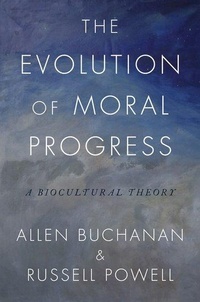
The Evolution of Moral Progress
A Biocultural Theory
Published on 30. August 2018
Book
Hardback
440 pages
978-0-19-086841-3 (ISBN)
Description
In The Evolution of Moral Progress, Allen Buchanan and Russell Powell resurrect the project of explaining moral progress. They avoid the errors of earlier attempts by drawing on a wide range of disciplines including moral and political philosophy, evolutionary biology, evolutionary psychology, anthropology, history, and sociology.
Their focus is on one especially important type of moral progress: gains in inclusivity. They develop a framework to explain progress in inclusivity to also illuminate moral regression--the return to exclusivist and "tribalistic" moral beliefs and attitudes. Buchanan and Powell argue those tribalistic moral responses are not hard-wired by evolution in human nature. Rather, human beings have an evolved "adaptively plastic" capacity for both inclusion and exclusion, depending on environmental conditions. Moral progress in the dimension of inclusivity is possible, but only to the extent that human beings can create environments conducive to extending moral standing to all human beings and even to some animals. Buchanan and Powell take biological evolution seriously, but with a critical eye, while simultaneously recognizing the crucial role of culture in creating environments in which moral progress can occur. The book avoids both biological and cultural determinism. Unlike earlier theories of moral progress, their theory provides a naturalistic account that is grounded in the best empirical work, and unlike earlier theories it does not present moral progress as inevitable or as occurring in definite stages; but rather it recognizes the highly contingent and fragile character of moral improvement.
Their focus is on one especially important type of moral progress: gains in inclusivity. They develop a framework to explain progress in inclusivity to also illuminate moral regression--the return to exclusivist and "tribalistic" moral beliefs and attitudes. Buchanan and Powell argue those tribalistic moral responses are not hard-wired by evolution in human nature. Rather, human beings have an evolved "adaptively plastic" capacity for both inclusion and exclusion, depending on environmental conditions. Moral progress in the dimension of inclusivity is possible, but only to the extent that human beings can create environments conducive to extending moral standing to all human beings and even to some animals. Buchanan and Powell take biological evolution seriously, but with a critical eye, while simultaneously recognizing the crucial role of culture in creating environments in which moral progress can occur. The book avoids both biological and cultural determinism. Unlike earlier theories of moral progress, their theory provides a naturalistic account that is grounded in the best empirical work, and unlike earlier theories it does not present moral progress as inevitable or as occurring in definite stages; but rather it recognizes the highly contingent and fragile character of moral improvement.
Reviews / Votes
Highly recommended. * J.H. Barker, CHOICE * This is a well-written book in which a novel and insightful theory of moral progress is developed. The analysis is rich and the research on which it rests is extensive. This will be of interest to students and researchers concerned with the interface of ethics and evolution, philosophy of biology, evolutionary psychology, and the importance of moral progress. * R. Paul Thompson, The Quarterly Review of Biology * Buchanan and Powell's rich book will justly be of interest to a broad variety of readers, philosophers as well as non-philosophers ... an illuminating book on a vitally important and intriguing topic. * Toni Ronnow-Rasmussen, Metascience * It seems that the book discussed might be regarded as obligatory reading for everyone interested in the idea of moral progress, but also for those who as-sume that the evolutionary past strongly affects - usually in a negative way - our current moral intuitions and patterns. * Konrad Szocik, European Society for the Study of Science and Theology * an illuminating book on a vitally important and intriguing topic. * Toni Ronnow-Rasmussen, Metascience * This book is neither about Marx nor Marxism, yet it will be of interest to any reader who, like Marx, is interested in the phenomenon of progress, and the material conditions that underlie it. Allen Buchanan and Russell Powell, philosophers with respective specializations in the fields of ethics and the philosophy of biology, offer a novel 'biocultural' theory of the conditions amenable to moral progress, and take issue with so-called 'evoconservative' views according to which our evolved psychology imposes severe constraints on the possibility of progress [...] Especially illuminating about Buchanan and Powell's biocultural theory is their analysis of the conditions that are likely to lead to an inclusivist moral response, and those likely to lead to moral exclusivism. * Jeroen Hopster, Utrecht University, Marx & Philosophy Review of Books * A compelling, well-researched, and timely book. It articulates arguably the most persuasive naturalistic theory of moral progress to date, and lays the groundwork for important and impactful research. * Michael Brownstein and Daniel Kelly, The British Journal of Philosophy of Science * This is a marvelous book...none of my worries about how to develop their proposals further lessen to any substantial degree my enthusiasm for their book [which] is remarkable in bringing us as I hope closer to a point where we can sketch and begin to confirm the kind of account they seek. * Allan Gibbard, Notre Dame Philosophical Reviews *More details
Language
English
Place of publication
New York
United States
Target group
Professional and scholarly
Dimensions
Height: 244 mm
Width: 164 mm
Thickness: 38 mm
Weight
718 gr
ISBN-13
978-0-19-086841-3 (9780190868413)
Copyright in bibliographic data and cover images is held by Nielsen Book Services Limited or by the publishers or by their respective licensors: all rights reserved.
Schweitzer Classification
Other editions
Additional editions
E-Book
06/2018
1st Edition
OUP eBook
€20.99
Available for download
E-Book
06/2018
1st Edition
OUP eBook
€20.99
Available for download
Persons
Allen Buchanan is James B. Duke Professor of Philosophy at Duke University.
Russell Powell is Assistant Professor of Philosophy at Boston University.
Russell Powell is Assistant Professor of Philosophy at Boston University.
Content
Introduction: Why a Theory of Moral Progress is Needed
Part One: What is Moral Progress?
Chapter 1: A Typology of Moral Progress
Chapter 2: Contemporary Accounts of Moral Progress
Chapter 3: A Pluralistic, Dynamic Conception of Moral Progress
Part Two: Evolution and the Possibility of Moral Progress
Chapter 4: Is Evolved Human Nature an Obstacle to Moral Progress?
Chapter 5: The Inclusivist Anomaly and the Limits of Evolutionary Explanation
Chapter 6: Toward a Naturalistic Theory of Inclusivist Moral Progress
Chapter 7: Naturalizing Moral Regression: A Biocultural Account
Chapter 8: De-Moralization and the Evolution of Invalid Moral Norms
Part Three: The Path Traveled and the Way Forward
Chapter 9: Improvements in Moral Understanding and the Human Rights Movement
Chapter 10: Human Rights Naturalized
Chapter 11: Biomedical Moral Enhancement and Moral Progress
Conclusion: The Future of Human Morality
Appendix: Topics for Further Research
Part One: What is Moral Progress?
Chapter 1: A Typology of Moral Progress
Chapter 2: Contemporary Accounts of Moral Progress
Chapter 3: A Pluralistic, Dynamic Conception of Moral Progress
Part Two: Evolution and the Possibility of Moral Progress
Chapter 4: Is Evolved Human Nature an Obstacle to Moral Progress?
Chapter 5: The Inclusivist Anomaly and the Limits of Evolutionary Explanation
Chapter 6: Toward a Naturalistic Theory of Inclusivist Moral Progress
Chapter 7: Naturalizing Moral Regression: A Biocultural Account
Chapter 8: De-Moralization and the Evolution of Invalid Moral Norms
Part Three: The Path Traveled and the Way Forward
Chapter 9: Improvements in Moral Understanding and the Human Rights Movement
Chapter 10: Human Rights Naturalized
Chapter 11: Biomedical Moral Enhancement and Moral Progress
Conclusion: The Future of Human Morality
Appendix: Topics for Further Research