

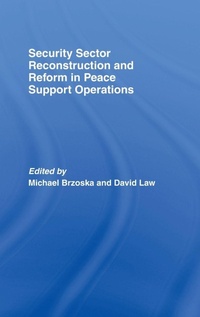
Security Sector Reconstruction and Reform in Peace Support Operations
1st Edition
Published on 7. December 2006
Book
Hardback
142 pages
978-0-415-37786-7 (ISBN)
Description
This volume provides a framework for analyzing security sector reform under international tutelage.
Following violent conflict and military interventions, international organizations or coalitions of countries increasingly engage in post-conflict reconstruction. Part of the international post-conflict agenda is the 'reconstruction' or 'reform' of the security sector (SSR). In post-conflict situations, the security sector is often characterized by politicization, ethnicization, corruption of the security services, excessive military spending, lack of professionalism, poor oversight and inefficient allocation of resources. At the same time, there is great need for effective and efficient (re-)establishment of a legitimate monopoly of force. While initially this is in the purview of the external intervention forces, they also face the task of the building up of effective, efficient accountable and democratically legitimized security forces as quickly as possible.
The contributors analyze six pertinent cases: Afghanistan, Bosnia-Herzegovina, Haiti, Kosovo, Sierra Leone and Timor Leste, focusing on issues such as priorities for security and for security sector reform, sequencing of reconstruction and reform, tensions between requirements of security and security governance and the interaction of domestic and external actors in security sector reform.
This book was previously published as a special issue of International Peacekeeping.
Following violent conflict and military interventions, international organizations or coalitions of countries increasingly engage in post-conflict reconstruction. Part of the international post-conflict agenda is the 'reconstruction' or 'reform' of the security sector (SSR). In post-conflict situations, the security sector is often characterized by politicization, ethnicization, corruption of the security services, excessive military spending, lack of professionalism, poor oversight and inefficient allocation of resources. At the same time, there is great need for effective and efficient (re-)establishment of a legitimate monopoly of force. While initially this is in the purview of the external intervention forces, they also face the task of the building up of effective, efficient accountable and democratically legitimized security forces as quickly as possible.
The contributors analyze six pertinent cases: Afghanistan, Bosnia-Herzegovina, Haiti, Kosovo, Sierra Leone and Timor Leste, focusing on issues such as priorities for security and for security sector reform, sequencing of reconstruction and reform, tensions between requirements of security and security governance and the interaction of domestic and external actors in security sector reform.
This book was previously published as a special issue of International Peacekeeping.
Reviews / Votes
'...this book provides us with a clear set of indexes to help us determine what we mean by successful SSR. It also lays out the various SSR challenges for international actors in the detailed descriptions of the six most prominent case studies. As a result, this is a very useful book, not only for students of SSR but also for all those interested in peace support operations.'Atsushi Yasutomi, Security DialogueMore details
Language
English
Place of publication
London
United Kingdom
Publishing group
Taylor & Francis Ltd
Target group
College/higher education
Professional and scholarly
Dimensions
Height: 240 mm
Width: 161 mm
Thickness: 13 mm
Weight
388 gr
ISBN-13
978-0-415-37786-7 (9780415377867)
Copyright in bibliographic data and cover images is held by Nielsen Book Services Limited or by the publishers or by their respective licensors: all rights reserved.
Schweitzer Classification
Other editions
Additional editions
Michael Brzoska | Law David
Security Sector Reconstruction and Reform in Peace Support Operations
Book
06/2016
1st Edition
Routledge
€72.70
Shipment within 10-20 days
Michael Brzoska | Law David
Security Sector Reconstruction and Reform in Peace Support Operations
E-Book
12/2006
1st Edition
Routledge
€67.49
Available for download
Michael Brzoska | Law David
Security Sector Reconstruction and Reform in Peace Support Operations
E-Book
12/2006
1st Edition
Routledge
€67.49
Available for download
Persons
Michael Brzoska, Director of Research, Bonn International Center for Conversion (BICC), has published widely on the role of armed forces in developing countries, military expenditures and the arms trade and security sector reform.
David Law is Senior Fellow, Security Sector Reform, Geneva Center for the Democratic Control of Armed Forces (DCAF) and coordinator of the DCAF Working Group on Security Sector Reform. In this capacity, he works on such issues as security sector reform in the Euro-Atlantic area, the interface between the security and development communities as well as the conceptual and programming links between security sector reform and other new approaches to security that have emerged in the post-Cold War environment, such as Human Security
David Law is Senior Fellow, Security Sector Reform, Geneva Center for the Democratic Control of Armed Forces (DCAF) and coordinator of the DCAF Working Group on Security Sector Reform. In this capacity, he works on such issues as security sector reform in the Euro-Atlantic area, the interface between the security and development communities as well as the conceptual and programming links between security sector reform and other new approaches to security that have emerged in the post-Cold War environment, such as Human Security
Content
Post-Conflict Reconstruction and Reform of the Security Sector under International Tutelage: A Framework for Analysis Michael Brzoska and Andreas Heinemann-Grueder. Security Sector Reform in Afghanistan: The Slide Toward Expediency Mark Sedra. Security Sector Reform in Bosnia and Herzegovina and the Role of the International Community: Background, Development and Results Heinz Vetschera. Security Sector Reform in Haiti: What Prospects for a Shadow State? Johanna Mendelson-Forman. Security Governance by Internationals: The Case of Kosovo Andreas Heinemann-Grueder and Igor Grebenschikov. Security Sector Reform in Post-Conflict Reconstruction under International Tutelage: The Sierra Leone Case Osman Gbla. Security Sector Construction in Timor Leste Nicola Dahrendorf. Summary and Comparative Analysis David Law.