

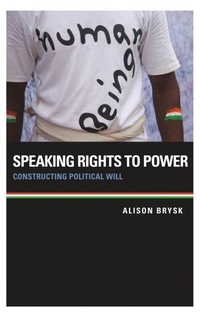
Speaking Rights to Power
Constructing Political Will
Published on 19. September 2013
Book
Hardback
272 pages
978-0-19-998266-0 (ISBN)
Description
How can "Speaking Rights to Power" construct political will to respond to human rights abuse worldwide? Examining dozens of cases of human rights campaigns, this book shows how carefully crafted communications build recognition, solidarity, and social change. Alison Brysk presents an innovative analysis of the politics of persuasion, based in the strategic use of voice, framing, media, protest performance, and audience bridging.
Building on twenty years of research on five continents, this comprehensive study ranges from Aung San Suu Kyi to Anna Hazare, from Congo to Colombia, and from the Arab Spring to Pussy Riot. It includes both well-chronicled campaigns, such as the struggle to end violence against women, as well as lesser-known efforts, including inter-ethnic human rights alliances in the U.S. Brysk compares relatively successful human rights campaigns with unavailing struggles. Grounding her analysis in the concrete practice of human rights campaigns, she lays out testable strategic guidance for human rights advocates.
Speaking Rights to Power addresses cutting edge debates on human rights and the ethic of care, cosmopolitanism, charismatic leadership, communicative action and political theater, and the role of social media. It draws on constructivist literature from social movement and international relations theory, and it analyzes human rights as a form of global social imagination. Combining a normative contribution with judicious critique, this book shows not only that human rights rhetoric matters-but how to make it matter more.
Building on twenty years of research on five continents, this comprehensive study ranges from Aung San Suu Kyi to Anna Hazare, from Congo to Colombia, and from the Arab Spring to Pussy Riot. It includes both well-chronicled campaigns, such as the struggle to end violence against women, as well as lesser-known efforts, including inter-ethnic human rights alliances in the U.S. Brysk compares relatively successful human rights campaigns with unavailing struggles. Grounding her analysis in the concrete practice of human rights campaigns, she lays out testable strategic guidance for human rights advocates.
Speaking Rights to Power addresses cutting edge debates on human rights and the ethic of care, cosmopolitanism, charismatic leadership, communicative action and political theater, and the role of social media. It draws on constructivist literature from social movement and international relations theory, and it analyzes human rights as a form of global social imagination. Combining a normative contribution with judicious critique, this book shows not only that human rights rhetoric matters-but how to make it matter more.
Reviews / Votes
This remarkable book shows the power of communication in enforcing human rights and dignity in our troubled world. At the crossroads of international relations and communication theory, Alison Brysk's original contribution is convincing, forceful, and opens new perspectives in the political understanding of globalization. * Manuel Castells, University Professor and Wallis Annenberg Chair in Communication Technology and Society, University of Southern California * Speaking Rights to Power is a wonderful book that pulls together twenty years of Alison Brysk's insightful and influential research on human rights and extends it with fresh and provocative ideas. The book is an extraordinary combination of systematic research, practical wisdom (what has mostly worked and what has not), and personal commitment. I both learned a great deal and thoroughly enjoyed it. * Wayne Sandholtz, John A. McCone Chair in International Relations, School of International Relations and Gould School of Law, University of Southern California * A wonderful book for teaching. My students loved the contemporary examples from all over the world. Using those examples and Brysk's key ideas, they were able to teach each other, and try to design a successful campaign for the Congo. * Rhoda E. Howard-Hassmann, Canada Research Chair in International Human Rights, Wilfrid Laurier University *More details
Language
English
Place of publication
New York
United States
Target group
College/higher education
Dimensions
Height: 240 mm
Width: 161 mm
Thickness: 19 mm
Weight
575 gr
ISBN-13
978-0-19-998266-0 (9780199982660)
Copyright in bibliographic data and cover images is held by Nielsen Book Services Limited or by the publishers or by their respective licensors: all rights reserved.
Schweitzer Classification
Other editions
Additional editions
Book
09/2013
Oxford University Press Inc
€52.00
Shipment within 15-20 days
E-Book
08/2013
1st Edition
OUP eBook
€21.99
Available for download
E-Book
08/2013
1st Edition
OUP eBook
€23.99
Available for download
Person
Alison Brysk is Mellichamp Professor of Global Governance at the University of California-Santa Barbara.
Content
PREFACE ; INTRODUCTION: Rhetoric For Rights ; 1) SPEAKING RIGHTS ; a. Why We Care: Constructing solidarity ; b. The message: Human rights as global social imagination ; c. Hearts and Minds: The politics of persuasion ; 2) HISTORICAL REPERTOIRES: ATTENTION MUST BE PAID ; a. Solidarity: The Dreyfus Affair ; b. Internationalism: The Spanish Civil War ; c. Symbolism: The Holocaust ; d. Globalization: Revolution 2.0 ; 3) VOICES: HEROES, MARTYRS, WITNESSES, AND EXPERTS ; a. Heroes and martyrs ; i. Nelson Mandela ; ii. Aung San Suu Kyi ; iii. Mothers of the Disappeared ; b. Witnesses and experts ; i. Doctors Without Borders ; ii. Amartya Sen ; iii. Paul Farmer ; c. <"The dog that didn't bark>": Death penalty campaigns in the U.S. ; 4) THE MESSAGE MATTERS: FRAMING THE CLAIM ; a. Poster children and sex slavery: framing human trafficking ; b. Reframing FGM: <"Our bodies, our selves>" ; c. Human rights in Colombia: when frames fail ; d. The rhetoric of recognition: Darfur vs. Congo ; 5) PLOTTING RIGHTS: THE POWER OF PERFORMANCE ; a. From tragedy to testimonial: ; i. Voices of Witness ; ii. The Vagina Monologues ; b. Allegory as protest performance: Indian Summer ; c. The Power of Parody ; 1. From Putin's penis to Pussy Riot ; 2. Speaking <"truthiness>" to power: the Colbert challenge ; 6) MOBILIZING MEDIA: IS THERE AN APP FOR THAT? ; a. Iran: The revolution will not be televised ; b. China: The Long March to human rights ; c. The Arab Spring: The Face book path to freedom ; d. Kony 2012: When buzz is not enough ; 7) AUDIENCES: CONSTRUCTING COSMOPOLITANS ; a. Building communities of conscience: Scholars at Risk ; b. Inter-ethnic solidarity: <"My brother's keeper>" ; i. The Japanese-American Citizens' League and Arab-Americans ; ii. African-Americans and the anti-apartheid movement ; iii. American Jews and Darfur ; iv. Armenian-Americans ; v. Dueling diasporas and burning bridges: Israel-Palestine ; c. Across the great divide: Men who care about violence against women ; i. Norm entrepreneurs: <"a few good men>" ; ii. Role change through small talk ; iii. Global Good Samaritans and gender-based asylum ; 8) CONSTRUCTING POLITICAL WILL ; a. Another world is possible ; b. The power of persuasion: The Liberian civil war ; c. Acting globally ; REFERENCES