

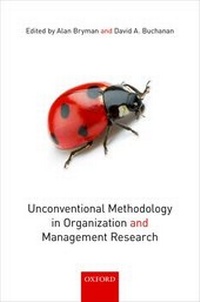
Unconventional Methodology in Organization and Management Research
Published on 22. March 2018
Book
Paperback/Softback
320 pages
978-0-19-879698-5 (ISBN)
Description
Most researchers in organization and management studies stick to two or three traditional research methods like surveys and interviews. Sticking with the familiar is seen as a safe bet, and innovation is discouraged by academic incentives and rewards. But research participants are now suffering from 'survey fatigue', and using the same old methods runs the risk of generating the same old findings.
This book describes twelve unconventional methodologies in organization and management research. These include unconventional research settings and data sources, unconventional research designs and data collection methods, unconventional analytic approaches, and designs and methods that exploit new technology developments. The aim is to encourage dialogue and experimentation with regard to the development of innovative, unconventional approaches to organization and management research. Several commentators have criticized the way in which research methods have become more formulaic, and have argued for greater diversity in research approaches. The methodological perspective that the we adopt shapes our interpretation of the information that we gather. Different methods generate different kinds of information, leading to different ways of understanding the phenomena that we are investigating. Our methods influence our styles of theorizing, ways of thinking and reasoning, and forms of writing and reporting research.
This book will be of value to academic researchers in organization and management studies, Doctoral candidates, and Masters students on MBA and similar programmes.
This book describes twelve unconventional methodologies in organization and management research. These include unconventional research settings and data sources, unconventional research designs and data collection methods, unconventional analytic approaches, and designs and methods that exploit new technology developments. The aim is to encourage dialogue and experimentation with regard to the development of innovative, unconventional approaches to organization and management research. Several commentators have criticized the way in which research methods have become more formulaic, and have argued for greater diversity in research approaches. The methodological perspective that the we adopt shapes our interpretation of the information that we gather. Different methods generate different kinds of information, leading to different ways of understanding the phenomena that we are investigating. Our methods influence our styles of theorizing, ways of thinking and reasoning, and forms of writing and reporting research.
This book will be of value to academic researchers in organization and management studies, Doctoral candidates, and Masters students on MBA and similar programmes.
Reviews / Votes
Bryman and Buchanan have assembled an interesting and rigorous set of chapters designed to introduce readers to some of the most novel approaches to data collection, research design, and data analysis. Importantly, this assemblage includes ideas sampled from a broad array of disciplines spanning quantitative, qualitative, and mixed methods domains. I strongly recommend this book to any scholar seeking to expand the tools comprising his or her methodological tool chest. * James M. LeBreton, Professor of Psychology, Pennsylvania State University, and Editor of Organizational Research Methods * At present there are strong institutional forces pushing scholars towards publishing safe, conventional papers, which rarely advance methodological thinking or generate major theoretical advances. Unconventional Methodology in Organization and Management Research is a welcome call for pluralism and diversity, which brings together a provocative and stimulating collection of contributions. It should be compulsory reading for students of research methods, but will also provide more experienced scholars with valuable insights and hopefully challenge them to expand their methodological repertoires. * Professor Bill Harley, James Riady Chair of Asian Business, The University of Melbourne and Editor of Journal of Management Studies * Most journal editors and readers crave 'something different' in topics of inquiry and the design of research. This book shows why conservatism in fact prevails and provides a powerful and comprehensive set of exemplars of alternative unconventional approaches, covering sources of data, methods, and modes of analysis. It will freeire scholars to be more imaginative in their research. Journal editors and their readers will be truly grateful. * Paul Edwards, Professor of Employment Relations, University of Birmingham and former editor-in-chief of Human Relations * At a time it is common to bemoan research which is rather boring this stimulating book conceived by Alan Bryman and David Buchanan points out that methods matter and that most researchers use a limited range of conventional approaches which affects what they see and how they see it. Furthermore researchers' methodological perspective also shapes their interpretation of the research. They point the way forward for more adventurous research with unconventional approaches to methodology including unconventional settings, unconventional research design and data collection, and unconventional analytic approaches. * Professor Adrian Wilkinson, Centre for Work, Organisation and Wellbeing, Griffith University, Queensland Australia, and Editor-in-Chief, Human Resource Management Journal *More details
Language
English
Place of publication
Oxford
United Kingdom
Target group
College/higher education
Dimensions
Height: 234 mm
Width: 156 mm
Thickness: 17 mm
Weight
486 gr
ISBN-13
978-0-19-879698-5 (9780198796985)
Copyright in bibliographic data and cover images is held by Nielsen Book Services Limited or by the publishers or by their respective licensors: all rights reserved.
Schweitzer Classification
Other editions
Additional editions
Alan Bryman | David A. Buchanan
Unconventional Methodology in Organization and Management Research
E-Book
03/2018
1st Edition
OUP eBook
€36.49
Available for download
Alan Bryman | David A. Buchanan
Unconventional Methodology in Organization and Management Research
E-Book
03/2018
1st Edition
OUP eBook
€36.49
Available for download
Persons
Alan Bryman is Emeritus Professor of Organizational and Social Research at the University of Leicester School of Business, UK. His research interests focus on methodology, leadership, organizational analysis, Disneyization, and theme parks. He has published on social and organizational research methods, including two leading textbooks (Social Research Methods, and Business Research Methods) which have been translated into numerous other languages, and he has a specific interest in leadership in higher education.
David Buchanan is Emeritus Professor of Organizational Behaviour at Cranfield University School of Management, UK. His research interests lie with change management and organization politics. He is co-author of a leading text in organizational behaviour, and co-editor with Alan Bryman of The Sage Handbook of Organizational Research Methods (2009). Current projects include studies of change in healthcare, post-crisis change, and the implications of new technology for the role of the HR function.
David Buchanan is Emeritus Professor of Organizational Behaviour at Cranfield University School of Management, UK. His research interests lie with change management and organization politics. He is co-author of a leading text in organizational behaviour, and co-editor with Alan Bryman of The Sage Handbook of Organizational Research Methods (2009). Current projects include studies of change in healthcare, post-crisis change, and the implications of new technology for the role of the HR function.
Content
1: David A. Buchanan and Alan Bryman: 'Not Another Survey': The Value of Unconventional Methods
Part 1 Unconventional settings and data sources
2: Laurie Cohen and Joanne Duberley: Desert Island Data: Using BBC Radio 4's Desert Island Discs in Organization and Management Research
3: Robin Holt and Mike Zundel: Using Fiction in Organization and Management Research
4: Andrew Knight: Innovations in Unobtrusive Methods
5: David A. Buchanan and David Denyer: Research in Extreme Contexts
6: Christopher J. Schneider: Making the Case: A Qualitative Approach to Studying Social Media Documents
Part 2: Unconventional Research Design and Data Collection Methods
7: Robert Kozinets and Manuela Nocker: Netnography: Engaging with the Challenges
8: Alex Bitektine, Jeffrey W. Lucas, and Oliver Schilke: Institutions Under A Microscope: Experimental Methods in Institutional Theory
9: Steve Kempster and Ken Parry: Beyond One Voice: Co-Constructed Analytic Auto-Ethnography
10: Rebecca Whiting, Helen Roby, Gillian Symon, and Petros Chamakiotis: Participant-Led Video Diaries
11: Olivier Berthod, Michael Grothe-Hammer, and Joerg Sydow: Inter-Organizational Ethnography: Promises and Pitfalls
Part 3 Unconventional Analytic Approaches
12: Paul Carlile And Karl-Emanuel Dionne: Unconventional Yet Consequential: Using A Sociomaterial Approach To Drive Impact in Organization Studies Research
13: Joerg Sydow, Arnold Windeler, Gordon Mueller-Seitz And Knut Lange: Path Constitution Analysis: A Methodology For Understanding Path Dependence and Path Creation
14: Alan Bryman And David A. Buchanan: Methodology Matters
Part 1 Unconventional settings and data sources
2: Laurie Cohen and Joanne Duberley: Desert Island Data: Using BBC Radio 4's Desert Island Discs in Organization and Management Research
3: Robin Holt and Mike Zundel: Using Fiction in Organization and Management Research
4: Andrew Knight: Innovations in Unobtrusive Methods
5: David A. Buchanan and David Denyer: Research in Extreme Contexts
6: Christopher J. Schneider: Making the Case: A Qualitative Approach to Studying Social Media Documents
Part 2: Unconventional Research Design and Data Collection Methods
7: Robert Kozinets and Manuela Nocker: Netnography: Engaging with the Challenges
8: Alex Bitektine, Jeffrey W. Lucas, and Oliver Schilke: Institutions Under A Microscope: Experimental Methods in Institutional Theory
9: Steve Kempster and Ken Parry: Beyond One Voice: Co-Constructed Analytic Auto-Ethnography
10: Rebecca Whiting, Helen Roby, Gillian Symon, and Petros Chamakiotis: Participant-Led Video Diaries
11: Olivier Berthod, Michael Grothe-Hammer, and Joerg Sydow: Inter-Organizational Ethnography: Promises and Pitfalls
Part 3 Unconventional Analytic Approaches
12: Paul Carlile And Karl-Emanuel Dionne: Unconventional Yet Consequential: Using A Sociomaterial Approach To Drive Impact in Organization Studies Research
13: Joerg Sydow, Arnold Windeler, Gordon Mueller-Seitz And Knut Lange: Path Constitution Analysis: A Methodology For Understanding Path Dependence and Path Creation
14: Alan Bryman And David A. Buchanan: Methodology Matters