

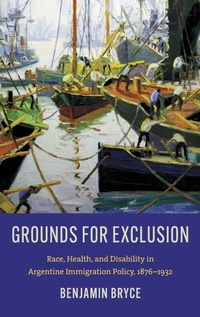
Grounds for Exclusion
Race, Health, and Disability in Argentine Immigration Policy, 1876-1932
Published on 24. April 2026
Book
Hardback
266 pages
978-1-4696-9534-1 (ISBN)
Description
Argentina has been one the most important destinations for international labor migrants in the modern world. But while it was long imagined as a nation of immigrants, a closer look at its history and policies reveals that the country's doors were only open to certain people. In the late nineteenth and early twentieth centuries, officials developed a long list of grounds for exclusion that deterred many people from ever boarding a ship to the country. Travelers who did come to Argentina were frequently barred at ports of entry on account of race, health, or disability.
Tracing the attempts of European, Asian, and Middle Eastern migrants to enter Argentina, Benjamin Bryce shows how the modern state worked to privilege white supremacy and expansion over diversity and magnanimity. As Argentine officials, politicians, and influential thinkers envisioned their country's future, they tried to define the ideal citizens who would live, work, vote, and reproduce in Argentina-and the characteristics of those who would not. Anyone deemed unhealthy or disabled was labeled unproductive or a potential burden on the state. Race often shaped notions of health and productivity and therefore determined who was welcome. Bryce's thorough analysis of immigration exclusions reconceptualizes Argentina's long-accepted reputation as a haven for newcomers.
Tracing the attempts of European, Asian, and Middle Eastern migrants to enter Argentina, Benjamin Bryce shows how the modern state worked to privilege white supremacy and expansion over diversity and magnanimity. As Argentine officials, politicians, and influential thinkers envisioned their country's future, they tried to define the ideal citizens who would live, work, vote, and reproduce in Argentina-and the characteristics of those who would not. Anyone deemed unhealthy or disabled was labeled unproductive or a potential burden on the state. Race often shaped notions of health and productivity and therefore determined who was welcome. Bryce's thorough analysis of immigration exclusions reconceptualizes Argentina's long-accepted reputation as a haven for newcomers.
Reviews / Votes
"Truly remarkable multilanguage research that illuminates the international system of immigration restriction at work during the nineteenth and twentieth centuries. Readers will be intrigued by the parallels between the United States and Argentina's systems of exclusion in immigration policy."-Benjamin Montoya, author of A Diplomatic History of US Immigration During the 20th Century: Policy, Law, and National Identity?"Benjamin Bryce's careful attention to how state officials and their allies used race, national origin, and health to build a 'system of exclusion' provides fresh challenges to popular histories of Argentina that overlook the restriction of immigration to the country."-Eduardo Elena, author of Dignifying Argentina: Peronism, Citizenship, and Mass Consumption
More details
Series
Language
English
Place of publication
Chapel Hill
United States
Target group
Professional and scholarly
Product notice
Trade binding
Illustrations
9 illustrations - 9 halftones, 9 tables - 9 Tables, unspecified - 9 Halftones, unspecified
Dimensions
Height: 240 mm
Width: 161 mm
Thickness: 20 mm
Weight
619 gr
ISBN-13
978-1-4696-9534-1 (9781469695341)
Copyright in bibliographic data and cover images is held by Nielsen Book Services Limited or by the publishers or by their respective licensors: all rights reserved.
Schweitzer Classification
Other editions
Additional editions
Benjamin Bryce
Grounds for Exclusion
Race, Health, and Disability in Argentine Immigration Policy, 1876-1932
E-Book
04/2026
The University of North Carolina Press
€29.49
Available for download
Person
Benjamin Bryce is associate professor of history at the University of British Columbia.