

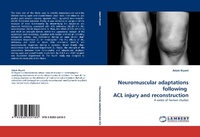
Neuromuscular Adaptations Following ACL Injury and Reconstruction
A series of human studies
Published on 31. October 2009
Book
Paperback/Softback
392 pages
978-3-8383-2418-0 (ISBN)
Description
The main aim of this thesis was to identify neuromuscular variables, derived during open and closed kinetic chain tasks that relate to and predict post anterior cruciate ligament (ACL) injury/ACL reconstruction (ACLR) functional outcome. Firstly, it was necessary to assign a clinical measure of knee functionality by determining the subjective and objective limitations associated with ACL deficiency (ACLD) and ACL reconstruction (ACLR) (Experiment 1). Then, the effect of ACL deficiency and ACLR on strength deficits within the operational domain of the quadriceps and hamstrings, together with medial and lateral hamstring antagonist activity, was determined during an open kinetic chain movement (Experiment 2). An investigation into the effects of ACL deficiency and ACLR on lower limb kinematics, kinetics and neuromuscular responses during a dynamic, closed kinetic chain deceleration task followed (Experiment 3). Finally, the strength of the associations between knee functionality and adaptations displayed during open and closed kinetic chain tasks by ACLD and ACLR subjects was elucidated (Experiment 4). The fourth study was designed to address the main aim of the thesis.
More details
Language
English
Place of publication
Germany
Product notice
Paperback (trade)
Unsewn / adhesive bound
Dimensions
Height: 220 mm
Width: 150 mm
Thickness: 25 mm
Weight
602 gr
ISBN-13
978-3-8383-2418-0 (9783838324180)
Copyright in bibliographic data and cover images is held by Nielsen Book Services Limited or by the publishers or by their respective licensors: all rights reserved.
Schweitzer Classification
Person
Dr Bryant is a biomechanist whose research focuses on identifying the underlying mechanisms of sports-related injuries. In addition, his research has a strong emphasis on the derivation of biomechanical adaptations that allow individuals with damaged or surgically reconstructed knee ligaments to exhibit near-normal levels of physical function.