

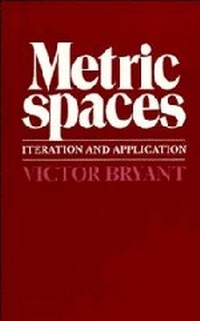
Metric Spaces
Iteration and Application
Published on 2. May 1985
Book
Hardback
112 pages
978-0-521-26857-8 (ISBN)
Description
Here is an introductory text on metric spaces that is the first to be written for students who are as interested in the applications as in the theory. Knowledge of metric spaces is fundamental to understanding numerical methods (for example for solving differential equations) as well as analysis, yet most books at this level emphasise just the abstraction and theory. Dr Bryant uses applications to provide motivation and to sustain the development and discusses numerical procedures where appropriate. The reader is expected to have had some exposure to elementary analysis, but the author provides examples throughout to refresh the student's memory and to test and extend understanding. In short, this is an introductory textbook that will appeal to students of mathematics and engineering and will give them the required background for more advanced courses in both analysis and numerical analysis.
Reviews / Votes
"...a fresh approach to a standard subject in topology and analysis...A healthy, vigorous introduction to analysis." American ScientistMore details
Language
English
Place of publication
Cambridge
United Kingdom
Target group
College/higher education
Professional and scholarly
Illustrations
Worked examples or Exercises
Dimensions
Height: 216 mm
Width: 138 mm
Weight
244 gr
ISBN-13
978-0-521-26857-8 (9780521268578)
Copyright in bibliographic data and cover images is held by Nielsen Book Services Limited or by the publishers or by their respective licensors: all rights reserved.
Schweitzer Classification
Other editions
New editions
Book
05/1985
Cambridge University Press
€57.10
Shipment within 15-20 days
Additional editions
Book
05/1985
Cambridge University Press
€57.10
Shipment within 15-20 days
Content
Preface; 1. Sequences by iteration; 2. Metric spaces; 3. The three Cs; 4. The contraction mapping principle; 5. What makes analysis work?; Index.