

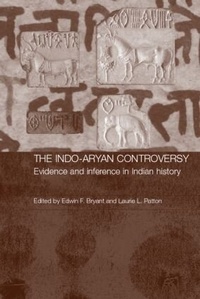
The Indo-Aryan Controversy
Evidence and Inference in Indian History
Published on 26. July 2005
Book
Hardback
536 pages
978-0-7007-1462-9 (ISBN)
Description
For the first time in a single volume, this book presents the various arguments in the Indo-Aryan controversy. It also provides a template for the basic issues addressing four major areas: archaeological research, linguistic issues, the interpretation of Vedic texts in their historical contexts, and ideological roots. The volume ends with a plea for a return to civility in the debates which have become increasingly, and unproductively, politicized, and suggests a program of research and inquiry upon which scholars from all sides of the debate might embark.
Reviews / Votes
'In her excellent introduction, coeditor Laurie Patton provides...a summary of the key issues involved in the debate...This monograph is an important step toward reappraising this field of enquiry and generating, as Patton suggests in her introduction, the sort of questions that could lead to rethinking the available evidence and structuring new field research.' - Traditional Yoga StudiesMore details
Language
English
Place of publication
London
United Kingdom
Publishing group
Taylor & Francis Ltd
Target group
College/higher education
Professional and scholarly
Illustrations
5 s/w Photographien bzw. Rasterbilder, 33 s/w Abbildungen, 5 s/w Tabellen, 28 s/w Zeichnungen
5 Tables, black and white; 28 Line drawings, black and white; 5 Halftones, black and white; 33 Illustrations, black and white
Dimensions
Height: 234 mm
Width: 156 mm
Weight
540 gr
ISBN-13
978-0-7007-1462-9 (9780700714629)
Copyright in bibliographic data and cover images is held by Nielsen Book Services Limited or by the publishers or by their respective licensors: all rights reserved.
Schweitzer Classification
Other editions
Additional editions
Book
07/2005
Routledge
€117.95
Shipment within 10-20 days
E-Book
08/2004
1st Edition
Routledge
€104.99
Available for download
E-Book
08/2004
1st Edition
Routledge
€104.99
Available for download
Persons
Edwin F. Bryant graduated from Columbia University in 1997, where he taught Sanskrit and Hindi. He was the lecturer in Hinduism at Harvard University for three years, and is presently assistant professor in Hinduism at Rutgers University, New Jersey. His publications include books on The Indo-Aryan Invasion Debate and Hinduism.
Laurie L. Patton is Professor of Early Indian Religions at Emory University and Winship Distinguished Research Professor in the Humanities. She is the author of two books and twenty five articles on early Indian myth and poetry, as well as a book of poetry and a translation of the Bhagavad Gita.
Laurie L. Patton is Professor of Early Indian Religions at Emory University and Winship Distinguished Research Professor in the Humanities. She is the author of two books and twenty five articles on early Indian myth and poetry, as well as a book of poetry and a translation of the Bhagavad Gita.
Content
Introduction Part 1: Archaeology 1. Culture Change During the Late Harappan Period at Harappa: New Insights on Vedic Aryan Issues 2. Aryan Invasion of India: Perpetuation of a Myth 3. South Asian Archaeology and the Myth of Indo-Aryan Invasions Part 2: Archaeology and Linguistics 4. The Cultural Counterparts to Proto-Indo-European, Proto-Uralic and Proto-Aryan: matching the Dispersal and Contact Patterns in the Linguistic and Archaeological Record 5. Archaeology and Language: The Case of the Bronze Age Indo-Iranians Part 3: Philology and Linguistics 6. The Date of the Rigveda and the Aryan Migration (Fresh Linguistic Evidence) 7. Linguistic Aspects of the Aryan Non-Invasion Theory 8. Philology and the Historical Interpretation of the Vedic Texts 9. Vedic Astronomy and Early Indian Chronology 10. The Textual Evidence: The Rigveda as a Source of Indo-European History 11. Indocentrism: Autochthonous Visions of Ancient India Part 4: Historiography 12. Aryan Origins: Arguments from 19th Century Maharashtra 13. Aryan Past and Post-Colonial Present: The Polemics and Politics of Indigenous Aryanism. Concluding Remarks