

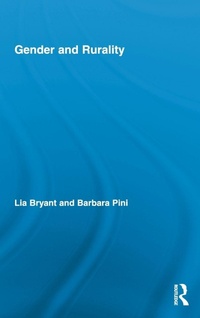
Gender and Rurality
1st Edition
Published on 16. July 2010
Book
Hardback
194 pages
978-0-415-48899-0 (ISBN)
Description
The study of gender in rural spaces is still in its infancy. Thus far, there has been little exploration of the constitution of the varied and differing ways that gender is constituted in rural settings. This book will place the question of gender, rurality and difference at its center.
The authors examine theoretical constructions of gender and explore the relationship between these and rural spaces. While there have been extensive debates in the feminist literature about gender and the intersection of multiple social categories, rural feminist social scientists have yet to theorize what gender means in a rural context and how gender blurs and intersects with other social categories such as sexuality, ethnicity, class and (dis)ability. This book will use empirical examples from a range of research projects undertaken by the authors as well as illustrations from work in the Australasia region, Europe, and the United States to explore gender and rurality and their relation to sexuality, ethnicity, class and (dis)ability.
The authors examine theoretical constructions of gender and explore the relationship between these and rural spaces. While there have been extensive debates in the feminist literature about gender and the intersection of multiple social categories, rural feminist social scientists have yet to theorize what gender means in a rural context and how gender blurs and intersects with other social categories such as sexuality, ethnicity, class and (dis)ability. This book will use empirical examples from a range of research projects undertaken by the authors as well as illustrations from work in the Australasia region, Europe, and the United States to explore gender and rurality and their relation to sexuality, ethnicity, class and (dis)ability.
More details
Series
Language
English
Place of publication
London
United Kingdom
Publishing group
Taylor & Francis Ltd
Target group
College/higher education
Illustrations
1 s/w Abbildung, 1 s/w Photographie bzw. Rasterbild
1 Halftones, black and white; 1 Illustrations, black and white
Dimensions
Height: 235 mm
Width: 157 mm
Thickness: 16 mm
Weight
459 gr
ISBN-13
978-0-415-48899-0 (9780415488990)
Copyright in bibliographic data and cover images is held by Nielsen Book Services Limited or by the publishers or by their respective licensors: all rights reserved.
Schweitzer Classification
Other editions
Additional editions
Lia Bryant | Barbara Pini
Gender and Rurality
Book
08/2011
1st Edition
Routledge
€73.60
Shipment within 15-20 days


Persons
Lia Bryant is a sociologist at the University of South Australia, and has been engaged in rural studies for 20 years. She has published widely on gender, sexuality and embodiment in the rural and has also had an ongoing interest in class and its intersections with gender in shaping relations in rural communities.
Barbara Pini has an extensive publication record in the areas of gender and rurality including the book Men, Masculinities and Management, published by Ashgate in 2009.?Publications have appeared in Gender, Work and Organization, Journal of Rural Studies, Sociologia Ruralis, Work, Employment and Society, Social and Cultural Geography and British Journal of the Sociology of Education.
Barbara Pini has an extensive publication record in the areas of gender and rurality including the book Men, Masculinities and Management, published by Ashgate in 2009.?Publications have appeared in Gender, Work and Organization, Journal of Rural Studies, Sociologia Ruralis, Work, Employment and Society, Social and Cultural Geography and British Journal of the Sociology of Education.
Content
1. Introduction 2. Gender, Indigeneity, and Rurality 3. Gender, Ethnicities, and Rurality 4. Gender, Class, and Rurality 5. Gender, Heterosexuality, and Rurality 6. Gender, Disability, and Rurality 7. Gender, Aging, and Rurality 8. Conclusion