

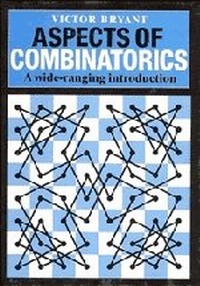
Aspects of Combinatorics
A Wide-ranging Introduction
Published on 14. January 1993
Book
Hardback
274 pages
978-0-521-41974-1 (ISBN)
Description
Combinatorics is a broad and important area of mathematics, and this textbook provides the beginner with the ideal introduction to many of the different aspects of the subject. By building up from the basics, and demonstrating the relationships between the various branches of combinatorics, Victor Bryant provides a readable text that presents its results in a straightforward way. Numerous examples and exercises, including hints and solutions, are included throughout and serve to lead the reader to some of the deeper results of the subject, many of which are usually excluded from elementary texts. This is an excellent textbook, by an experienced author, for introductory courses in combinatorics and graph theory.
Reviews / Votes
"...makes excellent reading for undergraduates who have already taken an introductory discrete mathematics course which covered counting methods, number theory, graph theory, and proof writing at an elementary level...I highly recommmend Aspects of Combinatorics as a great source of problems and examples that could supplement many upper division mathematics classes." Arthur Benjamin, SIAM NewsletterMore details
Language
English
Place of publication
Cambridge
United Kingdom
Target group
College/higher education
Dimensions
Height: 254 mm
Width: 179 mm
Thickness: 20 mm
Weight
646 gr
ISBN-13
978-0-521-41974-1 (9780521419741)
Copyright in bibliographic data and cover images is held by Nielsen Book Services Limited or by the publishers or by their respective licensors: all rights reserved.
Schweitzer Classification
Other editions
New editions
Book
01/1993
Cambridge University Press
€98.60
Shipment within 15-20 days
Additional editions
Book
01/1993
Cambridge University Press
€98.60
Shipment within 15-20 days
Person
Content
1. The binomial coefficients; 2. How many trees?; 3. The marriage theorem; 4. Three basic principles; 5. Latin squares; 6. The first theorem of graph theory; 7. Edge-colourings; 8. Harems and tournaments; 9. Minimax theorems; 10. Recurrence; 11. Vertex-colourings; 12. Rook polynomials; 13. Planar graphs; 14. Map-colourings; 15. Designs and codes; 16. Ramsey theory; Hints to exercises; Answers to exercises; Bibliography; Index.