

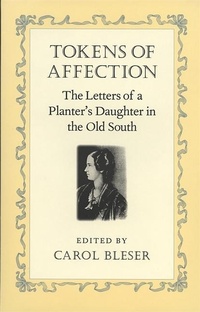
Tokens of Affection
The Letters of a Planter's Daughter in the Old South
Will be published approx. on 1. April 1996
Book
Hardback
444 pages
978-0-8203-1727-4 (ISBN)
Description
This collection comprises all of the known letters written by Maria Bryan (1808-1844) of Mt. Zion, Georgia, to her sister Julia Bryan Cumming of Augusta. Spanning a period from the mid-1820s to the mid-1840s, the letters relate firsthand the daily affairs and concerns of a planter's daughter on a moderately successful plantation in Hancock County, the heart of what was then the greatest cotton-growing region in the world. Few such accounts exist, especially by women, of this period of southern history, when the region was flourishing as a cotton kingdom and sectional tensions had not yet dominated everyone's thoughts.
A refined and remarkably well-educated woman, Maria Bryan began corresponding with her sister when she was sixteen years old, two weeks after Julia had married and moved seventy-five miles away to Augusta, at the time Georgia's third-largest city. As Carol K. Bleser points out in her introduction, Bryan travels, reads the popular books of the day, entertains visitors, and makes social calls. At the same time, however, notes Bleser, Bryan's letters belie popular notions about the privileged lives of "typical" planters' daughters in the antebellum South, for she also works at housekeeping, tends the sick at home and in the neighborhood, makes clothes for the family's slaves, and tutors younger siblings.
Bryan's letters keep her sister abreast of local news and gossip (a preacher who can no longer hide that he is suffering from a venereal disease) and family rifts and reconciliations (a brother's apparently severe depression and consequent aimlessness in life and career). They also contain a number of references to the family's slaves. In one letter only, however, did she reveal any feelings about the institution itself. Writing in January 1827 that their overseer had punished her personal slave, Jenny, for not meeting her quota of spinning, Bryan told her sister, "It would have distressed you to see her face bloody and swelled. Oh how great an evil is slavery."
Constituting a remarkable portrait of daily life in the Old South, these letters reveal a wealth of information, and attitudes about romance, courtship, marriage, family life, childbirth, child-rearing, friendship, religion, sickness, home remedies, death, books, fashion, travel, education, politics, and social events.
A refined and remarkably well-educated woman, Maria Bryan began corresponding with her sister when she was sixteen years old, two weeks after Julia had married and moved seventy-five miles away to Augusta, at the time Georgia's third-largest city. As Carol K. Bleser points out in her introduction, Bryan travels, reads the popular books of the day, entertains visitors, and makes social calls. At the same time, however, notes Bleser, Bryan's letters belie popular notions about the privileged lives of "typical" planters' daughters in the antebellum South, for she also works at housekeeping, tends the sick at home and in the neighborhood, makes clothes for the family's slaves, and tutors younger siblings.
Bryan's letters keep her sister abreast of local news and gossip (a preacher who can no longer hide that he is suffering from a venereal disease) and family rifts and reconciliations (a brother's apparently severe depression and consequent aimlessness in life and career). They also contain a number of references to the family's slaves. In one letter only, however, did she reveal any feelings about the institution itself. Writing in January 1827 that their overseer had punished her personal slave, Jenny, for not meeting her quota of spinning, Bryan told her sister, "It would have distressed you to see her face bloody and swelled. Oh how great an evil is slavery."
Constituting a remarkable portrait of daily life in the Old South, these letters reveal a wealth of information, and attitudes about romance, courtship, marriage, family life, childbirth, child-rearing, friendship, religion, sickness, home remedies, death, books, fashion, travel, education, politics, and social events.
Reviews / Votes
Chatty, thoughtful, and often charming . . . The richness of Maria's letters is enhanced by Bleser's careful editing. Instead of a lengthy biographical introduction, Bleser provides running headings to the letters detailing movements of key family members, identifying important characters, and offering other information designed to help the reader understand them. Bleser is thoroughly familiar with Maria Bryan's social milieu and shares her knowledge fully yet unobtrusively. -- <i>Journal of American History</i>More details
Series
Language
English
Place of publication
Georgia
United States
Target group
College/higher education
Professional and scholarly
Product notice
sewn/stitched
Cloth over boards
Illustrations
1 Maps; 1 Maps; 1 Maps; 1 Maps; 1 Maps; 1 Maps; 1 Maps
Dimensions
Height: 237 mm
Width: 162 mm
Thickness: 35 mm
Weight
780 gr
ISBN-13
978-0-8203-1727-4 (9780820317274)
Copyright in bibliographic data and cover images is held by Nielsen Book Services Limited or by the publishers or by their respective licensors: all rights reserved.
Schweitzer Classification
Persons
CAROL K. BLESER was Kathryn and Calhoun Lemon Distinguished Professor of History at Clemson University, and series editor for Southern Voices from the Past: Women's Letters, Diaries, and Writings. Her books include In Joy and Sorrow: Women, Family and Marriage in the Victorian South, 1830-1900, Secret and Sacred; The Diaries of James Henry Hammond, A Southern Slaveholder, and The Hammonds of Redcliffe.