

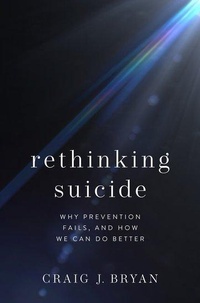
Rethinking Suicide
Why Prevention Fails, and How We Can Do Better
Published on 27. January 2022
Book
Hardback
232 pages
978-0-19-005063-4 (ISBN)
Description
An examination of how suicide prevention efforts largely fail due to the mistaken assumption that greater mental health awareness is the key to saving lives.
Over the last two decades, the US suicide rate has steadily grown despite extensive awareness campaigns, wide implementation of suicide prevention programs and initiatives, and increased mental health advocacy. To the confusion and frustration of researchers, healthcare providers, and many others, these efforts have largely failed to reverse the trend. Why do suicide rates continue to climb despite our best efforts? Why aren't we better at this? What are we doing wrong?
Rethinking Suicide is a critical examination of what we think we know about suicide, with particular focus on the assumed role of mental illness. Craig J. Bryan, a leading expert on suicide prevention, argues that most prevention efforts have failed because they disproportionately emphasize mental health-focused solutions such as access to treatment and crisis services. Instead of classifying suicide as a mental health issue, careful analysis of research findings suggest it should instead be seen as a highly complex problem with many risk factors - from personal decision-making styles, to the availability of lethal means, to financial uncertainty. As such suicide rates will not be curtailed by conventional solution-oriented thinking; rather, we need process-based thinking that may, in some cases, defy or contradict many of our long-held assumptions about suicide. Rethinking Suicide interweaves the author's firsthand experiences with explanations of scientific findings to reveal the limitations of widely-used practices and to introduce new perspectives that may trigger a paradigm shift in how we understand and prevent suicide.
Over the last two decades, the US suicide rate has steadily grown despite extensive awareness campaigns, wide implementation of suicide prevention programs and initiatives, and increased mental health advocacy. To the confusion and frustration of researchers, healthcare providers, and many others, these efforts have largely failed to reverse the trend. Why do suicide rates continue to climb despite our best efforts? Why aren't we better at this? What are we doing wrong?
Rethinking Suicide is a critical examination of what we think we know about suicide, with particular focus on the assumed role of mental illness. Craig J. Bryan, a leading expert on suicide prevention, argues that most prevention efforts have failed because they disproportionately emphasize mental health-focused solutions such as access to treatment and crisis services. Instead of classifying suicide as a mental health issue, careful analysis of research findings suggest it should instead be seen as a highly complex problem with many risk factors - from personal decision-making styles, to the availability of lethal means, to financial uncertainty. As such suicide rates will not be curtailed by conventional solution-oriented thinking; rather, we need process-based thinking that may, in some cases, defy or contradict many of our long-held assumptions about suicide. Rethinking Suicide interweaves the author's firsthand experiences with explanations of scientific findings to reveal the limitations of widely-used practices and to introduce new perspectives that may trigger a paradigm shift in how we understand and prevent suicide.
Reviews / Votes
Dr. Bryan offers a much-needed rebuke of the status quo. It will challenge you to rethink suicide prevention at every level, from clinical care to public health campaigns. But most importantly, it provides a roadmap for how to innovate, make use of the latest science in clinical practice and public health, and make changes that will help save lives. * M. David Rudd, PhD, ABPP, President and Distinguished Professor of Psychology, The University of Memphis * Dr. Bryan brings tremendous expertise as both an accomplished scientist and an empathic clinician. He describes a complex and sensitive topic - suicide prevention - in a way that will connect with readers from all backgrounds. * Michael Anestis, PhD, Executive Director of the New Jersey Gun Violence Research Center and Associate Professor of Urban-Global Public Health at Rutgers University * A veteran, a seasoned clinician, an esteemed scholar, and an expert on suicide and its prevention, Craig J. Bryan has provided a lucid and thought-provoking book, with significant potential to help right a wrong: Namely, that American losses to suicide approach 50,000 per year, and we need to do better with more understanding, and with more ways forward. * Thomas Joiner, PhD, The Robert O. Lawton Distinguished Professor of Psychology, Florida State University; Author, Mindlessness: The Corruption of Mindfulness in a Culture of Narcissism *More details
Language
English
Place of publication
New York
United States
Target group
Professional and scholarly
Dimensions
Height: 239 mm
Width: 162 mm
Thickness: 27 mm
Weight
450 gr
ISBN-13
978-0-19-005063-4 (9780190050634)
Copyright in bibliographic data and cover images is held by Nielsen Book Services Limited or by the publishers or by their respective licensors: all rights reserved.
Schweitzer Classification
Other editions
Additional editions
E-Book
10/2021
OUP eBook
€9.99
Available for download
E-Book
10/2021
OUP eBook
€9.99
Available for download
Person
Craig J. Bryan, PsyD, ABPP, is a board-certified clinical psychologist and the Stress, Trauma, and Resilience (STAR) Professor of Psychiatry and Behavioral Health at The Ohio State University Wexner Medical Center. His research on suicide has led to the development and refinement of interventions that significantly reduce suicidal behaviors, and has been featured in major media outlets including Scientific American, CNN, Fox News, NPR, USA Today, the New York Times, and the Washington Post. Dr. Bryan has published hundreds of scientific articles and multiple books, and has received numerous awards and recognitions for this work.
Content
Introduction
Chapter 1: On the Merits of (Productive) Stupidity
Chapter 2: The 90% Statistic
Chapter 3: Balance Beams and Suicide Risk Screening
Chapter 4: Performance Escapes and Catastrophes
Chapter 5: Marshmallows and Braking Systems
Chapter 6: Handwashing and Changing the Status Quo
Chapter 7: Seat Belts and Second Chances
Chapter 8: Creating Lives Worth Living
Chapter 1: On the Merits of (Productive) Stupidity
Chapter 2: The 90% Statistic
Chapter 3: Balance Beams and Suicide Risk Screening
Chapter 4: Performance Escapes and Catastrophes
Chapter 5: Marshmallows and Braking Systems
Chapter 6: Handwashing and Changing the Status Quo
Chapter 7: Seat Belts and Second Chances
Chapter 8: Creating Lives Worth Living